Quick answer
IUCN status: VulnerableSpotted seahorse at a glance
The Spotted seahorse (Hippocampus kuda) is a marine animal in the family Syngnathidae. Its IUCN Red List category is Vulnerable.
| Scientific name | Hippocampus kuda |
|---|---|
| Indonesian name | Kuda laut |
| Group | Marine |
| Family | Syngnathidae |
| Range in Indonesia | Indonesian coastal waters, including Bintan (Riau Islands) and Lampung Bay |
| Linked habitats | Mangroves, Coral Reefs |
| Diet | Zooplankton, small crustaceans and fish larvae |
| Range in Indonesia | Shallow coasts, including Bintan and Lampung Bay |
| Key feature | Horse-like head, grasping tail, brood pouch in males |
| Other names | Kuda laut (Indonesian), common seahorse |
| IUCN status | Vulnerable · IUCN Red List (via GBIF) · checked 25 September 2026 |
In this guide (10)
What is the spotted seahorse?
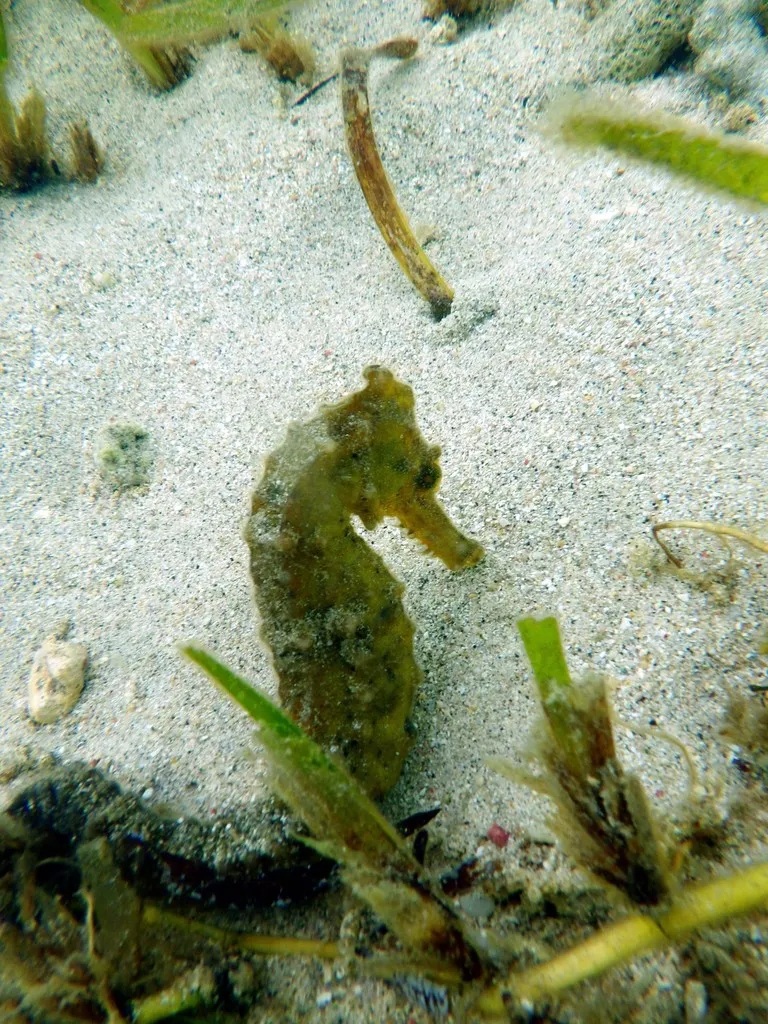
The spotted seahorse (Hippocampus kuda) is a small fish of the pipefish family (Syngnathidae) with a horse-like head and an upright swimming posture. Its head sits at about 90 degrees to an armour-plated body, and its tail can curl around objects to hold on. Colour varies from black with a grainy texture to cream or pale yellow with large dark spots, and it can change colour for camouflage. FishBase gives a maximum length of 30 cm. Other seahorses also live in Indonesia, such as H. comes, H. barbouri, H. hystrix and H. spinosissimus, so the Indonesian name kuda laut does not always mean H. kuda.
Evidence: Animal Diversity Web — Hippocampus kuda (common seahorse) ↗ · FishBase — Hippocampus kuda, Spotted seahorse ↗ · Oseanologi dan Limnologi di Indonesia (BRIN, 2019) — Sumberdaya Kuda Laut (Hippocampus spp.) di Perairan Pulau Bintan, Teluk Lampung dan Pulau Tanakeke ↗
Where does the spotted seahorse live?
The spotted seahorse lives in shallow coastal waters, especially seagrass beds, algal beds, estuaries and reefs, usually at 0–8 metres. FishBase adds that it occurs on muddy slopes and clings to drifting Sargassum seaweed up to 20 km from shore. ADW also lists mangroves, bays, lagoons, harbours and brackish rivers. Its range covers the Indo-Pacific, from southern Africa and the Red Sea to Hawaii. In Indonesia, a 2016 study found H. kuda in Lampung Bay and, as dried specimens, at collectors in southern Bintan in the Riau Islands.
Evidence: FishBase — Hippocampus kuda, Spotted seahorse ↗ · Animal Diversity Web — Hippocampus kuda (common seahorse) ↗ · Oseanologi dan Limnologi di Indonesia (BRIN, 2019) — Sumberdaya Kuda Laut (Hippocampus spp.) di Perairan Pulau Bintan, Teluk Lampung dan Pulau Tanakeke ↗
What does the spotted seahorse eat?
The spotted seahorse feeds on zooplankton, small crustaceans and fish larvae. According to ADW, it is an ambush predator that eats only live, moving prey. As a poor swimmer, it relies on its thick snout and specialised jaws to suck in prey that passes close by. Research in Indonesian waters describes brown algae such as Sargassum and seagrass beds as places where seahorses feed and shelter. Small animals living on Sargassum, such as amphipods, are part of their food supply. Damage to seagrass and algae therefore also cuts their food.
Evidence: FishBase — Hippocampus kuda, Spotted seahorse ↗ · Animal Diversity Web — Hippocampus kuda (common seahorse) ↗ · Oseanologi dan Limnologi di Indonesia (BRIN, 2019) — Sumberdaya Kuda Laut (Hippocampus spp.) di Perairan Pulau Bintan, Teluk Lampung dan Pulau Tanakeke ↗
How does the spotted seahorse reproduce?
In seahorses it is the male that becomes pregnant: the female places her eggs in a brood pouch under his tail. According to FishBase, the pouch can hold 20–1,000 young, which develop for 20–28 days before birth. Adults are often found in pairs. ADW describes a courtship ritual in which the male changes colour, the pair entwine their tails, and the female transfers her eggs into his pouch with her ovipositor. The ritual may be repeated each morning while the male is pregnant. The species has also been bred in captivity.
Evidence: FishBase — Hippocampus kuda, Spotted seahorse ↗ · Animal Diversity Web — Hippocampus kuda (common seahorse) ↗
Why is the spotted seahorse threatened?
The spotted seahorse is threatened by overfishing for traditional medicine, souvenirs and the aquarium trade, and by habitat loss. FishBase describes it as highly valued in traditional Chinese medicine. Seahorses are also caught as bycatch in shrimp trawls, and their reef, mangrove, seagrass and estuary habitats are being damaged. The IUCN lists the species as Vulnerable, and it is on CITES Appendix II. Surveys in Bintan, Lampung Bay and Tanakeke found low seahorse densities due to exploitation and habitat damage. In December 2021, KKP destroyed 220.12 kg of illegal dried seahorses that were to be smuggled to Vietnam.
Evidence: FishBase — Hippocampus kuda, Spotted seahorse ↗ · Oseanologi dan Limnologi di Indonesia (BRIN, 2019) — Sumberdaya Kuda Laut (Hippocampus spp.) di Perairan Pulau Bintan, Teluk Lampung dan Pulau Tanakeke ↗ · Kementerian Kelautan dan Perikanan — Musnahkan Kuda Laut Kering Ilegal, KKP Beri Pesan Keras ke Penyelundup ↗
How can we help protect the spotted seahorse?
The simplest way to help is not to buy dried seahorses, seahorse souvenirs or seahorse-based medicines, and not to take seahorses from the wild. According to KKP, seahorse exports are allowed only for two species, H. kuda and H. comes, and only for captive-bred animals exported alive for the aquarium trade. LIPI, Indonesia's scientific authority, no longer recommends wild capture for trade. When diving or snorkelling, watch seahorses without touching or moving them. Protecting seagrass beds, mangroves and coral reefs also protects their habitat. Report suspicious seahorse trading to fisheries officers.
Evidence: Kementerian Kelautan dan Perikanan — Musnahkan Kuda Laut Kering Ilegal, KKP Beri Pesan Keras ke Penyelundup ↗ · Oseanologi dan Limnologi di Indonesia (BRIN, 2019) — Sumberdaya Kuda Laut (Hippocampus spp.) di Perairan Pulau Bintan, Teluk Lampung dan Pulau Tanakeke ↗
Explore related habitats
These habitat relationships are supported by species sources in this guide. This is not a complete range map.
Common questions about the Spotted seahorse
What is the scientific name of the Spotted seahorse?
The scientific name of the Spotted seahorse is Hippocampus kuda, in the family Syngnathidae. In Indonesian it is called Kuda laut.
Where can the Spotted seahorse be found in Indonesia?
In Indonesia, this guide records the Spotted seahorse in: Indonesian coastal waters, including Bintan (Riau Islands) and Lampung Bay.
Source-supported habitats: Mangroves, Coral Reefs.
What does the Spotted seahorse eat?
Diet of the Spotted seahorse: zooplankton, small crustaceans and fish larvae.
What is the conservation status of the Spotted seahorse?
On the IUCN Red List, the Spotted seahorse is listed as Vulnerable: it is considered to face a high risk of extinction in the wild. Source: IUCN Red List (via GBIF), checked 25 September 2026.
This global category is separate from legal protection in Indonesia. To check whether the Spotted seahorse is a protected species, consult the current national list of protected species or contact the local BKSDA (natural resources conservation office).
Sources & references
- FishBase — Hippocampus kuda, Spotted seahorse ↗
- Animal Diversity Web — Hippocampus kuda (common seahorse) ↗
- Kementerian Kelautan dan Perikanan — Musnahkan Kuda Laut Kering Ilegal, KKP Beri Pesan Keras ke Penyelundup ↗
- Oseanologi dan Limnologi di Indonesia (BRIN, 2019) — Sumberdaya Kuda Laut (Hippocampus spp.) di Perairan Pulau Bintan, Teluk Lampung dan Pulau Tanakeke ↗
- IUCN Red List of Threatened Species, version 2026-1, via GBIF (CC BY 4.0) ↗
References can change. Check dates and context in the original source.
Further reading
Seahorse: facts, threats and conservation ↗ — World Animal Rescue Network. A broader overview that covers this animal.
Cite this page
PanduanHewan. (2026, 25 September). Spotted seahorse (Hippocampus kuda). PanduanHewan.org. https://panduanhewan.org/en/species/spotted-seahorse/