Quick answer
IUCN status: Near ThreatenedIndo-Pacific bottlenose dolphin at a glance
The Indo-Pacific bottlenose dolphin (Tursiops aduncus) is a marine animal in the family Delphinidae. Its IUCN Red List category is Near Threatened.
| Scientific name | Tursiops aduncus |
|---|---|
| Indonesian name | Lumba-lumba hidung botol Indo-Pasifik |
| Group | Marine |
| Family | Delphinidae |
| Range in Indonesia | West Sumatra, East Kalimantan, Bali and West Papua |
| Linked habitats | Coral Reefs |
| Diet | Mainly bony fish, with some squid and other cephalopods |
| Range in Indonesia | West Sumatra, East Kalimantan, Bali and West Papua |
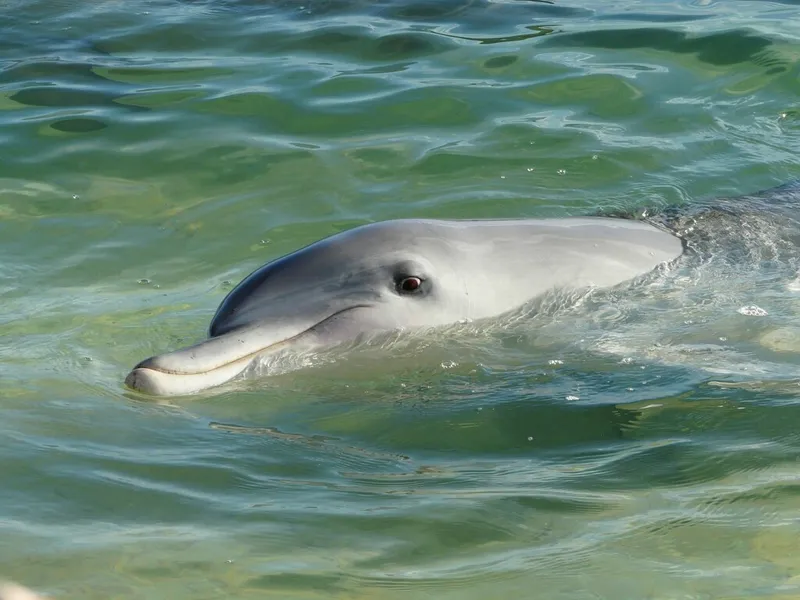
| Key feature | Dark grey back; pale belly that is spotted in adults |
| Other names | Indian Ocean bottlenose dolphin; lumba-lumba hidung botol (Indonesian) |
| Legal protection in Indonesia | Fully protected (KKP Decree 66/2025; Environment Regulation P.106/2018) |
| IUCN status | Near Threatened · IUCN Red List (via GBIF) · checked 25 September 2026 |
In this guide (10)
What is the Indo-Pacific bottlenose dolphin?
The Indo-Pacific bottlenose dolphin (Tursiops aduncus) is a slender coastal dolphin with a distinct beak. Its back is dark grey, its fins and extremities are darker, and its underside is paler, often pinkish. Adults have spotted bellies, and the spotting increases with age. The species was once lumped with the common bottlenose dolphin (Tursiops truncatus). Animal Diversity Web says T. aduncus has a smaller body, a longer and more slender beak, and larger flippers. The Mammal Diversity Database notes that the genus Tursiops still needs revision, so its species boundaries may change.
Evidence: Kementerian Kelautan dan Perikanan (JDIH KKP) — Keputusan Menteri Kelautan dan Perikanan Nomor 66 Tahun 2025 tentang Jenis Ikan yang Dilindungi ↗ · Animal Diversity Web — Tursiops aduncus (Indo-Pacific bottlenose dolphin) ↗ · Mammal Diversity Database — Tursiops aduncus, Indo-Pacific Bottlenose Dolphin ↗
Where does the Indo-Pacific bottlenose dolphin live?
This dolphin lives in warm, shallow coastal waters of the Indian Ocean and western Pacific, including Indonesia. The annex to KKP Decree 66/2025 lists its Indonesian range as the waters of East Kalimantan and Bali. A 2019–2022 survey recorded six encounters in the Pieh Marine Protected Area, West Sumatra, at an average depth of 60 m. In Kaimana, West Papua, the species is seen year-round, and the area was recognised as an Important Marine Mammal Area in 2018. Its preferred habitats include rocky and coral reef waters, sandy bottoms and seagrass beds.
Evidence: Kementerian Kelautan dan Perikanan (JDIH KKP) — Keputusan Menteri Kelautan dan Perikanan Nomor 66 Tahun 2025 tentang Jenis Ikan yang Dilindungi ↗ · Raffles Bulletin of Zoology (2025) — Cetacean diversity, distribution, and population estimation of Stenella dolphins in Pieh Marine Protected Area and the surrounding seas, West Sumatra Province ↗ · Frontiers in Marine Science (2025) — Insights into cetacean sightings, abundance, and feeding associations: observations from the boat lift net fishery in the Kaimana important marine mammal area, Indonesia ↗
What does the Indo-Pacific bottlenose dolphin eat?
Indo-Pacific bottlenose dolphins eat mainly bony fish and, to a lesser extent, squid and other cephalopods. Animal Diversity Web notes that although they take many fish species, most of their diet comes from a few species that vary by region. Pods often hunt together. In shallow water they may kick fish into the sand with their tails or chase small fish up onto the shore. In Kaimana, West Papua, they are often seen feeding on anchovies around lift-net fishing platforms (bagan), especially around sunrise, when fishers haul their last nets.
Evidence: Animal Diversity Web — Tursiops aduncus (Indo-Pacific bottlenose dolphin) ↗ · Frontiers in Marine Science (2025) — Insights into cetacean sightings, abundance, and feeding associations: observations from the boat lift net fishery in the Kaimana important marine mammal area, Indonesia ↗
How do Indo-Pacific bottlenose dolphins behave?
Indo-Pacific bottlenose dolphins live in groups and tend to be shy. Animal Diversity Web says most live in pods of 5–15 animals and stay faithful to a home range. In the Pieh Marine Protected Area, groups averaged 13 animals and tended to keep their distance from the research vessel. Each dolphin has a signature whistle that helps others recognise it. Females mature at 7–12 years of age and breed about every 4–6 years. Newborn calves are 0.8–1.1 m long. Calves are weaned at about 3.5 years on average and stay with their mothers for some time afterwards.
Evidence: Animal Diversity Web — Tursiops aduncus (Indo-Pacific bottlenose dolphin) ↗ · Raffles Bulletin of Zoology (2025) — Cetacean diversity, distribution, and population estimation of Stenella dolphins in Pieh Marine Protected Area and the surrounding seas, West Sumatra Province ↗
What threatens the Indo-Pacific bottlenose dolphin?
Because it lives in shallow water close to shore, this dolphin often comes into contact with human activity. It is listed as Near Threatened on the IUCN Red List. Animal Diversity Web names hunting and shark nets as past threats, and the species is also captured for entertainment. In Indonesia, confiscated dolphins have been rehabilitated at Umah Lumba in Banyuwedang Bay, Buleleng, Bali, before release into North Bali waters. In Kaimana the dolphins rely on anchovies that lift-net fisheries also catch, so researchers recommend managing the anchovy fishery.
Evidence: Animal Diversity Web — Tursiops aduncus (Indo-Pacific bottlenose dolphin) ↗ · Jurnal Biologi Udayana (2024) — Aktivitas harian lumba-lumba hidung botol Indo-Pasifik (Tursiops aduncus) rehabilitasi di Umah Lumba, Teluk Banyuwedang, Bali ↗ · Frontiers in Marine Science (2025) — Insights into cetacean sightings, abundance, and feeding associations: observations from the boat lift net fishery in the Kaimana important marine mammal area, Indonesia ↗
What should you do if you see an Indo-Pacific bottlenose dolphin?
Enjoy dolphins from a distance, and do not chase, touch or feed them. The species is fully protected under KKP Decree 66/2025 and is listed in the annex to Environment Regulation P.106/2018. Full protection covers every life stage, including body parts and products made from them. For dolphin-watching trips at Lovina, Bali, the KKP coastal and marine office in Denpasar (BPSPL Denpasar) reported four rules agreed by local guide groups. Boats should not cut across the dolphins' path and should travel alongside them. Propellers are lifted and engines switched off nearby. Boats keep at least 50 m away, and no one feeds the dolphins.
Evidence: Kementerian Kelautan dan Perikanan (JDIH KKP) — Keputusan Menteri Kelautan dan Perikanan Nomor 66 Tahun 2025 tentang Jenis Ikan yang Dilindungi ↗ · Kementerian LHK (via JDIH Kemenko Infrastruktur) — Permen LHK Nomor P.106/MENLHK/SETJEN/KUM.1/12/2018 tentang Jenis Tumbuhan dan Satwa yang Dilindungi ↗ · Mongabay Indonesia (2016) — Mencari Tips Wisata Melihat Lumba-lumba yang Aman di Lovina. Seperti Apa? ↗
Explore related habitats
These habitat relationships are supported by species sources in this guide. This is not a complete range map.
Common questions about the Indo-Pacific bottlenose dolphin
What is the scientific name of the Indo-Pacific bottlenose dolphin?
The scientific name of the Indo-Pacific bottlenose dolphin is Tursiops aduncus, in the family Delphinidae. In Indonesian it is called Lumba-lumba hidung botol Indo-Pasifik.
Where can the Indo-Pacific bottlenose dolphin be found in Indonesia?
In Indonesia, this guide records the Indo-Pacific bottlenose dolphin in: West Sumatra, East Kalimantan, Bali and West Papua.
Source-supported habitats: Coral Reefs.
What does the Indo-Pacific bottlenose dolphin eat?
Diet of the Indo-Pacific bottlenose dolphin: mainly bony fish, with some squid and other cephalopods.
What is the conservation status of the Indo-Pacific bottlenose dolphin?
On the IUCN Red List, the Indo-Pacific bottlenose dolphin is listed as Near Threatened: it is close to qualifying, or likely to qualify, for a threatened category in the near future. Source: IUCN Red List (via GBIF), checked 25 September 2026.
This global category is separate from legal protection in Indonesia. To check whether the Indo-Pacific bottlenose dolphin is a protected species, consult the current national list of protected species or contact the local BKSDA (natural resources conservation office).
Sources & references
- Kementerian Kelautan dan Perikanan (JDIH KKP) — Keputusan Menteri Kelautan dan Perikanan Nomor 66 Tahun 2025 tentang Jenis Ikan yang Dilindungi ↗
- Kementerian LHK (via JDIH Kemenko Infrastruktur) — Permen LHK Nomor P.106/MENLHK/SETJEN/KUM.1/12/2018 tentang Jenis Tumbuhan dan Satwa yang Dilindungi ↗
- Animal Diversity Web — Tursiops aduncus (Indo-Pacific bottlenose dolphin) ↗
- Raffles Bulletin of Zoology (2025) — Cetacean diversity, distribution, and population estimation of Stenella dolphins in Pieh Marine Protected Area and the surrounding seas, West Sumatra Province ↗
- Frontiers in Marine Science (2025) — Insights into cetacean sightings, abundance, and feeding associations: observations from the boat lift net fishery in the Kaimana important marine mammal area, Indonesia ↗
- Jurnal Biologi Udayana (2024) — Aktivitas harian lumba-lumba hidung botol Indo-Pasifik (Tursiops aduncus) rehabilitasi di Umah Lumba, Teluk Banyuwedang, Bali ↗
- Mongabay Indonesia (2016) — Mencari Tips Wisata Melihat Lumba-lumba yang Aman di Lovina. Seperti Apa? ↗
- Mammal Diversity Database — Tursiops aduncus, Indo-Pacific Bottlenose Dolphin ↗
- IUCN Red List of Threatened Species, version 2026-1, via GBIF (CC BY 4.0) ↗
References can change. Check dates and context in the original source.
Cite this page
PanduanHewan. (2026, 25 September). Indo-Pacific bottlenose dolphin (Tursiops aduncus). PanduanHewan.org. https://panduanhewan.org/en/species/indo-pacific-bottlenose-dolphin/