Quick answer
IUCN status: Least ConcernBanded Malaysian coral snake at a glance
The banded Malaysian coral snake (Calliophis intestinalis) is a reptile in the family Elapidae. Range in Indonesia: Sumatra, Java, Bali, Borneo (Kalimantan) and the Riau Islands. Diet: mainly other snakes, such as the Brahminy blind snake; a carnivore. IUCN Red List status: Least Concern.
| Scientific name | Calliophis intestinalis |
|---|---|
| Indonesian name | Ular cabai kecil |
| Group | Reptiles |
| Family | Elapidae |
| Range in Indonesia | Sumatra, Java, Bali, Borneo (Kalimantan) and the Riau Islands |
| Linked habitats | Tropical Rainforests, Urban Habitats |
| Diet | Mainly other snakes, such as the Brahminy blind snake |
| Range in Indonesia | Sumatra, Java, Bali, Borneo and the Riau Islands |
| Key feature | Red-orange back stripe, red tail, black-and-white belly |
| Length | Up to about 50 cm |
| Risk to people | Venomous; bites need prompt medical care |
| Other names | Ular cabai kecil, ular cabe, striped coral snake |
| IUCN status | Least Concern · IUCN Red List (via GBIF) · checked 1 October 2026 |
| Diet type | Carnivore (meat-eater) — eats other snakes, especially small blind snakes · Ecology Asia |
| Reproduction | Laying eggs (oviparous) · Reptile Database |
| Venom or poison | Venomous · Clinical Toxinology Resources (WCH / Univ. of Adelaide): Calliophis intestinalis (archived copy) |
| Active | Nocturnal (active at night) · Calliophis intestinalis - Flora & Fauna Web, National Parks Board (NParks) Singapore |
In this guide (12)
What is the banded Malaysian coral snake?
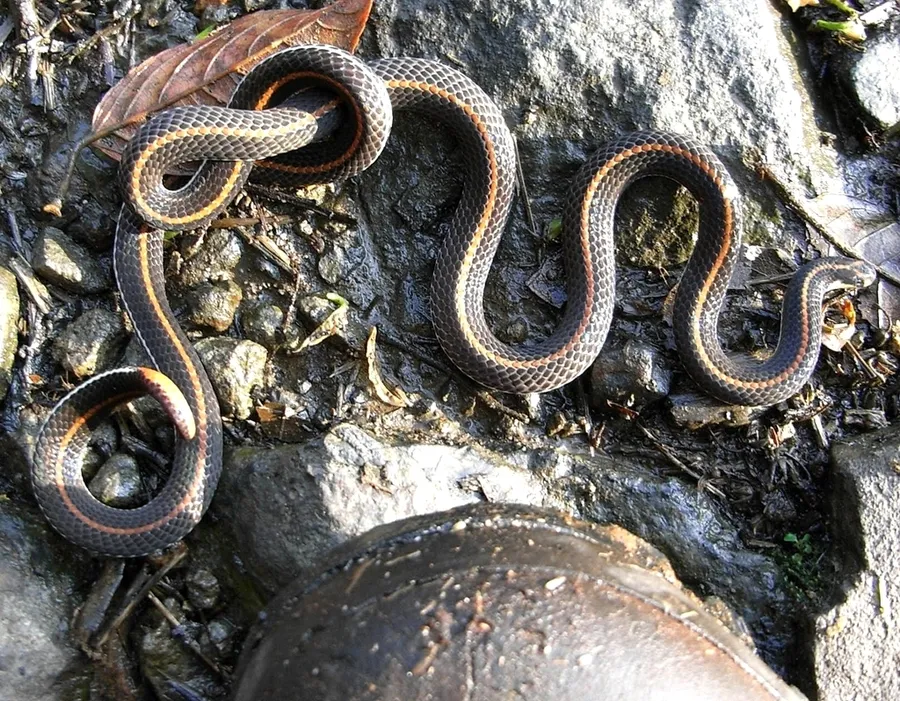
The banded Malaysian coral snake (Calliophis intestinalis) is a venomous Asian coral snake in the family Elapidae. It reaches about 50 cm at most. It has a reddish-orange stripe down the back, a red tail, a pale stripe along each side and a striking black-and-white banded belly.
Its colouring varies greatly. The Bornean subspecies, C. i. thepassi, lacks reddish stripes on the body. In 2020 the bright red-bellied form, once included in this species, was separated as Calliophis nigrotaeniatus, which has a pair of grey or dark blue stripes along the sides. Like its relatives, it has a head barely distinct from the neck and small eyes.
Evidence: Ecology Asia — Banded Malayan Coral Snake, Calliophis intestinalis ↗ · The Reptile Database — Calliophis intestinalis (Laurenti, 1768) ↗ · Zoological Science (PubMed) — Fukuyama et al. (2020), Systematics of Calliophis intestinalis with the resurrection of Calliophis nigrotaeniatus ↗
Where does the banded Malaysian coral snake live?
In Indonesia, the banded Malaysian coral snake is recorded from Sumatra, Java, Bali, Borneo (Kalimantan) and the Riau Islands. The Reptile Database recognises three subspecies: C. i. intestinalis on Java and Sumatra, C. i. lineata in the Riau Islands and Sumatra, and C. i. thepassi on Borneo, described from Sintang in West Kalimantan. Records from the Mentawai Islands have not been assigned to a subspecies.
Outside Indonesia it occurs in Peninsular Malaysia, Singapore, Thailand, Brunei and East Malaysia. It lives on the ground in forest and sometimes in overgrown parks and gardens. In Greater Jakarta it appeared twice in records of snakes rescued from residential areas between 2015 and 2019.
Evidence: The Reptile Database — Calliophis intestinalis (Laurenti, 1768) ↗ · Ecology Asia — Banded Malayan Coral Snake, Calliophis intestinalis ↗ · Media Konservasi (IPB) — Khoerunisa et al. (2022), Diversity of snake rescued from residential areas in Greater Jakarta Metropolitan Area, Indonesia ↗
What does the banded Malaysian coral snake eat?
The banded Malaysian coral snake feeds mainly on other snakes, especially the tiny Brahminy blind snake, according to Ecology Asia, a guide to South-east Asian wildlife. The Reptile Database also cites Greene (1997) as saying that snakes of the genus Maticora eat only snakes. Maticora is the old genus name for this group, which Slowinski and colleagues merged into Calliophis in 2001.
Evidence: Ecology Asia — Banded Malayan Coral Snake, Calliophis intestinalis ↗ · The Reptile Database — Calliophis intestinalis (Laurenti, 1768) ↗
How does the banded Malaysian coral snake behave?
The banded Malaysian coral snake lives on the ground and lays eggs. When threatened, it flips over to show its boldly black-and-white banded belly. WHO notes that the harmless Cylindrophis ruffus may mimic Calliophis coral snakes with its colouring and tail-raising display.
In Calliophis coral snakes, the venom glands are not confined to the head. The genus diagnosis cited by The Reptile Database describes venom glands that extend far back into the body cavity and end in a long, club-shaped tip.
Evidence: The Reptile Database — Calliophis intestinalis (Laurenti, 1768) ↗ · Ecology Asia — Banded Malayan Coral Snake, Calliophis intestinalis ↗ · WHO South-East Asia Regional Office — Guidelines for the management of snakebites, 2nd edition (PDF) ↗
Is the banded Malaysian coral snake venomous and dangerous?
Yes, the banded Malaysian coral snake is venomous, and a bite needs prompt medical attention. Tan and colleagues (2019) found its venom is mostly phospholipase A2 (43.4 per cent) and three-finger toxins (20.1 per cent), mainly cytotoxins. In laboratory tests it damaged muscle, and another study found it weakened nerve-to-muscle signalling.
Tan and colleagues note that Asian coral snake bites are rarely fatal. Ten years of records from Thailand's Ramathibodi Poison Center included seven bites by C. i. lineata; these patients more often had pain and a fast heart rate and stayed longer in hospital than other coral snake patients. If bitten, seek medical care at a health facility immediately.
Evidence: Journal of Proteomics (PubMed) — Tan et al. (2019), Unlocking the secrets of banded coral snake (Calliophis intestinalis, Malaysia): a venom with proteome novelty, low toxicity and distinct antigenicity ↗ · Neurotoxicity Research (PubMed) — Dashevsky et al. (2022), Novel neurotoxic activity in Calliophis intestinalis venom ↗ · Toxins (PMC) — Tansuwannarat et al. (2026), Clinical characteristics and outcomes of Asian coral snake bites in Thailand: a retrospective cohort study ↗
What should you do if you meet a banded Malaysian coral snake?
If you meet a banded Malaysian coral snake, keep your distance and do not approach, catch, handle or kill it. Let it move away, or ask trained officers such as Damkar, the fire and rescue service, for help. In Greater Jakarta, fire departments in Bogor, Jakarta, Depok, Tangerang and Bekasi are among the groups that handle snake reports from homes.
Because this small snake lives on the ground, follow WHO's general prevention advice: wear closed shoes and long trousers in undergrowth or in the dark, use a torch at night, do not put your hands into holes or hidden places, and clear rubbish and undergrowth from around the house.
Evidence: Media Konservasi (IPB) — Khoerunisa et al. (2022), Diversity of snake rescued from residential areas in Greater Jakarta Metropolitan Area, Indonesia ↗ · WHO South-East Asia Regional Office — Guidelines for the management of snakebites, 2nd edition (PDF) ↗
Explore related habitats
These habitat relationships are supported by species sources in this guide. This is not a complete range map.
Scientific classification of the Banded Malaysian coral snake
| Kingdom | Animalia |
|---|---|
| Phylum | Chordata |
| Class | Reptilia |
| Order | Squamata |
| Family | Elapidae |
| Genus | Calliophis |
| Species | Calliophis intestinalis |
Source: GBIF Backbone Taxonomy, adjusted to the ranks commonly used in school biology (for example class Reptilia).
Common questions about the banded Malaysian coral snake
What is the scientific name of the banded Malaysian coral snake?
The scientific name of the banded Malaysian coral snake is Calliophis intestinalis, in the family Elapidae. In Indonesian it is called Ular cabai kecil.
What kind of animal is the banded Malaysian coral snake?
The banded Malaysian coral snake is a reptile in the family Elapidae. By diet it is a carnivore (meat-eater): a eats other snakes, especially small blind snakes.
Where does the banded Malaysian coral snake live in Indonesia?
In Indonesia, this guide records the banded Malaysian coral snake in: Sumatra, Java, Bali, Borneo (Kalimantan) and the Riau Islands.
Source-supported habitats: Tropical Rainforests, Urban Habitats.
What does the banded Malaysian coral snake eat?
Diet of the banded Malaysian coral snake: mainly other snakes, such as the Brahminy blind snake. That makes it a carnivore (meat-eater). Source: Ecology Asia.
How does the banded Malaysian coral snake reproduce?
The banded Malaysian coral snake reproduces by laying eggs (oviparous). Source: Reptile Database.
Is the banded Malaysian coral snake venomous?
Yes. The banded Malaysian coral snake is venomous. Bites are rare, but as an elapid, potentially lethal envenoming cannot be ruled out. Source: Clinical Toxinology Resources (WCH / Univ. of Adelaide): Calliophis intestinalis (archived copy).
Do not catch, handle or disturb wild animals. If bitten, stung or exposed to its toxins, go to the nearest health facility straight away.
Is the banded Malaysian coral snake nocturnal?
The cited source records the banded Malaysian coral snake as nocturnal (active at night). Source: Calliophis intestinalis - Flora & Fauna Web, National Parks Board (NParks) Singapore.
See also the list of nocturnal and diurnal animals in Indonesia.
What are the main features of the banded Malaysian coral snake?
Key features of the banded Malaysian coral snake, from this guide’s sources: Key feature: red-orange back stripe, red tail, black-and-white belly; Length: up to about 50 cm.
Is the banded Malaysian coral snake dangerous to people?
Venomous; bites need prompt medical care.
Do not approach, catch or handle wild animals. If you are injured or bitten, get medical care at a health facility straight away.
What is the scientific classification of the banded Malaysian coral snake?
Scientific classification of the banded Malaysian coral snake: kingdom Animalia, phylum Chordata, class Reptilia, order Squamata, family Elapidae, genus Calliophis, species Calliophis intestinalis.
Source: GBIF Backbone Taxonomy, adjusted to the ranks commonly used in school biology.
Is the banded Malaysian coral snake endangered?
No, according to the global IUCN assessment. On the IUCN Red List, the banded Malaysian coral snake is listed as Least Concern: it does not qualify for a threatened category or for Near Threatened in the global assessment. Source: IUCN Red List (via GBIF), checked 1 October 2026.
This global category is separate from legal protection in Indonesia. To check whether the banded Malaysian coral snake is a protected species, consult the current national list of protected species or contact the local BKSDA (natural resources conservation office).
Sources & references
- The Reptile Database — Calliophis intestinalis (Laurenti, 1768) ↗
- Ecology Asia — Banded Malayan Coral Snake, Calliophis intestinalis ↗
- Zoological Science (PubMed) — Fukuyama et al. (2020), Systematics of Calliophis intestinalis with the resurrection of Calliophis nigrotaeniatus ↗
- Journal of Proteomics (PubMed) — Tan et al. (2019), Unlocking the secrets of banded coral snake (Calliophis intestinalis, Malaysia): a venom with proteome novelty, low toxicity and distinct antigenicity ↗
- Neurotoxicity Research (PubMed) — Dashevsky et al. (2022), Novel neurotoxic activity in Calliophis intestinalis venom ↗
- Toxins (PMC) — Tansuwannarat et al. (2026), Clinical characteristics and outcomes of Asian coral snake bites in Thailand: a retrospective cohort study ↗
- Media Konservasi (IPB) — Khoerunisa et al. (2022), Diversity of snake rescued from residential areas in Greater Jakarta Metropolitan Area, Indonesia ↗
- WHO South-East Asia Regional Office — Guidelines for the management of snakebites, 2nd edition (PDF) ↗
- Calliophis intestinalis - Flora & Fauna Web, National Parks Board (NParks) Singapore ↗
- Clinical Toxinology Resources (WCH / Univ. of Adelaide): Calliophis intestinalis (archived copy) ↗
- GBIF Backbone Taxonomy (GBIF) ↗
- IUCN Red List of Threatened Species, version 2026-1, via GBIF (CC BY 4.0) ↗
References can change. Check dates and context in the original source. How we use sources and data →
Cite this page
Credit PanduanHewan when referring to this page. Check the original evidence sources before reusing a claim.
PanduanHewan. Banded Malaysian coral snake (Calliophis intestinalis). Last substantive update: 1 October 2026. https://panduanhewan.org/en/species/banded-malaysian-coral-snake/