Quick answer
IUCN status: EndangeredSunda slow loris at a glance
The Sunda slow loris (Nycticebus coucang) is a mammal in the family Lorisidae. Range in Indonesia: Sumatra, the Riau Islands and the Natuna Islands. Diet: tree gum, nectar and fruit; sometimes insects, snails and eggs; a omnivore. IUCN Red List status: Endangered. It is a legally protected species in Indonesia (Regulation P.106/2018).
| Scientific name | Nycticebus coucang |
|---|---|
| Indonesian name | Kukang sunda |
| Group | Mammals |
| Family | Lorisidae |
| Range in Indonesia | Sumatra, the Riau Islands and the Natuna Islands |
| Linked habitats | Tropical Rainforests |
| Diet | Tree gum, nectar and fruit; sometimes insects, snails and eggs |
| Range in Indonesia | Sumatra, Batam, Galang and the Natuna Islands |
| Key feature | Large eyes, white stripe between them, slow movements |
| Risk to people | Venomous bite; can trigger anaphylactic shock |
| Other names | Greater slow loris, kukang sumatera, malu-malu |
| IUCN status | Endangered · IUCN Red List (via GBIF) · checked 1 October 2026 |
| Legal protection in Indonesia | Protected · Regulation P.106/2018 · annex no. 73 |
| Gestation | About 188 days on average, usually one young · Animal Diversity Web — Nycticebus coucang |
| Weaning age | 3–6 months · Animal Diversity Web — Nycticebus coucang |
| Diet type | Omnivore (eats plants and animals) — gum, nectar and fruit; plus insects, snails and eggs · Animal Diversity Web |
| Reproduction | Giving birth to live young (viviparous) · Animal Diversity Web |
| Venom or poison | Venomous · Fitzpatrick, Ligabue-Braun & Nekaris 2023, Slowly Making Sense: A Review of the Two-Step Venom System within Slow and Pygmy Lorises (Toxins) |
| Observance days | Indonesian Primate Day (30 January); International Slow Loris Day (13 September) |
| Active | Nocturnal (active at night) · Nycticebus coucang (Sunda slow loris) - Animal Diversity Web, University of Michigan |
In this guide (12)
What is the Sunda slow loris?
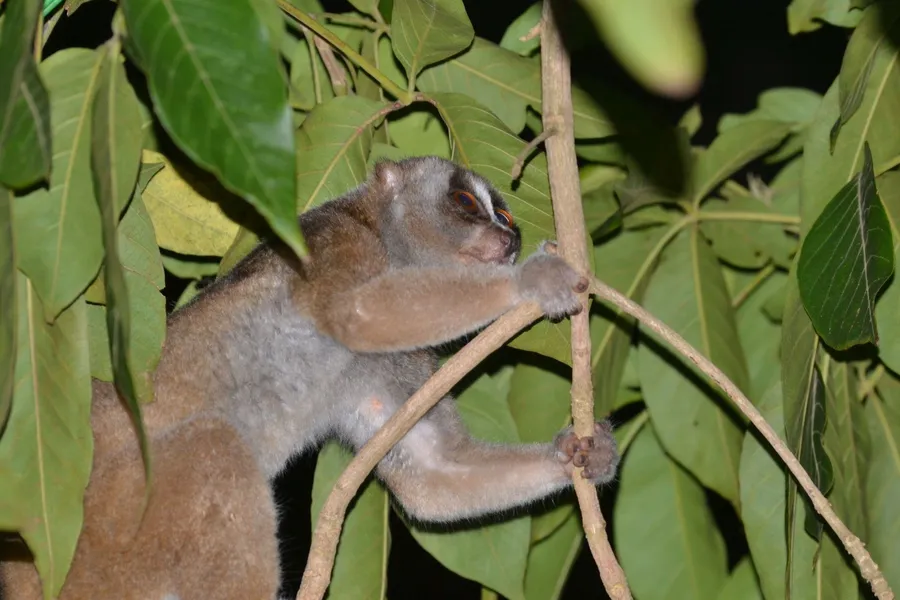
The Sunda slow loris (Nycticebus coucang), often called kukang sumatera in Indonesia, is a small, venomous primate that is active at night and moves slowly. Animal Diversity Web gives a length of 27–38 cm and a weight of about 600–685 g. It has light brown fur with a darker stripe down the back and a white stripe between its large eyes. The tail is a tiny stump hidden in the fur. N. coucang once also included the Javan, Bornean and Bangka slow lorises, now separate species. The Mammal Diversity Database also treats northern Sumatran lorises as Nycticebus hilleri and lists the Sunda slow loris as Endangered.
Evidence: Animal Diversity Web — Nycticebus coucang (Sunda slow loris) ↗ · Mammal Diversity Database (ASM) — Nycticebus coucang, Malaysian (Sunda) Slow Loris ↗ · Mammal Diversity Database (ASM) — Nycticebus hilleri, Hiller's Slow Loris ↗
Where does the Sunda slow loris live?
In Indonesia, the Sunda slow loris lives in Sumatra and some nearby islands, including Batam and Galang in the Riau Archipelago and Bunguran in the Natuna Islands. Outside Indonesia it occurs in Peninsular Malaysia, southern Thailand and Singapore. According to Animal Diversity Web, it mainly inhabits primary and secondary lowland rainforest up to 1,300 m, including peat swamp and logged forest. It needs an unbroken canopy to move from tree to tree. In Lampung, the conservation agency has released rehabilitated lorises into Bukit Barisan Selatan National Park and Batutegi forest.
Evidence: Animal Diversity Web — Nycticebus coucang (Sunda slow loris) ↗ · Mammal Diversity Database (ASM) — Nycticebus coucang, Malaysian (Sunda) Slow Loris ↗ · Mongabay Indonesia — Mewaspadai Perdagangan Ilegal Kukang di Media Sosial (2020) ↗
What does the Sunda slow loris eat?
The Sunda slow loris eats tree gum and sap, nectar and fruit, and occasionally insects, snails and birds' eggs. Animal Diversity Web estimates that about a third of its diet is gum, another third nectar and nectar-producing plants, and roughly a quarter fruit. It uses the toothcomb in its lower jaw to scrape gum from bark. ADW also notes that a loris whose teeth have been removed can no longer be returned to the wild. International Animal Rescue reports that pet lorises are often fed the wrong food and become obese, with infections, diabetes or bone disease.
Evidence: Animal Diversity Web — Nycticebus coucang (Sunda slow loris) ↗ · International Animal Rescue — The Truth Behind the Slow Loris Pet Trade ↗
Is the Sunda slow loris venomous?
Yes, slow lorises are among the few venomous mammals: fluid from a gland on the inner elbow mixes with saliva, and the venom is delivered by a bite. A 2013 review by Nekaris and colleagues describes a threatened loris raising its arms above its head, bringing its mouth to the brachial glands, then biting or smearing the mixture on its head. Bites are rare, but International Animal Rescue says they are extremely painful and can cause anaphylactic shock and even death in humans. If bitten, seek medical care at a health facility immediately. Never catch, handle or keep a slow loris.
Evidence: Journal of Venomous Animals and Toxins including Tropical Diseases — Nekaris et al. (2013), Mad, bad and dangerous to know: the biochemistry, ecology and evolution of slow loris venom ↗ · International Animal Rescue — The Truth Behind the Slow Loris Pet Trade ↗ · Animal Diversity Web — Nycticebus coucang (Sunda slow loris) ↗
Why are slow lorises traded, and what is wrong with ‘tickling’ videos?
Slow lorises are poached for the pet trade because they look cute, and online ‘tickling’ videos have helped to fuel that demand. A 2013 PLOS ONE study by Nekaris and colleagues analysed 12,411 comments on a viral video of a pet pygmy slow loris being tickled in Russia; in the early months, a quarter of commenters said they wanted one. International Animal Rescue explains that a loris raising its arms like this is terrified and in a defensive posture. Before sale, traders often cut out lorises' teeth with pliers or nail clippers, without anaesthetic. IAR Indonesia recorded 353 Facebook groups offering about 4,089 lorises between 2012 and 2019.
Evidence: PLOS ONE — Nekaris et al. (2013), Tickled to death: analysing public perceptions of ‘cute’ videos of threatened species (slow lorises) on Web 2.0 sites ↗ · International Animal Rescue — The Truth Behind the Slow Loris Pet Trade ↗ · Mongabay Indonesia — Mewaspadai Perdagangan Ilegal Kukang di Media Sosial (2020) ↗
What should you do if you find a slow loris?
If you find a slow loris near your home, do not touch, catch or keep it; keep your distance and report it to the local conservation agency (BKSDA). Nycticebus coucang is listed as protected under Ministerial Regulation P.106/2018, and all slow lorises have been on CITES Appendix I since 2007. In Lampung, residents and electricity company staff, who often find lorises on substations, hand them to the BKSDA for rehabilitation and release. Never buy a loris: Nekaris and colleagues note that lorises have one young every one to two years and rarely breed in captivity, so traded animals are most likely wild-caught.
Evidence: JDIH Kementerian Kehutanan — Permen LHK P.106/MENLHK/SETJEN/KUM.1/12/2018 tentang Jenis Tumbuhan dan Satwa yang Dilindungi (PDF, dengan lampiran) ↗ · Mongabay Indonesia — Mewaspadai Perdagangan Ilegal Kukang di Media Sosial (2020) ↗ · PLOS ONE — Nekaris et al. (2013), Tickled to death: analysing public perceptions of ‘cute’ videos of threatened species (slow lorises) on Web 2.0 sites ↗
Explore related habitats
These habitat relationships are supported by species sources in this guide. This is not a complete range map.
Scientific classification of the Sunda slow loris
| Kingdom | Animalia |
|---|---|
| Phylum | Chordata |
| Class | Mammalia |
| Order | Primates |
| Family | Lorisidae |
| Genus | Nycticebus |
| Species | Nycticebus coucang |
Source: GBIF Backbone Taxonomy, adjusted to the ranks commonly used in school biology (for example class Reptilia).
Common questions about the Sunda slow loris
What is the scientific name of the Sunda slow loris?
The scientific name of the Sunda slow loris is Nycticebus coucang, in the family Lorisidae. In Indonesian it is called Kukang sunda.
What kind of animal is the Sunda slow loris?
The Sunda slow loris is a mammal in the family Lorisidae. By diet it is a omnivore (eats plants and animals): a gum, nectar and fruit; plus insects, snails and eggs.
Where does the Sunda slow loris live in Indonesia?
In Indonesia, this guide records the Sunda slow loris in: Sumatra, the Riau Islands and the Natuna Islands.
Source-supported habitats: Tropical Rainforests.
What does the Sunda slow loris eat?
Diet of the Sunda slow loris: tree gum, nectar and fruit; sometimes insects, snails and eggs. That makes it a omnivore (eats plants and animals). Source: Animal Diversity Web.
How does the Sunda slow loris reproduce?
The Sunda slow loris reproduces by giving birth to live young (viviparous). Source: Animal Diversity Web.
Is the Sunda slow loris venomous?
Yes. The Sunda slow loris is venomous. Slow lorises are among the few venomous mammals; bites can cause necrotic wounds and anaphylactic reactions. Source: Fitzpatrick, Ligabue-Braun & Nekaris 2023, Slowly Making Sense: A Review of the Two-Step Venom System within Slow and Pygmy Lorises (Toxins).
Do not catch, handle or disturb wild animals. If bitten, stung or exposed to its toxins, go to the nearest health facility straight away.
Is the Sunda slow loris nocturnal?
The cited source records the Sunda slow loris as nocturnal (active at night). Source: Nycticebus coucang (Sunda slow loris) - Animal Diversity Web, University of Michigan.
See also the list of nocturnal and diurnal animals in Indonesia.
What are the main features of the Sunda slow loris?
Key features of the Sunda slow loris, from this guide’s sources: Key feature: large eyes, white stripe between them, slow movements.
Is the Sunda slow loris dangerous to people?
Venomous bite; can trigger anaphylactic shock.
Do not approach, catch or handle wild animals. If you are injured or bitten, get medical care at a health facility straight away.
What is the scientific classification of the Sunda slow loris?
Scientific classification of the Sunda slow loris: kingdom Animalia, phylum Chordata, class Mammalia, order Primates, family Lorisidae, genus Nycticebus, species Nycticebus coucang.
Source: GBIF Backbone Taxonomy, adjusted to the ranks commonly used in school biology.
Is the Sunda slow loris endangered?
Yes. On the IUCN Red List, the Sunda slow loris is listed as Endangered: it is considered to face a very high risk of extinction in the wild. Source: IUCN Red List (via GBIF), checked 1 October 2026.
This global category is separate from national legal protection. Is the Sunda slow loris protected in Indonesia?
Is the Sunda slow loris protected in Indonesia?
Yes. The Sunda slow loris (Nycticebus coucang) is a protected species in Indonesia under Environment and Forestry Ministerial Regulation No. P.106/MENLHK/SETJEN/KUM.1/12/2018 on protected plant and animal species (annex, entry 73).
Article 21(2) of Law No. 5 of 1990, as amended by Law No. 32 of 2024, prohibits anyone from hunting, catching, injuring, killing, storing, owning, keeping, transporting or trading a protected animal, alive or dead, including its body parts, eggs and nests.
If you see this animal being traded, kept or injured, contact the local BKSDA office.
Can the Sunda slow loris be kept as a pet?
No. Because the Sunda slow loris is a protected species, catching, owning, keeping, transporting or trading it without a permit is prohibited by law. Trading without a permit through electronic media is also prohibited.
If you see this animal for sale or being kept, report it to the local BKSDA office.
Compare with similar animals
Sources & references
- Animal Diversity Web — Nycticebus coucang (Sunda slow loris) ↗
- Mammal Diversity Database (ASM) — Nycticebus coucang, Malaysian (Sunda) Slow Loris ↗
- Mammal Diversity Database (ASM) — Nycticebus hilleri, Hiller's Slow Loris ↗
- Journal of Venomous Animals and Toxins including Tropical Diseases — Nekaris et al. (2013), Mad, bad and dangerous to know: the biochemistry, ecology and evolution of slow loris venom ↗
- PLOS ONE — Nekaris et al. (2013), Tickled to death: analysing public perceptions of ‘cute’ videos of threatened species (slow lorises) on Web 2.0 sites ↗
- International Animal Rescue — The Truth Behind the Slow Loris Pet Trade ↗
- Mongabay Indonesia — Mewaspadai Perdagangan Ilegal Kukang di Media Sosial (2020) ↗
- JDIH Kementerian Kehutanan — Permen LHK P.106/MENLHK/SETJEN/KUM.1/12/2018 tentang Jenis Tumbuhan dan Satwa yang Dilindungi (PDF, dengan lampiran) ↗
- Animal Diversity Web ↗
- Fitzpatrick, Ligabue-Braun & Nekaris 2023, Slowly Making Sense: A Review of the Two-Step Venom System within Slow and Pygmy Lorises (Toxins) ↗
- GBIF Backbone Taxonomy (GBIF) ↗
- IUCN Red List of Threatened Species, version 2026-1, via GBIF (CC BY 4.0) ↗
References can change. Check dates and context in the original source. How we use sources and data →
National parks where it is recorded
According to the official national park profiles from the KSDAE directorate. The animal may also live elsewhere.
Related causes and news
Help from outside Indonesia
If you live outside Indonesia, you can help slow lorises through rescue and rehabilitation with World Animal Rescue Network.
Related site: PanduanHewan’s founder is also a director of World Animal Rescue Network. PanduanHewan itself does not accept donations, and this invitation is not directed at people in Indonesia.
Further reading
Slow loris: facts, threats and conservation ↗ — World Animal Rescue Network. A broader overview that covers this animal.
Related site: PanduanHewan’s founder is also a director of World Animal Rescue Network.
Cite this page
Credit PanduanHewan when referring to this page. Check the original evidence sources before reusing a claim.
PanduanHewan. Sunda slow loris (Nycticebus coucang). Last substantive update: 1 October 2026. https://panduanhewan.org/en/species/sunda-slow-loris/