Quick answer
IUCN status: VulnerablePhilippine slow loris at a glance
The Philippine slow loris (Nycticebus menagensis) is a mammal in the family Lorisidae. Its IUCN Red List category is Vulnerable.
| Scientific name | Nycticebus menagensis |
|---|---|
| Indonesian name | Kukang Kalimantan |
| Group | Mammals |
| Family | Lorisidae |
| Range in Indonesia | Borneo, mainly the northern and eastern coast (East Kalimantan) |
| Linked habitats | Tropical Rainforests |
| Diet | Insects, tree gum, nectar, fruit and eggs |
| Range in Indonesia | Coastal north and east Borneo, including East Kalimantan |
| Key feature | Very pale fur, soft face mask, usually bare ears |
| Risk to people | Venomous, very painful bite that can cause anaphylactic shock |
| Other names | Kukang Kalimantan; formerly called Bornean slow loris |
| Legal protection in Indonesia | Protected under ministerial regulation P.106/2018 |
| IUCN status | Vulnerable · IUCN Red List (via GBIF) · checked 25 September 2026 |
In this guide (10)
What is the Philippine slow loris?
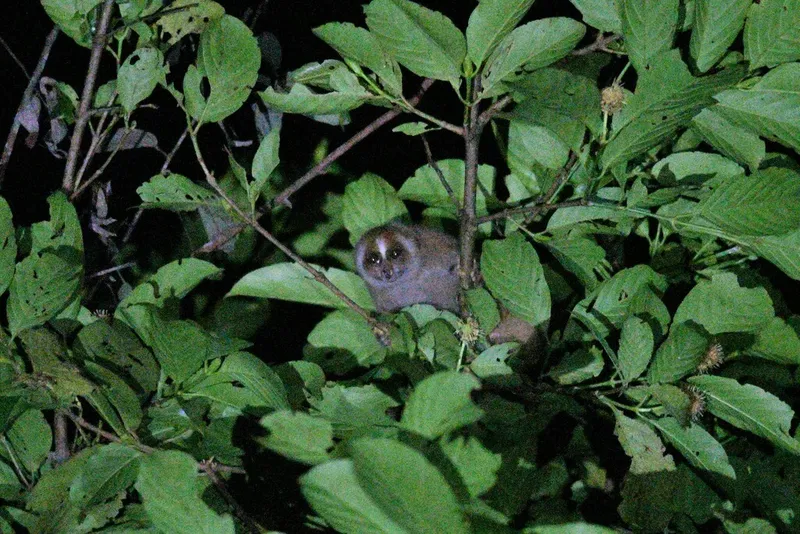
The Philippine slow loris (Nycticebus menagensis) is a small, night-active primate and one of the slow lorises, the only venomous primates. The Mammal Diversity Database lists it as Vulnerable on the IUCN Red List.
All lorises on Borneo were once placed in N. menagensis. In 2013, Munds and colleagues used facial mask patterns to split them into four species: N. menagensis, N. bancanus, N. borneanus and N. kayan. In that study, N. menagensis is very pale, with a softly contrasting face mask, a narrow white stripe between the eyes and ears that are usually bare. Six museum specimens averaged 274.2 mm in head-and-body length.
Evidence: American Journal of Primatology — Munds, Nekaris & Ford (2013), Taxonomy of the Bornean slow loris, with new species Nycticebus kayan (PDF, Wayback Machine copy) ↗ · Mammal Diversity Database (ASM) — Nycticebus menagensis, Philippine Slow Loris ↗ · Journal of Venomous Animals and Toxins including Tropical Diseases — Nekaris et al. (2013), Mad, bad and dangerous to know: the biochemistry, ecology and evolution of slow loris venom ↗
Where does the Philippine slow loris live?
Under the 2013 revision, the Philippine slow loris lives on the northern and eastern coasts of Borneo (East Kalimantan, Sabah and Brunei) and in the southern Philippine islands. In East Kalimantan and Sabah it overlaps with the Kayan slow loris (N. kayan), which appears absent from the coast.
West, Central and South Kalimantan are home to its relatives N. bancanus and N. borneanus. Yet Indonesian release reports still use N. menagensis for lorises from other areas, such as one freed by the conservation agency (BKSDA) at Gunung Tarak, West Kalimantan, in 2022. The IUCN assessment reproduced by ESABII lists primary and secondary lowland forest, gardens and plantations as its habitat.
Evidence: American Journal of Primatology — Munds, Nekaris & Ford (2013), Taxonomy of the Bornean slow loris, with new species Nycticebus kayan (PDF, Wayback Machine copy) ↗ · Yayasan IAR Indonesia — Selamat Setelah Tersengat Listrik, Kukang Elektro Dilepasliarkan di HL Gunung Tarak (2022) ↗ · ESABII (Kementerian Lingkungan Hidup Jepang) — Threatened Mammal Species Database: Nycticebus menagensis ↗
What does the Philippine slow loris eat?
The Philippine slow loris is omnivorous: in the wild, slow lorises eat insects, nectar, tree gum, fruit, eggs and small animals. Mongabay describes this diet for slow lorises in general, including the Bornean species.
Diet data for this species alone are still limited. Wirdateti, a primate researcher at LIPI quoted by Mongabay, explains that lorises use their canine teeth to bite hard food such as insects and fruit. Lorises also play a role in the forest: by eating fruit they spread seeds, and by eating insects they help control pests. The same researcher says they also help pollinate flowers.
Evidence: Mongabay — New species of cute, but venomous, primate discovered in Borneo (2012) ↗ · Mongabay Indonesia — Kukang Bukan Hewan Peliharaan, Hidupnya di Hutan (2026) ↗ · Mongabay Indonesia — Mencabut Gigi Kukang Sama Saja Membunuhnya Perlahan (2017) ↗
How does the Philippine slow loris behave?
The Philippine slow loris is active at night, lives almost entirely in trees and moves slowly. The older IUCN assessment reproduced by ESABII describes lorises on Borneo as rarely encountered: in 46,000 trap-nights in Kinabalu National Park, Sabah, lorises were caught only three times.
When threatened, a slow loris raises both arms above its head, so its mouth can quickly reach the brachial gland inside the elbow; the gland's fluid mixes with saliva to form venom. A 2013 review by Nekaris and colleagues shows a Philippine slow loris in this posture. The review suggests the venom mainly works against parasites and other lorises, and may also deter predators.
Evidence: ESABII (Kementerian Lingkungan Hidup Jepang) — Threatened Mammal Species Database: Nycticebus menagensis ↗ · Journal of Venomous Animals and Toxins including Tropical Diseases — Nekaris et al. (2013), Mad, bad and dangerous to know: the biochemistry, ecology and evolution of slow loris venom ↗
Is the Philippine slow loris venomous?
Yes, like all slow lorises, the Philippine slow loris has a venomous bite. A 2013 review by Nekaris and colleagues reports that loris bites are intensely painful and can cause swelling and festering wounds that take weeks to heal and leave scars. In extreme cases, people who are bitten go into anaphylactic shock, which is sometimes fatal.
Wirdateti, a primate researcher at LIPI, told Mongabay that the venom comes from an arm gland, not the teeth. Common symptoms are vomiting, dizziness and swelling at the bite. Never handle, catch or keep a slow loris. If you are bitten, seek medical care at a health facility immediately.
Evidence: Journal of Venomous Animals and Toxins including Tropical Diseases — Nekaris et al. (2013), Mad, bad and dangerous to know: the biochemistry, ecology and evolution of slow loris venom ↗ · Mongabay Indonesia — Mencabut Gigi Kukang Sama Saja Membunuhnya Perlahan (2017) ↗
How can the Philippine slow loris be protected?
The Philippine slow loris is protected in Indonesia: the annex to ministerial regulation P.106/2018 lists Nycticebus menagensis as kukang kalimantan. Its main threat is the pet trade. Mongabay reported in 2026 that about 7,000 slow lorises are traded each year, and almost all lorises on sale are caught from the wild.
Hunters and traders often cut or pull out lorises' teeth, leaving them prone to infection and unable to eat properly; many can never be released. Lorises kept as pets after their teeth are cut survive only about six months. To help, do not buy, keep or share videos of pet lorises, and report loris trading to local conservation officers.
Evidence: JDIH Kemenko Infrastruktur — Permen LHK P.106/MENLHK/SETJEN/KUM.1/12/2018 tentang Jenis Tumbuhan dan Satwa yang Dilindungi (PDF) ↗ · Mongabay Indonesia — Kukang Bukan Hewan Peliharaan, Hidupnya di Hutan (2026) ↗ · Mongabay Indonesia — Mencabut Gigi Kukang Sama Saja Membunuhnya Perlahan (2017) ↗
Explore related habitats
These habitat relationships are supported by species sources in this guide. This is not a complete range map.
Common questions about the Philippine slow loris
What is the scientific name of the Philippine slow loris?
The scientific name of the Philippine slow loris is Nycticebus menagensis, in the family Lorisidae. In Indonesian it is called Kukang Kalimantan.
Where can the Philippine slow loris be found in Indonesia?
In Indonesia, this guide records the Philippine slow loris in: Borneo, mainly the northern and eastern coast (East Kalimantan).
Source-supported habitats: Tropical Rainforests.
What does the Philippine slow loris eat?
Diet of the Philippine slow loris: insects, tree gum, nectar, fruit and eggs.
What is the conservation status of the Philippine slow loris?
On the IUCN Red List, the Philippine slow loris is listed as Vulnerable: it is considered to face a high risk of extinction in the wild. Source: IUCN Red List (via GBIF), checked 25 September 2026.
This global category is separate from legal protection in Indonesia. To check whether the Philippine slow loris is a protected species, consult the current national list of protected species or contact the local BKSDA (natural resources conservation office).
Sources & references
- American Journal of Primatology — Munds, Nekaris & Ford (2013), Taxonomy of the Bornean slow loris, with new species Nycticebus kayan (PDF, Wayback Machine copy) ↗
- Mammal Diversity Database (ASM) — Nycticebus menagensis, Philippine Slow Loris ↗
- ESABII (Kementerian Lingkungan Hidup Jepang) — Threatened Mammal Species Database: Nycticebus menagensis ↗
- Journal of Venomous Animals and Toxins including Tropical Diseases — Nekaris et al. (2013), Mad, bad and dangerous to know: the biochemistry, ecology and evolution of slow loris venom ↗
- Mongabay Indonesia — Mencabut Gigi Kukang Sama Saja Membunuhnya Perlahan (2017) ↗
- Mongabay Indonesia — Kukang Bukan Hewan Peliharaan, Hidupnya di Hutan (2026) ↗
- Mongabay — New species of cute, but venomous, primate discovered in Borneo (2012) ↗
- Yayasan IAR Indonesia — Selamat Setelah Tersengat Listrik, Kukang Elektro Dilepasliarkan di HL Gunung Tarak (2022) ↗
- JDIH Kemenko Infrastruktur — Permen LHK P.106/MENLHK/SETJEN/KUM.1/12/2018 tentang Jenis Tumbuhan dan Satwa yang Dilindungi (PDF) ↗
- IUCN Red List of Threatened Species, version 2026-1, via GBIF (CC BY 4.0) ↗
References can change. Check dates and context in the original source.
Further reading
Slow loris: facts, threats and conservation ↗ — World Animal Rescue Network. A broader overview that covers this animal.
Cite this page
PanduanHewan. (2026, 25 September). Philippine slow loris (Nycticebus menagensis). PanduanHewan.org. https://panduanhewan.org/en/species/philippine-slow-loris/