Quick answer
IUCN status: Near ThreatenedMarbled cat at a glance
The marbled cat (Pardofelis marmorata) is a mammal in the family Felidae. Range in Indonesia: Sumatra and Borneo (Kalimantan). Diet: probably birds, squirrels, fruit bats and rats; a carnivore. IUCN Red List status: Near Threatened. It is a legally protected species in Indonesia (Regulation P.106/2018).
| Scientific name | Pardofelis marmorata |
|---|---|
| Indonesian name | Kucing batu |
| Group | Mammals |
| Family | Felidae |
| Range in Indonesia | Sumatra and Borneo (Kalimantan) |
| Linked habitats | Tropical Rainforests |
| Diet | Probably birds, squirrels, fruit bats and rats |
| Range in Indonesia | Sumatra and Kalimantan |
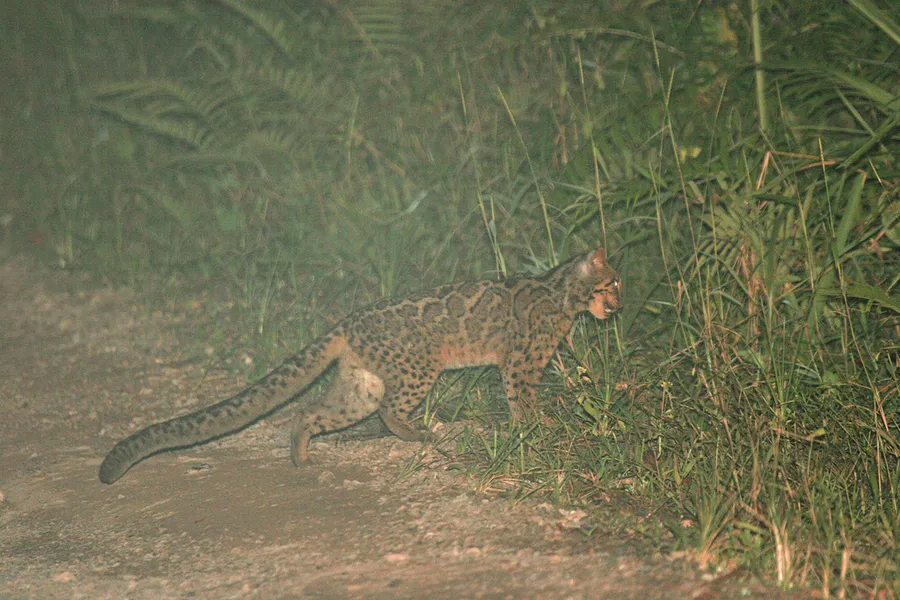
| Key feature | Marbled coat, bushy tail almost as long as body |
| Other names | Kucing batu (Indonesian) |
| IUCN status | Near Threatened · IUCN Red List (via GBIF) · checked 1 October 2026 |
| Legal protection in Indonesia | Protected · Regulation P.106/2018 · annex no. 57 |
| Longevity | Up to 12 years · IUCN SSC Cat Specialist Group — Marbled cat |
| Population density | 19.57 individuals per 100 km² in Danum Valley, Sabah (primary lowland forest) · IUCN SSC Cat Specialist Group — Marbled cat |
| Diet type | Carnivore (meat-eater) — predator of birds and small tree-dwelling mammals · Animal Diversity Web |
| Reproduction | Giving birth to live young (viviparous) · Animal Diversity Web |
| Active | Diurnal (active by day) · Spatio-temporal ecology of sympatric felids on Borneo. Evidence for resource partitioning? (Hearn et al. 2018, PLoS ONE) |
In this guide (12)
What is the marbled cat?
The marbled cat (Pardofelis marmorata) is a small wild cat about the size of a large house cat, with a marbled coat and a thick, very long tail. ADW gives a head-and-body length of 45–61 cm, a tail of 35–55 cm and a weight of 2.4–5 kg. The base colour ranges from grey-brown to red-brown, with large black-edged blotches. Its pattern resembles a clouded leopard's, but genetic studies show its closest relatives are the Asiatic golden cat (Catopuma temminckii) and the bay cat (Catopuma badia). Sumatran and Bornean animals belong to the subspecies P. m. marmorata.
Evidence: IUCN SSC Cat Specialist Group — Marbled cat ↗ · Animal Diversity Web (University of Michigan) — Pardofelis marmorata, marbled cat ↗
Where does the marbled cat live?
In Indonesia, the marbled cat lives in the forests of Sumatra and Borneo. It depends on forest and appears to prefer remote, moist primary forest. On Sumatra, camera traps have recorded it in Bukit Barisan Selatan National Park, in lowland secondary and primary forest, and even in small forest fragments among coffee plantations. In Kalimantan it has been recorded in the Sabangau peat-swamp forest. It seems to avoid heavily disturbed habitats, and a survey in Sabah did not record it inside oil palm plantations. Across its range it has been recorded from sea level to about 3,000 m.
Evidence: IUCN SSC Cat Specialist Group — Marbled cat ↗ · PLOS One (Hearn et al. 2016) — The first estimates of marbled cat Pardofelis marmorata population density from Bornean primary and selectively logged forest ↗
What does the marbled cat eat?
The marbled cat is thought to prey on birds and small mammals, especially those living in trees. No dedicated diet study exists. The IUCN Cat Specialist Group lists likely prey as birds, tree squirrels, fruit bats and rats, and probably insects, lizards and frogs. There are several records of marbled cats preying on primates, and one has been seen stalking birds in trees. The stomach of a dead individual in Thailand held the remains of a small rat. On Sumatra, villagers outside national parks report that it very occasionally takes poultry.
Evidence: IUCN SSC Cat Specialist Group — Marbled cat ↗ · Animal Diversity Web (University of Michigan) — Pardofelis marmorata, marbled cat ↗
How does the marbled cat behave?
The marbled cat is a skilled climber that usually lives alone, yet it also often walks on the ground. It can climb down trees head-first, and its long tail helps it balance while climbing. Camera traps on Sumatra and Borneo suggest it may be mainly active by day, contrary to the old view that it is nocturnal. Most breeding data come from captivity. According to ADW, gestation lasts 66–82 days, litters have 2–4 kittens, and sexual maturity comes at about 21–22 months.
Evidence: IUCN SSC Cat Specialist Group — Marbled cat ↗ · Animal Diversity Web (University of Michigan) — Pardofelis marmorata, marbled cat ↗ · PLOS One (Hearn et al. 2016) — The first estimates of marbled cat Pardofelis marmorata population density from Bornean primary and selectively logged forest ↗
Why is the marbled cat threatened?
Forest loss is the main threat, because the marbled cat depends on tree cover. South-east Asia has some of the fastest deforestation anywhere, driven by logging and conversion to settlements, oil palm, coffee, rubber and other plantations. Indiscriminate snaring is also a major problem. Some Dayak communities in Kalimantan use its meat and skin as medicine. IUCN lists it as Near Threatened, with an unknown population trend. It is rarely photographed: in the Sabangau peat-swamp forest, more than 5,423 camera-trap nights passed before the first image.
Evidence: IUCN SSC Cat Specialist Group — Marbled cat ↗ · PLOS One (Hearn et al. 2016) — The first estimates of marbled cat Pardofelis marmorata population density from Bornean primary and selectively logged forest ↗
How can the marbled cat be protected?
The marbled cat is protected in Indonesia: it is listed in the annex to Permen LHK P.106/MENLHK/SETJEN/KUM.1/12/2018, and internationally it is on CITES Appendix I. Do not catch, keep or trade marbled cats or their body parts. Protecting forest is key, including selectively logged forest: a study in Sabah found evidence of marbled cats breeding in such forest. If you find snares or see marbled cats offered for sale, report it to the local BKSDA. Camera-trap photos and sighting records also help researchers understand this rarely seen cat.
Evidence: JDIH Kementerian Kehutanan — Permen LHK P.106/MENLHK/SETJEN/KUM.1/12/2018 tentang Jenis Tumbuhan dan Satwa yang Dilindungi (PDF, dengan lampiran) ↗ · IUCN SSC Cat Specialist Group — Marbled cat ↗ · PLOS One (Hearn et al. 2016) — The first estimates of marbled cat Pardofelis marmorata population density from Bornean primary and selectively logged forest ↗
Explore related habitats
These habitat relationships are supported by species sources in this guide. This is not a complete range map.
Scientific classification of the Marbled cat
| Kingdom | Animalia |
|---|---|
| Phylum | Chordata |
| Class | Mammalia |
| Order | Carnivora |
| Family | Felidae |
| Genus | Pardofelis |
| Species | Pardofelis marmorata |
Source: GBIF Backbone Taxonomy, adjusted to the ranks commonly used in school biology (for example class Reptilia).
Common questions about the marbled cat
What is the scientific name of the marbled cat?
The scientific name of the marbled cat is Pardofelis marmorata, in the family Felidae. In Indonesian it is called Kucing batu.
What kind of animal is the marbled cat?
The marbled cat is a mammal in the family Felidae. By diet it is a carnivore (meat-eater): a predator of birds and small tree-dwelling mammals.
Where does the marbled cat live in Indonesia?
In Indonesia, this guide records the marbled cat in: Sumatra and Borneo (Kalimantan).
Source-supported habitats: Tropical Rainforests.
What does the marbled cat eat?
Diet of the marbled cat: probably birds, squirrels, fruit bats and rats. That makes it a carnivore (meat-eater). Source: Animal Diversity Web.
How does the marbled cat reproduce?
The marbled cat reproduces by giving birth to live young (viviparous). Source: Animal Diversity Web.
Is the marbled cat nocturnal?
The cited source records the marbled cat as diurnal (active by day). Source: Spatio-temporal ecology of sympatric felids on Borneo. Evidence for resource partitioning? (Hearn et al. 2018, PLoS ONE).
See also the list of nocturnal and diurnal animals in Indonesia.
What are the main features of the marbled cat?
Key features of the marbled cat, from this guide’s sources: Key feature: marbled coat, bushy tail almost as long as body.
How large is the population of the marbled cat?
19.57 individuals per 100 km² in Danum Valley, Sabah (primary lowland forest). Source: IUCN SSC Cat Specialist Group — Marbled cat. Wild population figures are estimates and can differ between surveys.
What is the scientific classification of the marbled cat?
Scientific classification of the marbled cat: kingdom Animalia, phylum Chordata, class Mammalia, order Carnivora, family Felidae, genus Pardofelis, species Pardofelis marmorata.
Source: GBIF Backbone Taxonomy, adjusted to the ranks commonly used in school biology.
Is the marbled cat endangered?
Not yet in a threatened category, but close to one. On the IUCN Red List, the marbled cat is listed as Near Threatened: it is close to qualifying, or likely to qualify, for a threatened category in the near future. Source: IUCN Red List (via GBIF), checked 1 October 2026.
This global category is separate from national legal protection. Is the marbled cat protected in Indonesia?
Is the marbled cat protected in Indonesia?
Yes. The marbled cat (Pardofelis marmorata) is a protected species in Indonesia under Environment and Forestry Ministerial Regulation No. P.106/MENLHK/SETJEN/KUM.1/12/2018 on protected plant and animal species (annex, entry 57).
Article 21(2) of Law No. 5 of 1990, as amended by Law No. 32 of 2024, prohibits anyone from hunting, catching, injuring, killing, storing, owning, keeping, transporting or trading a protected animal, alive or dead, including its body parts, eggs and nests.
If you see this animal being traded, kept or injured, contact the local BKSDA office.
Can the marbled cat be kept as a pet?
No. Because the marbled cat is a protected species, catching, owning, keeping, transporting or trading it without a permit is prohibited by law. Trading without a permit through electronic media is also prohibited.
If you see this animal for sale or being kept, report it to the local BKSDA office.
Compare with similar animals
Sources & references
- IUCN SSC Cat Specialist Group — Marbled cat ↗
- Animal Diversity Web (University of Michigan) — Pardofelis marmorata, marbled cat ↗
- PLOS One (Hearn et al. 2016) — The first estimates of marbled cat Pardofelis marmorata population density from Bornean primary and selectively logged forest ↗
- JDIH Kementerian Kehutanan — Permen LHK P.106/MENLHK/SETJEN/KUM.1/12/2018 tentang Jenis Tumbuhan dan Satwa yang Dilindungi (PDF, dengan lampiran) ↗
- Animal Diversity Web ↗
- Spatio-temporal ecology of sympatric felids on Borneo. Evidence for resource partitioning? (Hearn et al. 2018, PLoS ONE) ↗
- GBIF Backbone Taxonomy (GBIF) ↗
- IUCN Red List of Threatened Species, version 2026-1, via GBIF (CC BY 4.0) ↗
References can change. Check dates and context in the original source. How we use sources and data →
Related causes and news
Cite this page
Credit PanduanHewan when referring to this page. Check the original evidence sources before reusing a claim.
PanduanHewan. Marbled cat (Pardofelis marmorata). Last substantive update: 1 October 2026. https://panduanhewan.org/en/species/marbled-cat/