Quick answer
IUCN status: Critically EndangeredBawean deer at a glance
The Bawean deer (Axis kuhlii) is a mammal in the family Cervidae. Range in Indonesia: Bawean Island, Gresik Regency, East Java. It is endemic to Indonesia, living naturally only in Bawean Island, Gresik Regency, East Java. Diet: grasses, especially young lalang (cogon grass), and leaves; a herbivore. IUCN Red List status: Critically Endangered. It is a legally protected species in Indonesia (Regulation P.106/2018).
| Scientific name | Axis kuhlii |
|---|---|
| Indonesian name | Rusa bawean |
| Group | Mammals |
| Family | Cervidae |
| Range in Indonesia | Bawean Island, Gresik Regency, East Java |
| Linked habitats | Tropical Rainforests |
| Diet | Grasses, especially young lalang (cogon grass), and leaves |
| Range in Indonesia | Only Bawean Island, Gresik, East Java |
| Key feature | Short legs, grizzled brown coat, three-pronged antlers |
| Other names | Kuhl's deer, Bawean hog deer, rusa bawean |
| IUCN status | Critically Endangered · IUCN Red List (via GBIF) · checked 1 October 2026 |
| Legal protection in Indonesia | Protected · Regulation P.106/2018 · annex no. 29 |
| Diet type | Herbivore (plant-eater) — grasses (especially young cogon grass) and leaves · Ultimate Ungulate |
| Reproduction | Giving birth to live young (viviparous) · Ultimate Ungulate |
| Active | Nocturnal (active at night) · Ultimate Ungulate |
| Endemic to Indonesia | Yes — Bawean Island, Gresik Regency, East Java · Ultimate Ungulate |
In this guide (11)
What is the Bawean deer?
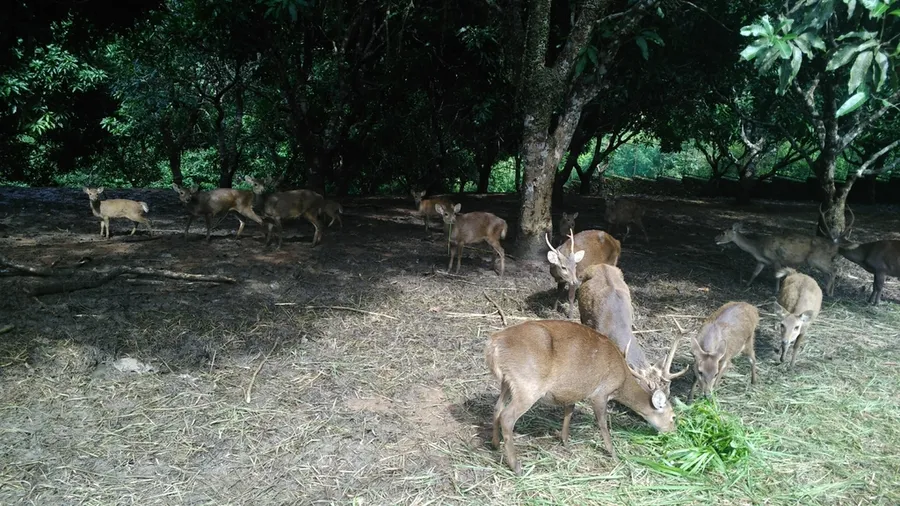
The Bawean deer (Axis kuhlii) is a small, short-legged deer found only on Bawean Island. The journal Oryx calls it the most isolated deer in the world. According to the Ultimate Ungulate fact sheet, it measures about 140 cm in head-and-body length, stands 65–70 cm at the shoulder and weighs 50–60 kg as adults.
The coat is mid-brown with yellow-banded hairs and a pale ring around the eye, and the back slopes from rump to shoulders. Only males carry antlers, each with three prongs and 25–47 cm long. The Bawean deer resembles the mainland hog deer (Axis porcinus) but is smaller, with shorter legs and a shorter face.
Evidence: Ultimate Ungulate — Bawean deer (Axis kuhlii) fact sheet ↗ · Oryx (Cambridge University Press) — Rahman, Gonzalez & Aulagnier (2016), Population size, distribution and status of the remote and Critically Endangered Bawean deer Axis kuhlii, Oryx 51(4): 665–672 ↗
Where does the Bawean deer live?
The Bawean deer lives only on Bawean Island, an island of about 200 km² in the Java Sea that belongs to Gresik Regency, East Java. Its range centres on the Bawean Island Nature Reserve and Wildlife Sanctuary in the west of the island.
A 2014 camera-trap survey published in Oryx recorded deer only in the south-western part of the reserve, from Mount Bulu to Mount Bengkuang, at 34–320 m elevation. Its habitat is a mosaic of evergreen and semi-deciduous forest, shrub, grassland and teak plantations. A 2004 Gadjah Mada University study found the deer used secondary forest most. By day the deer rest in dense cover.
Evidence: Oryx (Cambridge University Press) — Rahman, Gonzalez & Aulagnier (2016), Population size, distribution and status of the remote and Critically Endangered Bawean deer Axis kuhlii, Oryx 51(4): 665–672 ↗ · Universitas Gadjah Mada — Hutomo (2004), Studi habitat dan pakan rusa Bawean (Axis kuhlii) di Suaka Margasatwa Pulau Bawean (abstrak tesis S2) ↗ · Ultimate Ungulate — Bawean deer (Axis kuhlii) fact sheet ↗
What does the Bawean deer eat?
The Bawean deer eats grasses, especially young lalang (cogon grass), and leaves, according to Ultimate Ungulate. Hutomo's 2004 Gadjah Mada thesis recorded 17 food-plant species in the field, and faecal analysis identified 10 food species. The largest share of the diet came from plants known locally as pele and tali susu.
The Oryx study notes that most deer were photographed while feeding. Activity is concentrated below 300 m, where food and water are plentiful. Recorded densities rose in the dry season, possibly because the deer had to range further for food. The deer are also sometimes drawn to crops near villages.
Evidence: Ultimate Ungulate — Bawean deer (Axis kuhlii) fact sheet ↗ · Universitas Gadjah Mada — Hutomo (2004), Studi habitat dan pakan rusa Bawean (Axis kuhlii) di Suaka Margasatwa Pulau Bawean (abstrak tesis S2) ↗ · Oryx (Cambridge University Press) — Rahman, Gonzalez & Aulagnier (2016), Population size, distribution and status of the remote and Critically Endangered Bawean deer Axis kuhlii, Oryx 51(4): 665–672 ↗
How does the Bawean deer behave?
The Bawean deer is very shy and mainly active at night; Mongabay Indonesia reports that it usually moves between 17.00 and 21.00 local time. It avoids people and spends much of its time in forest and on steep slopes.
Ultimate Ungulate describes it as usually solitary but highly vocal. Mothers use sharp barks to find their young, and males bark to challenge each other. It has no alarm call; when threatened it creeps quietly away. Gestation lasts 225–230 days and produces a single fawn, with most births between February and June. Fawns have spotted coats that fade with age.
Evidence: Mongabay Indonesia (2021) — Rusa Bawean, Si Gesit yang Tidak Suka Kehadiran Manusia ↗ · Ultimate Ungulate — Bawean deer (Axis kuhlii) fact sheet ↗
Why is the Bawean deer endangered?
The Bawean deer is Critically Endangered because it lives on one small island, with an extent of occurrence under 100 km², and its habitat is still being disturbed. The main threats are illegal logging, hunting, snares and feral dogs.
The 2014 survey recorded hunting at 6 of 20 camera sites and found a wild-boar snare that could also catch deer. Feral dogs appeared in 12 grid cells, and two deer were recorded killed by dogs near villages. Population estimates vary by method and year: 307–316 (2004 Gadjah Mada study), about 227–416 (2014 survey), and, according to East Java conservation office (BBKSDA) data, a fall from 325 (2015) to 303 (2016).
Evidence: Oryx (Cambridge University Press) — Rahman, Gonzalez & Aulagnier (2016), Population size, distribution and status of the remote and Critically Endangered Bawean deer Axis kuhlii, Oryx 51(4): 665–672 ↗ · Mongabay Indonesia (2021) — Rusa Bawean, Si Gesit yang Tidak Suka Kehadiran Manusia ↗
How can the Bawean deer be protected?
The Bawean deer is legally protected: the annex to Regulation P.106/2018 lists it as entry 29. It is also on CITES Appendix I and among 25 species the government prioritised for conservation under decree SK.180/IV-KKH/2015.
A captive-breeding programme began in 2006 with two stags and five hinds and had grown to 35 animals by 2014, according to Oryx. Residents and visitors can help by not hunting or setting snares, not buying deer meat or antlers, keeping pet dogs out of the forest, and reporting illegal logging to the East Java conservation office (BBKSDA Jawa Timur). The species also inspired Atung, a mascot of the 2018 Asian Games.
Evidence: JDIH Kementerian Kehutanan — Lampiran Permen LHK P.106/MENLHK/SETJEN/KUM.1/12/2018 tentang Jenis Tumbuhan dan Satwa yang Dilindungi ↗ · Oryx (Cambridge University Press) — Rahman, Gonzalez & Aulagnier (2016), Population size, distribution and status of the remote and Critically Endangered Bawean deer Axis kuhlii, Oryx 51(4): 665–672 ↗ · Mongabay Indonesia (2021) — Rusa Bawean, Si Gesit yang Tidak Suka Kehadiran Manusia ↗
Explore related habitats
These habitat relationships are supported by species sources in this guide. This is not a complete range map.
Scientific classification of the Bawean deer
| Kingdom | Animalia |
|---|---|
| Phylum | Chordata |
| Class | Mammalia |
| Order | Artiodactyla |
| Family | Cervidae |
| Genus | Axis |
| Species | Axis kuhlii |
Source: GBIF Backbone Taxonomy, adjusted to the ranks commonly used in school biology (for example class Reptilia).
Common questions about the Bawean deer
What is the scientific name of the Bawean deer?
The scientific name of the Bawean deer is Axis kuhlii, in the family Cervidae. In Indonesian it is called Rusa bawean.
What kind of animal is the Bawean deer?
The Bawean deer is a mammal in the family Cervidae. By diet it is a herbivore (plant-eater): a grasses (especially young cogon grass) and leaves. It is also endemic to Indonesia.
Where does the Bawean deer live in Indonesia?
In Indonesia, this guide records the Bawean deer in: Bawean Island, Gresik Regency, East Java.
The Bawean deer is endemic to Indonesia and lives naturally only in Bawean Island, Gresik Regency, East Java. Source: Ultimate Ungulate.
Source-supported habitats: Tropical Rainforests.
What does the Bawean deer eat?
Diet of the Bawean deer: grasses, especially young lalang (cogon grass), and leaves. That makes it a herbivore (plant-eater). Source: Ultimate Ungulate.
How does the Bawean deer reproduce?
The Bawean deer reproduces by giving birth to live young (viviparous). Source: Ultimate Ungulate.
Is the Bawean deer nocturnal?
Yes. The Bawean deer is nocturnal (active at night). Comes out into clearings around dusk. Source: Ultimate Ungulate.
See also the list of nocturnal and diurnal animals in Indonesia.
What are the main features of the Bawean deer?
Key features of the Bawean deer, from this guide’s sources: Key feature: short legs, grizzled brown coat, three-pronged antlers.
What is the scientific classification of the Bawean deer?
Scientific classification of the Bawean deer: kingdom Animalia, phylum Chordata, class Mammalia, order Artiodactyla, family Cervidae, genus Axis, species Axis kuhlii.
Source: GBIF Backbone Taxonomy, adjusted to the ranks commonly used in school biology.
Is the Bawean deer endangered?
Yes. On the IUCN Red List, the Bawean deer is listed as Critically Endangered: it is considered to face an extremely high risk of extinction in the wild. Source: IUCN Red List (via GBIF), checked 1 October 2026.
This global category is separate from national legal protection. Is the Bawean deer protected in Indonesia?
Is the Bawean deer protected in Indonesia?
Yes. The Bawean deer (Axis kuhlii) is a protected species in Indonesia under Environment and Forestry Ministerial Regulation No. P.106/MENLHK/SETJEN/KUM.1/12/2018 on protected plant and animal species (annex, entry 29).
Article 21(2) of Law No. 5 of 1990, as amended by Law No. 32 of 2024, prohibits anyone from hunting, catching, injuring, killing, storing, owning, keeping, transporting or trading a protected animal, alive or dead, including its body parts, eggs and nests.
If you see this animal being traded, kept or injured, contact the local BKSDA office.
Can the Bawean deer be kept as a pet?
No. Because the Bawean deer is a protected species, catching, owning, keeping, transporting or trading it without a permit is prohibited by law. Trading without a permit through electronic media is also prohibited.
If you see this animal for sale or being kept, report it to the local BKSDA office.
Compare with similar animals
Sources & references
- Oryx (Cambridge University Press) — Rahman, Gonzalez & Aulagnier (2016), Population size, distribution and status of the remote and Critically Endangered Bawean deer Axis kuhlii, Oryx 51(4): 665–672 ↗
- Ultimate Ungulate — Bawean deer (Axis kuhlii) fact sheet ↗
- Universitas Gadjah Mada — Hutomo (2004), Studi habitat dan pakan rusa Bawean (Axis kuhlii) di Suaka Margasatwa Pulau Bawean (abstrak tesis S2) ↗
- Mongabay Indonesia (2021) — Rusa Bawean, Si Gesit yang Tidak Suka Kehadiran Manusia ↗
- JDIH Kementerian Kehutanan — Lampiran Permen LHK P.106/MENLHK/SETJEN/KUM.1/12/2018 tentang Jenis Tumbuhan dan Satwa yang Dilindungi ↗
- GBIF Backbone Taxonomy (GBIF) ↗
- IUCN Red List of Threatened Species, version 2026-1, via GBIF (CC BY 4.0) ↗
References can change. Check dates and context in the original source.
Cite this page
PanduanHewan. (2026, 1 October). Bawean deer (Axis kuhlii). PanduanHewan.org. https://panduanhewan.org/en/species/bawean-deer/