Quick answer
IUCN status: Critically EndangeredWestern long-beaked echidna at a glance
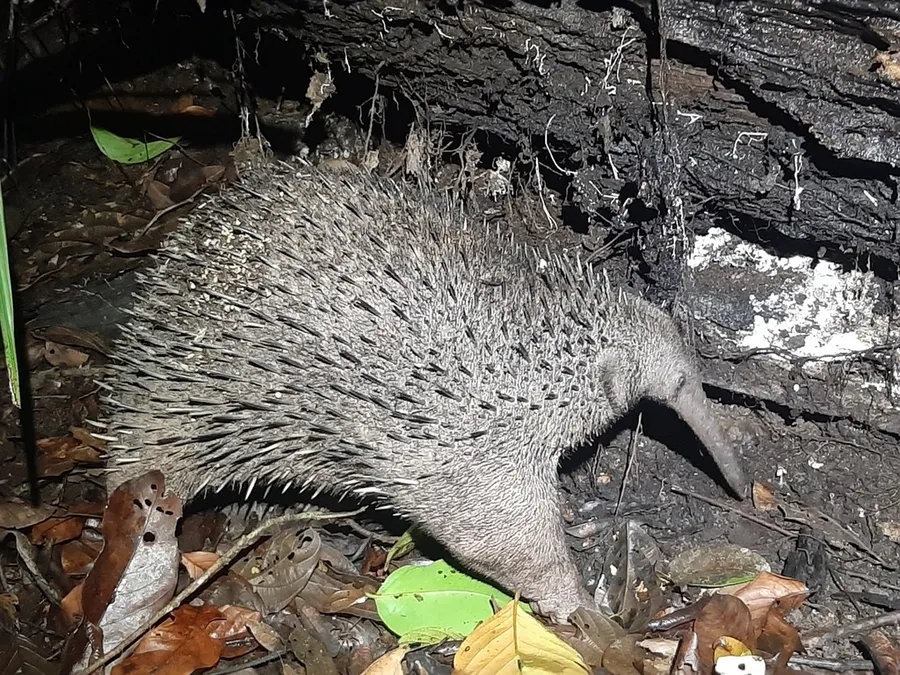
The western long-beaked echidna (Zaglossus bruijnii) is a mammal. Range in Indonesia: The Bird's Head (Vogelkop) and Bomberai peninsulas, West Papua and Southwest Papua. Diet: earthworms and soil invertebrates, especially insect larvae; a carnivore. IUCN Red List status: Critically Endangered. It is a legally protected species in Indonesia (Regulation P.106/2018).
| Scientific name | Zaglossus bruijnii |
|---|---|
| Indonesian name | Landak semut moncong panjang barat |
| Group | Mammals |
| Range in Indonesia | The Bird's Head (Vogelkop) and Bomberai peninsulas, West Papua and Southwest Papua |
| Linked habitats | Tropical Rainforests |
| Diet | Earthworms and soil invertebrates, especially insect larvae |
| Range in Indonesia | Bird's Head and Bomberai peninsulas, Papua |
| Key feature | Long down-curved snout, spiny body, three claws per foot |
| Reproduction | Lays eggs; a monotreme mammal |
| Other names | Long-beaked echidna, long-nosed spiny anteater, nokdiak |
| IUCN status | Critically Endangered · IUCN Red List (via GBIF) — Zaglossus bruijni |
| Legal protection in Indonesia | Protected · Regulation P.106/2018 · annex no. 117 |
| Diet type | Carnivore (meat-eater) — earthworms and other soil invertebrates, especially insect larvae · Animal Diversity Web |
| Reproduction | Laying eggs (oviparous) · Animal Diversity Web |
| Venom or poison | Not venomous · Whittington & Belov 2014, Tracing monotreme venom evolution in the genomics era (Toxins) |
| Active | Nocturnal (active at night) · Animal Diversity Web |
In this guide (11)
What is the western long-beaked echidna?
The western long-beaked echidna (Zaglossus bruijnii) is a spiny, egg-laying mammal (a monotreme) from Papua. Despite its Indonesian name, which means 'ant porcupine', it is not a porcupine. The genus Zaglossus is the largest egg-laying mammal, according to a study in ZooKeys.
According to HMW, this species differs from its relatives in having three (rarely four) claws on each foot. Its fur is mostly black, sometimes brown, with white to black spines. ADW gives a snout length of 7–9 cm, curving downwards, with no teeth and a long, sticky tongue. Since Flannery and Groves' 1998 revision, Zaglossus has been split into three species, including Z. attenboroughi of the Cyclops Mountains.
Evidence: Handbook of the Mammals of the World vol. 5 (Mittermeier & Wilson 2015), Tachyglossidae — Western Long-beaked Echidna Zaglossus bruijnii, taxonomic treatment via Plazi ↗ · Animal Diversity Web — Zaglossus bruijni, western long-beaked echidna ↗ · Mammal Diversity Database (ASM) — Zaglossus bruijnii, Western Long-beaked Echidna ↗
Where does the western long-beaked echidna live?
It lives mainly on the Bird's Head (Vogelkop) and Bomberai (Fakfak) peninsulas of north-western New Guinea, according to HMW. Its type locality is the Arfak Mountains. It has been recorded on Salawati Island, where it may now be extinct, and may occur on Batanta and Waigeo.
Its habitat ranges from tropical hill forest near sea level to upper montane forest at about 2,500 m. The Mammal Diversity Database shows a photo of the species taken on 11 June 2023 at Klalik, Sorong Regency, Southwest Papua. A specimen labelled as collected in the Kimberley, Western Australia, in 1901 suggests its range may once have included Australia (Helgen and colleagues, 2012), but the Mammal Diversity Database considers that label likely to be wrong.
Evidence: Handbook of the Mammals of the World vol. 5 (Mittermeier & Wilson 2015), Tachyglossidae — Western Long-beaked Echidna Zaglossus bruijnii, taxonomic treatment via Plazi ↗ · Mammal Diversity Database (ASM) — Zaglossus bruijnii, Western Long-beaked Echidna ↗ · ZooKeys (PMC) — Helgen et al. (2012), Twentieth century occurrence of the Long-Beaked Echidna Zaglossus bruijnii in the Kimberley region of Australia ↗
What does the western long-beaked echidna eat?
The western long-beaked echidna feeds mainly on earthworms and other soil invertebrates such as insect larvae, according to ADW. HMW adds that it has been reported eating ants in captivity, but its wild diet is probably like that of its eastern relative: earthworms and arthropods living in soil and rotting logs.
It forages by probing soil and leaf litter with its snout and drawing prey in with its sticky tongue. Having no teeth, it grinds food against hard keratin plates in its mouth. ADW also notes that echidnas use smell and electroreceptors to find prey.
Evidence: Animal Diversity Web — Zaglossus bruijni, western long-beaked echidna ↗ · Handbook of the Mammals of the World vol. 5 (Mittermeier & Wilson 2015), Tachyglossidae — Western Long-beaked Echidna Zaglossus bruijnii, taxonomic treatment via Plazi ↗
Does the western long-beaked echidna lay eggs?
Yes. The western long-beaked echidna is a mammal that lays eggs. Echidnas and the platypus are monotremes, the only mammals that lay eggs, yet they still feed their young on milk.
According to ADW, the female lays a single leathery egg into a temporary pouch on her belly. It hatches after about 10 days. The hatchling is hairless and weighs 1–2 g. It feeds on milk secreted from mammary glands, since monotremes have no nipples, and is moved to a burrow once its spines grow. HMW stresses that no breeding data exist for this species itself, so these figures mostly come from other echidnas.
Evidence: Animal Diversity Web — Zaglossus bruijni, western long-beaked echidna ↗ · ZooKeys (PMC) — Helgen et al. (2012), Twentieth century occurrence of the Long-Beaked Echidna Zaglossus bruijnii in the Kimberley region of Australia ↗ · Handbook of the Mammals of the World vol. 5 (Mittermeier & Wilson 2015), Tachyglossidae — Western Long-beaked Echidna Zaglossus bruijnii, taxonomic treatment via Plazi ↗
Why is the western long-beaked echidna critically endangered?
It is Critically Endangered mainly because of hunting and forest loss. HMW notes that it has been hunted out of densely populated areas and is uncommon in forests that hunters can reach.
According to ADW, it is hunted for meat, both for subsistence and for customary purposes, often with dogs. Logging, mining and farm expansion are also fragmenting its habitat. It breeds very slowly: ADW says female long-beaked echidnas breed only once every two to three years, with a single young, so populations struggle to recover.
Evidence: Handbook of the Mammals of the World vol. 5 (Mittermeier & Wilson 2015), Tachyglossidae — Western Long-beaked Echidna Zaglossus bruijnii, taxonomic treatment via Plazi ↗ · Animal Diversity Web — Zaglossus bruijni, western long-beaked echidna ↗
How can the western long-beaked echidna be protected?
It is legally protected: the annex to Regulation P.106/2018 lists it as entry 117, spelled Zaglossus bruijni, under the name nokdiak moncong panjang. It is also on CITES Appendix II, so international trade is monitored.
Do not hunt, catch, keep or buy echidnas or their body parts, and do not set hunting dogs loose in their forest. If you see one in the wild, leave it alone and keep your distance. A sighting record with a photo, location and date is valuable because the species is so rarely recorded; report it to the West Papua natural resources conservation office (BBKSDA Papua Barat), which also handles reports of hunting and trade.
Evidence: JDIH Kementerian Kehutanan — Lampiran Permen LHK P.106/MENLHK/SETJEN/KUM.1/12/2018 tentang Jenis Tumbuhan dan Satwa yang Dilindungi ↗ · Handbook of the Mammals of the World vol. 5 (Mittermeier & Wilson 2015), Tachyglossidae — Western Long-beaked Echidna Zaglossus bruijnii, taxonomic treatment via Plazi ↗
Explore related habitats
These habitat relationships are supported by species sources in this guide. This is not a complete range map.
Scientific classification of the Western long-beaked echidna
| Kingdom | Animalia |
|---|---|
| Phylum | Chordata |
| Class | Mammalia |
| Order | Monotremata |
| Family | Tachyglossidae |
| Genus | Zaglossus |
| Species | Zaglossus bruijnii |
Source: GBIF Backbone Taxonomy, adjusted to the ranks commonly used in school biology (for example class Reptilia).
Common questions about the western long-beaked echidna
What is the scientific name of the western long-beaked echidna?
The scientific name of the western long-beaked echidna is Zaglossus bruijnii. In Indonesian it is called Landak semut moncong panjang barat.
What kind of animal is the western long-beaked echidna?
The western long-beaked echidna is a mammal. By diet it is a carnivore (meat-eater): a earthworms and other soil invertebrates, especially insect larvae.
Where does the western long-beaked echidna live in Indonesia?
In Indonesia, this guide records the western long-beaked echidna in: The Bird's Head (Vogelkop) and Bomberai peninsulas, West Papua and Southwest Papua.
Source-supported habitats: Tropical Rainforests.
What does the western long-beaked echidna eat?
Diet of the western long-beaked echidna: earthworms and soil invertebrates, especially insect larvae. That makes it a carnivore (meat-eater). Source: Animal Diversity Web.
How does the western long-beaked echidna reproduce?
The western long-beaked echidna reproduces by laying eggs (oviparous). An egg-laying mammal (monotreme): the female lays a single leathery egg into a temporary pouch on her belly; it hatches after about 10 days, and the young then feeds on milk from mammary glands (monotremes have no nipples). Source: Animal Diversity Web.
Is the western long-beaked echidna venomous?
No. The western long-beaked echidna is not venomous. Male echidnas have a hind-leg spur like the platypus, but the venom system is thought to have been lost in echidnas. Source: Whittington & Belov 2014, Tracing monotreme venom evolution in the genomics era (Toxins).
Do not catch, handle or disturb wild animals. If bitten, stung or exposed to its toxins, go to the nearest health facility straight away.
Is the western long-beaked echidna nocturnal?
Yes. The western long-beaked echidna is nocturnal (active at night). Also active at dusk and dawn. Source: Animal Diversity Web.
See also the list of nocturnal and diurnal animals in Indonesia.
What are the main features of the western long-beaked echidna?
Key features of the western long-beaked echidna, from this guide’s sources: Key feature: long down-curved snout, spiny body, three claws per foot.
What is the scientific classification of the western long-beaked echidna?
Scientific classification of the western long-beaked echidna: kingdom Animalia, phylum Chordata, class Mammalia, order Monotremata, family Tachyglossidae, genus Zaglossus, species Zaglossus bruijnii.
Source: GBIF Backbone Taxonomy, adjusted to the ranks commonly used in school biology.
Is the western long-beaked echidna endangered?
Yes. The global conservation status of the western long-beaked echidna: Critically Endangered. In the IUCN system, this category means it is considered to face an extremely high risk of extinction in the wild. Source: IUCN Red List (via GBIF) — Zaglossus bruijni.
This global category is separate from national legal protection. Is the western long-beaked echidna protected in Indonesia?
Is the western long-beaked echidna protected in Indonesia?
Yes. The western long-beaked echidna (Zaglossus bruijnii) is a protected species in Indonesia under Environment and Forestry Ministerial Regulation No. P.106/MENLHK/SETJEN/KUM.1/12/2018 on protected plant and animal species (annex, entry 117); the annex lists it as Zaglossus bruijni.
Article 21(2) of Law No. 5 of 1990, as amended by Law No. 32 of 2024, prohibits anyone from hunting, catching, injuring, killing, storing, owning, keeping, transporting or trading a protected animal, alive or dead, including its body parts, eggs and nests.
If you see this animal being traded, kept or injured, contact the local BKSDA office.
Can the western long-beaked echidna be kept as a pet?
No. Because the western long-beaked echidna is a protected species, catching, owning, keeping, transporting or trading it without a permit is prohibited by law. Trading without a permit through electronic media is also prohibited.
If you see this animal for sale or being kept, report it to the local BKSDA office.
Sources & references
- Handbook of the Mammals of the World vol. 5 (Mittermeier & Wilson 2015), Tachyglossidae — Western Long-beaked Echidna Zaglossus bruijnii, taxonomic treatment via Plazi ↗
- Animal Diversity Web — Zaglossus bruijni, western long-beaked echidna ↗
- Mammal Diversity Database (ASM) — Zaglossus bruijnii, Western Long-beaked Echidna ↗
- ZooKeys (PMC) — Helgen et al. (2012), Twentieth century occurrence of the Long-Beaked Echidna Zaglossus bruijnii in the Kimberley region of Australia ↗
- JDIH Kementerian Kehutanan — Lampiran Permen LHK P.106/MENLHK/SETJEN/KUM.1/12/2018 tentang Jenis Tumbuhan dan Satwa yang Dilindungi ↗
- Whittington & Belov 2014, Tracing monotreme venom evolution in the genomics era (Toxins) ↗
- GBIF Backbone Taxonomy (GBIF) ↗
References can change. Check dates and context in the original source.
Cite this page
PanduanHewan. (2026, 1 October). Western long-beaked echidna (Zaglossus bruijnii). PanduanHewan.org. https://panduanhewan.org/en/species/western-long-beaked-echidna/