Quick answer
IUCN status: VulnerableSambar deer at a glance
The sambar deer (Rusa unicolor) is a mammal in the family Cervidae. Range in Indonesia: Sumatra, Borneo, Bangka, Nias and the Mentawai Islands. Diet: grass, understorey plants, leaves, fallen fruit and young bark; a herbivore. IUCN Red List status: Vulnerable. It is a legally protected species in Indonesia (Regulation P.106/2018).
| Scientific name | Rusa unicolor |
|---|---|
| Former scientific name | Cervus unicolor |
| Indonesian name | Rusa sambar |
| Group | Mammals |
| Family | Cervidae |
| Range in Indonesia | Sumatra, Borneo, Bangka, Nias and the Mentawai Islands |
| Linked habitats | Tropical Rainforests |
| Diet | Grass, understorey plants, leaves, fallen fruit and young bark |
| Range in Indonesia | Sumatra, Borneo and nearby islands such as Bangka and Nias |
| Key feature | Indonesia's largest deer; male antlers up to about one metre |
| Other names | Sambar, rusa sambar, Cervus unicolor |
| IUCN Red List status | Vulnerable |
| IUCN status | Vulnerable · IUCN Red List (via GBIF) · checked 1 October 2026 |
| Legal protection in Indonesia | Protected · Regulation P.106/2018 · annex no. 33 |
| Diet type | Herbivore (plant-eater) — browser and grazer: leaves, grass, fallen fruit and young bark · Animal Diversity Web |
| Reproduction | Giving birth to live young (viviparous) · Animal Diversity Web |
| Active | Nocturnal (active at night) — Activity peaks around dusk and dawn; where hunted, sambar are more strictly nocturnal. · Rusa unicolor (sambar) - Animal Diversity Web, University of Michigan |
In this guide (12)
What is the sambar deer?
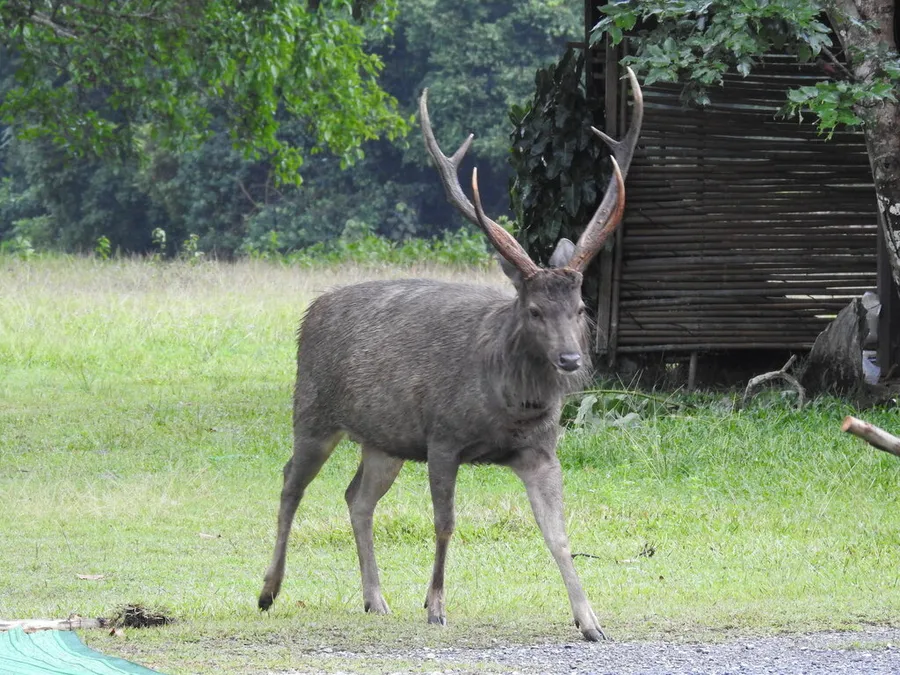
The sambar (Rusa unicolor) is Indonesia's largest deer, standing 1–1.6 m tall with a body about 1.5 m long, according to the forestry ministry's conservation directorate (KSDAE). KSDAE gives adult males as 90–125 kg and females as 80–90 kg, while Animal Diversity Web lists 109–260 kg across the species' whole range. The coat is short, coarse and dark, with paler underparts. Males have a thick neck mane and antlers with three or four tines, up to about 1 m long. It is still sometimes called Cervus unicolor. In Mandailing Natal, North Sumatra, local people call it ursa.
Evidence: Ditjen KSDAE — Menjadi Rusa Terbesar di Indonesia, Ini yang Menarik dari Rusa Sambar (2022) ↗ · Animal Diversity Web — Rusa unicolor (sambar) ↗ · Mammal Diversity Database (ASM) — Rusa unicolor, Sambar ↗
Where does the sambar live?
In Indonesia, the sambar lives only in Sumatra, Borneo and some nearby islands. The Mammal Diversity Database lists Sumatra, Borneo, Nias, Siberut, Sipora and the Pagai Islands, and Mongabay Indonesia also reports it from the Bangka Belitung Islands. Beyond Indonesia, its range stretches from India and Sri Lanka to southern China, Taiwan and Peninsular Malaysia. Sambar live on gentle and steep forested slopes, in swamp forest and in open scrub, from the lowlands to the mountains. They often forage along forest edges and in clearings.
Evidence: Mammal Diversity Database (ASM) — Rusa unicolor, Sambar ↗ · Mongabay Indonesia — Dambus dan Kelestarian Rusa Sambar di Pulau Bangka (2022) ↗ · Animal Diversity Web — Rusa unicolor (sambar) ↗
What does the sambar eat?
The sambar is a herbivore that eats grasses, understorey plants, leaves, berries, fallen fruit, buds and the bark of young trees. Animal Diversity Web notes that it feeds mainly at dusk and at night, a habit thought to have developed in response to hunting by people. KSDAE describes it, like other ruminants, feeding on grasses and low-growing plants. While foraging it may help to disperse seeds. Near villages, however, sambar sometimes damage crops.
Evidence: Animal Diversity Web — Rusa unicolor (sambar) ↗ · Ditjen KSDAE — Menjadi Rusa Terbesar di Indonesia, Ini yang Menarik dari Rusa Sambar (2022) ↗
How do sambar deer breed?
Sambar can mate at any time of year, and a female usually gives birth to a single fawn after a pregnancy of eight to nine months. According to Animal Diversity Web, a newborn weighs about 10 kg, has a brown coat with pale spots that soon fade, and stays with its mother for one to two years. Females mature at around two years old. Males live alone and become aggressive in the rutting season, while females often group with other females and their young. A male's antlers drop about a year after growing, then regrow. Sambar are also strong swimmers.
Evidence: Animal Diversity Web — Rusa unicolor (sambar) ↗ · Ditjen KSDAE — Menjadi Rusa Terbesar di Indonesia, Ini yang Menarik dari Rusa Sambar (2022) ↗
Why is the sambar threatened?
The sambar is threatened by hunting and habitat loss, and the IUCN Red List classes it as Vulnerable. In Aceh, Mongabay Indonesia reported in 2019 that hunting with snares and home-made guns was still going on. Deer meat was sold in markets and food stalls, and dried venison (dendeng) was even sold online. In September 2019, the Aceh conservation agency and a forest management unit seized 63 snares, mostly set for deer but also able to injure elephants and tigers. On Bangka Island, villagers now rarely see sambar as rivers and hills are lost to mining and large plantations.
Evidence: Mongabay Indonesia — Meski Dilindungi, Perburuan Rusa Sambar Belum Berhenti (2019) ↗ · Mongabay Indonesia — Dambus dan Kelestarian Rusa Sambar di Pulau Bangka (2022) ↗ · Ditjen KSDAE — Menjadi Rusa Terbesar di Indonesia, Ini yang Menarik dari Rusa Sambar (2022) ↗
How can the sambar be protected?
The most direct way to protect the sambar is not to hunt it, set snares or buy its meat, dendeng or antlers. Rusa unicolor is listed as a protected species under Ministerial Regulation P.106/2018. KSDAE stresses that catching, injuring, killing, keeping, transporting or trading a sambar, alive or dead, or any of its parts, is against the law. Report snares, poaching or deer meat for sale to the local BKSDA or national park office. Protecting forests also protects culture: on Bangka, the sambar inspired the shape of the dambus, a plucked lute now recognised as intangible cultural heritage.
Evidence: JDIH Kementerian Kehutanan — Permen LHK P.106/MENLHK/SETJEN/KUM.1/12/2018 tentang Jenis Tumbuhan dan Satwa yang Dilindungi (PDF, dengan lampiran) ↗ · Ditjen KSDAE — Menjadi Rusa Terbesar di Indonesia, Ini yang Menarik dari Rusa Sambar (2022) ↗ · Mongabay Indonesia — Dambus dan Kelestarian Rusa Sambar di Pulau Bangka (2022) ↗
Explore related habitats
These habitat relationships are supported by species sources in this guide. This is not a complete range map.
Scientific classification of the Sambar deer
| Kingdom | Animalia |
|---|---|
| Phylum | Chordata |
| Class | Mammalia |
| Order | Artiodactyla |
| Family | Cervidae |
| Genus | Rusa |
| Species | Rusa unicolor |
Source: GBIF Backbone Taxonomy, adjusted to the ranks commonly used in school biology (for example class Reptilia).
Common questions about the sambar deer
What is the scientific name of the sambar deer?
The scientific name of the sambar deer is Rusa unicolor, in the family Cervidae. In Indonesian it is called Rusa sambar. A former scientific name still often used: Cervus unicolor.
What kind of animal is the sambar deer?
The sambar deer is a mammal in the family Cervidae. By diet it is a herbivore (plant-eater): a browser and grazer: leaves, grass, fallen fruit and young bark.
Where does the sambar deer live in Indonesia?
In Indonesia, this guide records the sambar deer in: Sumatra, Borneo, Bangka, Nias and the Mentawai Islands.
Source-supported habitats: Tropical Rainforests.
What does the sambar deer eat?
Diet of the sambar deer: grass, understorey plants, leaves, fallen fruit and young bark. That makes it a herbivore (plant-eater). Source: Animal Diversity Web.
How does the sambar deer reproduce?
The sambar deer reproduces by giving birth to live young (viviparous). Source: Animal Diversity Web.
Is the sambar deer nocturnal?
The cited source records the sambar deer as nocturnal (active at night). Activity peaks around dusk and dawn; where hunted, sambar are more strictly nocturnal. Source: Rusa unicolor (sambar) - Animal Diversity Web, University of Michigan.
See also the list of nocturnal and diurnal animals in Indonesia.
What are the main features of the sambar deer?
Key features of the sambar deer, from this guide’s sources: Key feature: indonesia's largest deer; male antlers up to about one metre.
What is the scientific classification of the sambar deer?
Scientific classification of the sambar deer: kingdom Animalia, phylum Chordata, class Mammalia, order Artiodactyla, family Cervidae, genus Rusa, species Rusa unicolor.
Source: GBIF Backbone Taxonomy, adjusted to the ranks commonly used in school biology.
Is the sambar deer endangered?
Yes. On the IUCN Red List, the sambar deer is listed as Vulnerable: it is considered to face a high risk of extinction in the wild. Source: IUCN Red List (via GBIF), checked 1 October 2026.
This global category is separate from national legal protection. Is the sambar deer protected in Indonesia?
Is the sambar deer protected in Indonesia?
Yes. The sambar deer (Rusa unicolor) is a protected species in Indonesia under Environment and Forestry Ministerial Regulation No. P.106/MENLHK/SETJEN/KUM.1/12/2018 on protected plant and animal species (annex, entry 33).
Article 21(2) of Law No. 5 of 1990, as amended by Law No. 32 of 2024, prohibits anyone from hunting, catching, injuring, killing, storing, owning, keeping, transporting or trading a protected animal, alive or dead, including its body parts, eggs and nests.
If you see this animal being traded, kept or injured, contact the local BKSDA office.
Can the sambar deer be kept as a pet?
No. Because the sambar deer is a protected species, catching, owning, keeping, transporting or trading it without a permit is prohibited by law. Trading without a permit through electronic media is also prohibited.
If you see this animal for sale or being kept, report it to the local BKSDA office.
Sources & references
- Ditjen KSDAE — Menjadi Rusa Terbesar di Indonesia, Ini yang Menarik dari Rusa Sambar (2022) ↗
- Animal Diversity Web — Rusa unicolor (sambar) ↗
- Mammal Diversity Database (ASM) — Rusa unicolor, Sambar ↗
- Mongabay Indonesia — Dambus dan Kelestarian Rusa Sambar di Pulau Bangka (2022) ↗
- Mongabay Indonesia — Meski Dilindungi, Perburuan Rusa Sambar Belum Berhenti (2019) ↗
- JDIH Kementerian Kehutanan — Permen LHK P.106/MENLHK/SETJEN/KUM.1/12/2018 tentang Jenis Tumbuhan dan Satwa yang Dilindungi (PDF, dengan lampiran) ↗
- Animal Diversity Web ↗
- GBIF Backbone Taxonomy (GBIF) ↗
- IUCN Red List of Threatened Species, version 2026-1, via GBIF (CC BY 4.0) ↗
References can change. Check dates and context in the original source. How we use sources and data →
National parks where it is recorded
According to the official national park profiles from the KSDAE directorate. The animal may also live elsewhere.
Related causes and news
Cite this page
Credit PanduanHewan when referring to this page. Check the original evidence sources before reusing a claim.
PanduanHewan. Sambar deer (Rusa unicolor). Last substantive update: 1 October 2026. https://panduanhewan.org/en/species/sambar-deer/