Quick answer
IUCN status: Near ThreatenedPalm cockatoo at a glance
The Palm cockatoo (Probosciger aterrimus) is a bird in the family Psittacidae. Its IUCN Red List category is Near Threatened.
| Scientific name | Probosciger aterrimus |
|---|---|
| Indonesian name | Kakatua raja |
| Group | Birds |
| Family | Psittacidae |
| Range in Indonesia | Papua (including Misool) and the Aru Islands |
| Linked habitats | Tropical Rainforests, Savannas |
| Diet | Seeds, fruit, leaf buds, sometimes insects |
| Range in Indonesia | Papua, Misool and the Aru Islands |
| Key feature | Black plumage, long crest, red cheek patches |
| Other names | Goliath cockatoo, great black cockatoo, Cape York cockatoo |
| IUCN status | Near Threatened (BirdLife assessment, 2023) |
| Legal protection in Indonesia | Protected (Ministerial Regulation P.106/MENLHK/SETJEN/KUM.1/12/2018) |
| IUCN status | Near Threatened · IUCN Red List (via GBIF) · checked 25 September 2026 |
In this guide (10)
What is the palm cockatoo?
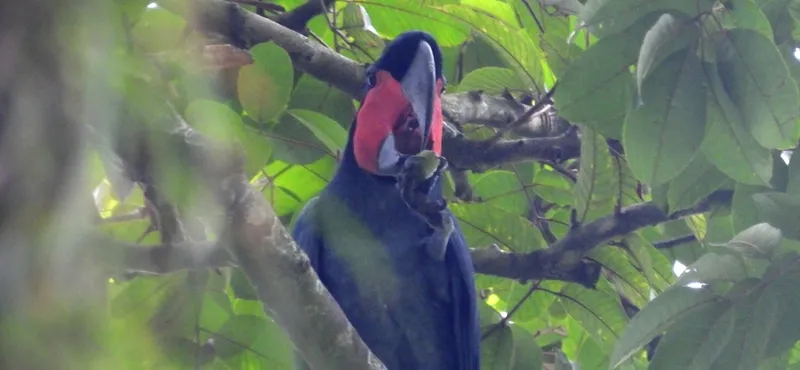
The palm cockatoo (Probosciger aterrimus) is a large black cockatoo with a long erectile crest of about 15 cm and bare red cheek patches. According to Animal Diversity Web, it measures 49–68 cm and weighs 500–1,100 g; males are usually heavier, with larger bills. Its powerful bill never closes completely, so the red tongue often shows. During courtship the male’s cheek skin usually turns deep red.
BirdLife places it in the cockatoo family, Cacatuidae. Its black plumage makes it easy to tell apart from white cockatoos such as the yellow-crested cockatoo.
Evidence: Animal Diversity Web — Probosciger aterrimus (palm cockatoo) ↗ · BirdLife International DataZone — Palm Cockatoo Probosciger aterrimus species factsheet ↗
Where does the palm cockatoo live?
In Indonesia, the palm cockatoo lives on New Guinea, including Misool and other western Papuan islands, and in the Aru Islands. Beyond Indonesia it occurs in Papua New Guinea and on the northern tip of Cape York Peninsula, Australia. BirdLife notes that in New Guinea it is widespread in the lowlands and foothills, occasionally up to 1,350 m, but is commonest below 750 m. Its habitats include rainforest, gallery forest, forest edges and monsoon woodland. It depends on forest but tolerates some degradation, and it needs large trees for nesting and roosting.
Evidence: BirdLife International DataZone — Palm Cockatoo Probosciger aterrimus species factsheet ↗ · Animal Diversity Web — Probosciger aterrimus (palm cockatoo) ↗
What does the palm cockatoo eat?
The palm cockatoo mainly eats seeds, fruit and leaf buds, and sometimes insects and their larvae. According to Animal Diversity Web, it forages mostly in the forest canopy but also drops to the ground for fallen fruit and seeds. Its large bill is used to crack hard seeds and fruit. Palm cockatoos often feed in groups, with one bird acting as a sentinel that calls an alarm if a predator appears. By eating and carrying fruit, the species also helps to disperse the seeds of many forest fruit trees.
Evidence: Animal Diversity Web — Probosciger aterrimus (palm cockatoo) ↗
Do palm cockatoos really play the drums?
Yes, male palm cockatoos really do drum, striking home-made sticks against trunks or tree hollows while displaying to females. They make the sticks from thick twigs or seed pods. Heinsohn and colleagues (2017) analysed 131 drumming sequences by 18 wild males on Cape York Peninsula, Australia. The beats were regularly spaced, and each male had his own drumming style. The researchers concluded that the drumming shares key elements of human instrumental music, including making a sound tool and keeping a regular beat. According to Sci-News, the sound carries up to about 100 m, and drumming is also used to advertise territory.
Evidence: PubMed — Heinsohn et al. 2017, Tool-assisted rhythmic drumming in palm cockatoos shares key elements of human instrumental music, Science Advances ↗ · Sci-News — Male Palm Cockatoos Play Drums to Attract Mates (2017) ↗ · Animal Diversity Web — Probosciger aterrimus (palm cockatoo) ↗
Why is the palm cockatoo threatened by the wildlife trade?
The palm cockatoo is threatened by trapping for the pet trade and by forest loss, and it breeds very slowly. BirdLife assessed it as Near Threatened in 2023 and suspects a population decline of 20–29% over three generations (47 years). Females lay a single egg per nest, and at one site in Papua New Guinea pairs were estimated to nest only once every six years. According to Animal Diversity Web, chicks take 100–110 days to fledge. Even low levels of trapping, especially of adults, can therefore have a large impact, and new roads are opening forests to trappers.
Evidence: BirdLife International DataZone — Palm Cockatoo Probosciger aterrimus species factsheet ↗ · Animal Diversity Web — Probosciger aterrimus (palm cockatoo) ↗
How can the palm cockatoo be protected?
The palm cockatoo is listed as a protected species in the annex to Indonesian Ministerial Regulation P.106/MENLHK/SETJEN/KUM.1/12/2018 and is on CITES Appendix I, the strictest level of international trade control. The most direct way to help is not to buy, keep or accept wild-caught palm cockatoos. Large old trees should be kept, because the species needs deep tree hollows for nesting. BirdLife stresses the need to enforce the CITES listing, monitor trade and track forest cover in New Guinea. If you see palm cockatoos for sale, report it to local conservation officers.
Evidence: JDIH Kemenko Infrastruktur — Permen LHK No. P.106/MENLHK/SETJEN/KUM.1/12/2018 tentang Jenis Tumbuhan dan Satwa yang Dilindungi (PDF) ↗ · BirdLife International DataZone — Palm Cockatoo Probosciger aterrimus species factsheet ↗
Explore related habitats
These habitat relationships are supported by species sources in this guide. This is not a complete range map.
Common questions about the Palm cockatoo
What is the scientific name of the Palm cockatoo?
The scientific name of the Palm cockatoo is Probosciger aterrimus, in the family Psittacidae. In Indonesian it is called Kakatua raja.
Where can the Palm cockatoo be found in Indonesia?
In Indonesia, this guide records the Palm cockatoo in: Papua (including Misool) and the Aru Islands.
Source-supported habitats: Tropical Rainforests, Savannas.
What does the Palm cockatoo eat?
Diet of the Palm cockatoo: seeds, fruit, leaf buds, sometimes insects.
What is the conservation status of the Palm cockatoo?
On the IUCN Red List, the Palm cockatoo is listed as Near Threatened: it is close to qualifying, or likely to qualify, for a threatened category in the near future. Source: IUCN Red List (via GBIF), checked 25 September 2026.
This global category is separate from legal protection in Indonesia. To check whether the Palm cockatoo is a protected species, consult the current national list of protected species or contact the local BKSDA (natural resources conservation office).
Sources & references
- BirdLife International DataZone — Palm Cockatoo Probosciger aterrimus species factsheet ↗
- Animal Diversity Web — Probosciger aterrimus (palm cockatoo) ↗
- PubMed — Heinsohn et al. 2017, Tool-assisted rhythmic drumming in palm cockatoos shares key elements of human instrumental music, Science Advances ↗
- Sci-News — Male Palm Cockatoos Play Drums to Attract Mates (2017) ↗
- JDIH Kemenko Infrastruktur — Permen LHK No. P.106/MENLHK/SETJEN/KUM.1/12/2018 tentang Jenis Tumbuhan dan Satwa yang Dilindungi (PDF) ↗
- IUCN Red List of Threatened Species, version 2026-1, via GBIF (CC BY 4.0) ↗
References can change. Check dates and context in the original source.
Further reading
Palm cockatoo: facts, threats and conservation ↗ — World Animal Rescue Network.
Cite this page
PanduanHewan. (2026, 25 September). Palm cockatoo (Probosciger aterrimus). PanduanHewan.org. https://panduanhewan.org/en/species/palm-cockatoo/