Quick answer
IUCN status: Least ConcernNew Guinea crocodile at a glance
The New Guinea crocodile (Crocodylus novaeguineae) is a reptile in the family Crocodylidae. Range in Indonesia: Papua, mainly freshwater rivers, lakes and swamps such as the Mamberamo basin. Diet: fish, waterbirds, frogs and reptiles; young eat insects; a carnivore. IUCN Red List status: Least Concern. It is a legally protected species in Indonesia (Regulation P.106/2018).
| Scientific name | Crocodylus novaeguineae |
|---|---|
| Indonesian name | Buaya irian |
| Group | Reptiles |
| Family | Crocodylidae |
| Range in Indonesia | Papua, mainly freshwater rivers, lakes and swamps such as the Mamberamo basin |
| Linked habitats | Freshwater Wetlands |
| Diet | Fish, waterbirds, frogs and reptiles; young eat insects |
| Range in Indonesia | Papua, including Kimaam Island |
| Key feature | Fairly narrow snout, dark bands on body and tail |
| Risk to people | Large predator up to 3.5 m; do not approach |
| Other names | New Guinea freshwater crocodile, buaya nugini, pukpuk |
| IUCN status | Least Concern · IUCN Red List (via GBIF) · checked 1 October 2026 |
| Legal protection in Indonesia | Protected · Regulation P.106/2018 · annex no. 705 |
| Diet type | Carnivore (meat-eater) — predator of fish, waterbirds, frogs and reptiles; young eat insects and aquatic invertebrates · Crocodilian Species List (IUCN Crocodile Specialist Group) |
| Reproduction | Laying eggs (oviparous) · Reptile Database |
| Venom or poison | Not venomous · Animal Diversity Web: Crocodylus novaeguineae |
| Active | Nocturnal (active at night) · Crocodilian Species List (IUCN Crocodile Specialist Group) |
In this guide (11)
What is the New Guinea crocodile?
The New Guinea crocodile (Crocodylus novaeguineae) is a medium-sized freshwater crocodile found only on the island of New Guinea. According to the IUCN Crocodile Specialist Group (CSG), the largest documented adults are about 3 m for females and 3.5 m for males.
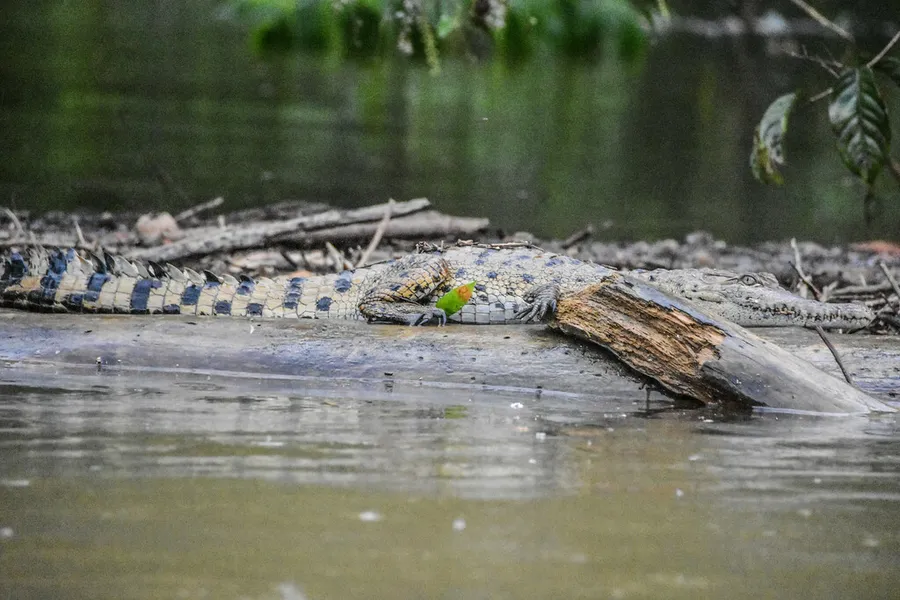
Its snout is fairly narrow. The body is brownish to grey, with dark bands on the body and tail that are clearer in young animals. The Philippine crocodile (C. mindorensis) was once treated as its subspecies but is now recognised as a separate species. In 2019, Murray and colleagues also split the populations south of Papua New Guinea's central highlands off as a new species, Crocodylus halli.
Evidence: IUCN Crocodile Specialist Group — Cox (2010), New Guinea Freshwater Crocodile Crocodylus novaeguineae, in Crocodiles: Status Survey and Conservation Action Plan, 3rd ed., pp. 90–93 ↗ · Crocodilians: Natural History & Conservation (Britton) — New Guinea Crocodile (Crocodylus novaeguineae) ↗ · Copeia 107(3) — Murray, Russo, Zorrilla & McMahan (2019), Crocodylus halli new species, taxonomic treatment via Plazi/Zenodo ↗
Where does the New Guinea crocodile live?
The New Guinea crocodile lives only on New Guinea, in Papua New Guinea and Indonesian Papua, and on Kimaam Island off south-western Papua. It is probably extinct in the Aru Islands, according to The Reptile Database.
According to the CSG, it lives in freshwater rivers, swamps and lakes. Researcher Scott Frazier, quoted by Jubi, places it in rivers, swamps and lakes north of the Jayawijaya Mountains, including the Mamberamo basin. Since C. halli was described from drainages south of Papua New Guinea's central highlands, the status of freshwater crocodiles in southern Indonesian Papua has not been clearly addressed in the sources we checked.
Evidence: The Reptile Database — Crocodylus novaeguineae SCHMIDT, 1928 ↗ · IUCN Crocodile Specialist Group — Cox (2010), New Guinea Freshwater Crocodile Crocodylus novaeguineae, in Crocodiles: Status Survey and Conservation Action Plan, 3rd ed., pp. 90–93 ↗ · Jubi (2026) — Mengenal jenis buaya di Tanah Papua ↗
What does the New Guinea crocodile eat?
The New Guinea crocodile is an opportunistic predator that hunts mainly at night. It eats fish, waterbirds such as rails and grebes, and other vertebrates such as frogs and reptiles, according to the Crocodilians: Natural History & Conservation site.
Its diet changes with age. According to Animal Diversity Web (ADW), hatchlings eat mosquitoes, grasshoppers, water bugs and other aquatic invertebrates, while small juveniles feed heavily on schools of small fish. Adults have been reported eating insects, fish, frogs, turtles, water snakes, lizards, rails, grebes and ducks. As an apex predator, it helps keep freshwater ecosystems in balance.
Evidence: Crocodilians: Natural History & Conservation (Britton) — New Guinea Crocodile (Crocodylus novaeguineae) ↗ · Animal Diversity Web — Crocodylus novaeguineae, New Guinea crocodile ↗
How does the New Guinea crocodile breed?
The New Guinea crocodile lays its eggs in mound nests built from vegetation. According to the CSG, females mature at 1.6–2.0 m long. Northern populations nest in the dry season (August–October), usually on floating mats of vegetation in overgrown channels and lake edges.
Northern females lay more but smaller eggs, about 22–45 per nest according to the Crocodilians site. Southern populations nest on land in the wet season, with fewer, larger eggs, a difference that helped justify splitting southern Papua New Guinea populations off as C. halli. Eggs hatch after about 80 days, and both parents have been reported helping to open the nest and carry the young to water.
Evidence: IUCN Crocodile Specialist Group — Cox (2010), New Guinea Freshwater Crocodile Crocodylus novaeguineae, in Crocodiles: Status Survey and Conservation Action Plan, 3rd ed., pp. 90–93 ↗ · Crocodilians: Natural History & Conservation (Britton) — New Guinea Crocodile (Crocodylus novaeguineae) ↗ · Copeia 107(3) — Murray, Russo, Zorrilla & McMahan (2019), Crocodylus halli new species, taxonomic treatment via Plazi/Zenodo ↗
Is the New Guinea crocodile dangerous, and how does it differ from the saltwater crocodile?
The New Guinea crocodile is much smaller and tends to be shyer than the saltwater crocodile (Crocodylus porosus), but it is still a large predator. ADW records no known harm to people from this species.
According to Jubi, New Guinea crocodiles are usually 1.5–2.5 m long with a slender snout and darker skin, while saltwater crocodiles reach 5–7 m and have killed people in Mimika and Jayapura. The two are hard to tell apart at a distance, so treat every crocodile as dangerous: keep away, do not catch, feed or kill it, and ask conservation officers (BKSDA) for help. If bitten, seek medical care at a health facility immediately.
Evidence: Jubi (2026) — Mengenal jenis buaya di Tanah Papua ↗ · Animal Diversity Web — Crocodylus novaeguineae, New Guinea crocodile ↗ · Crocodilians: Natural History & Conservation (Britton) — New Guinea Crocodile (Crocodylus novaeguineae) ↗
How can the New Guinea crocodile be protected?
The New Guinea crocodile is entry 705 in the annex to Regulation P.106/2018 and is on CITES Appendix II. According to the CSG, after widespread illegal hunting and skin smuggling, Indonesia introduced permits, skin tags, size limits and, from 1998, harvest quotas.
The main threats are illegal hunting and habitat damage. At Lake Sentani, researcher Hari Suroto records hunters burning scrub and poisoning channels with tuba root, which also harms sago forest and fish. For clans with a crocodile totem in Dondai village, eating the animal is taboo. People can help by not buying crocodile products without official documents and by reporting illegal hunting to BBKSDA Papua.
Evidence: JDIH Kementerian Kehutanan — Lampiran Permen LHK P.106/MENLHK/SETJEN/KUM.1/12/2018 tentang Jenis Tumbuhan dan Satwa yang Dilindungi ↗ · IUCN Crocodile Specialist Group — Cox (2010), New Guinea Freshwater Crocodile Crocodylus novaeguineae, in Crocodiles: Status Survey and Conservation Action Plan, 3rd ed., pp. 90–93 ↗ · Mongabay Indonesia (2021) — Dilindungi dan Dihormati, Buaya Endemik Papua Ini Masih Diburu ↗
Explore related habitats
These habitat relationships are supported by species sources in this guide. This is not a complete range map.
Scientific classification of the New Guinea crocodile
| Kingdom | Animalia |
|---|---|
| Phylum | Chordata |
| Class | Reptilia |
| Order | Crocodylia |
| Family | Crocodylidae |
| Genus | Crocodylus |
| Species | Crocodylus novaeguineae |
Source: GBIF Backbone Taxonomy, adjusted to the ranks commonly used in school biology (for example class Reptilia).
Common questions about the New Guinea crocodile
What is the scientific name of the New Guinea crocodile?
The scientific name of the New Guinea crocodile is Crocodylus novaeguineae, in the family Crocodylidae. In Indonesian it is called Buaya irian.
What kind of animal is the New Guinea crocodile?
The New Guinea crocodile is a reptile in the family Crocodylidae. By diet it is a carnivore (meat-eater): a predator of fish, waterbirds, frogs and reptiles; young eat insects and aquatic invertebrates.
Where does the New Guinea crocodile live in Indonesia?
In Indonesia, this guide records the New Guinea crocodile in: Papua, mainly freshwater rivers, lakes and swamps such as the Mamberamo basin.
Source-supported habitats: Freshwater Wetlands.
What does the New Guinea crocodile eat?
Diet of the New Guinea crocodile: fish, waterbirds, frogs and reptiles; young eat insects. That makes it a carnivore (meat-eater). Source: Crocodilian Species List (IUCN Crocodile Specialist Group).
How does the New Guinea crocodile reproduce?
The New Guinea crocodile reproduces by laying eggs (oviparous). Source: Reptile Database.
Is the New Guinea crocodile venomous?
No. The New Guinea crocodile is not venomous. Not venomous; no adverse effects are recorded, but as a large crocodile its bite can still cause injury. Source: Animal Diversity Web: Crocodylus novaeguineae.
Do not catch, handle or disturb wild animals. If bitten, stung or exposed to its toxins, go to the nearest health facility straight away.
Is the New Guinea crocodile nocturnal?
Yes. The New Guinea crocodile is nocturnal (active at night). Source: Crocodilian Species List (IUCN Crocodile Specialist Group).
See also the list of nocturnal and diurnal animals in Indonesia.
What are the main features of the New Guinea crocodile?
Key features of the New Guinea crocodile, from this guide’s sources: Key feature: fairly narrow snout, dark bands on body and tail.
Is the New Guinea crocodile dangerous to people?
Large predator up to 3.5 m; do not approach.
Do not approach, catch or handle wild animals. If you are injured or bitten, get medical care at a health facility straight away.
What is the scientific classification of the New Guinea crocodile?
Scientific classification of the New Guinea crocodile: kingdom Animalia, phylum Chordata, class Reptilia, order Crocodylia, family Crocodylidae, genus Crocodylus, species Crocodylus novaeguineae.
Source: GBIF Backbone Taxonomy, adjusted to the ranks commonly used in school biology.
Is the New Guinea crocodile endangered?
No, according to the global IUCN assessment. On the IUCN Red List, the New Guinea crocodile is listed as Least Concern: it does not qualify for a threatened category or for Near Threatened in the global assessment. Source: IUCN Red List (via GBIF), checked 1 October 2026.
This global category is separate from national legal protection. Is the New Guinea crocodile protected in Indonesia?
Is the New Guinea crocodile protected in Indonesia?
Yes. The New Guinea crocodile (Crocodylus novaeguineae) is a protected species in Indonesia under Environment and Forestry Ministerial Regulation No. P.106/MENLHK/SETJEN/KUM.1/12/2018 on protected plant and animal species (annex, entry 705).
Article 21(2) of Law No. 5 of 1990, as amended by Law No. 32 of 2024, prohibits anyone from hunting, catching, injuring, killing, storing, owning, keeping, transporting or trading a protected animal, alive or dead, including its body parts, eggs and nests.
If you see this animal being traded, kept or injured, contact the local BKSDA office.
Can the New Guinea crocodile be kept as a pet?
No. Because the New Guinea crocodile is a protected species, catching, owning, keeping, transporting or trading it without a permit is prohibited by law. Trading without a permit through electronic media is also prohibited.
If you see this animal for sale or being kept, report it to the local BKSDA office.
Compare with similar animals
Sources & references
- The Reptile Database — Crocodylus novaeguineae SCHMIDT, 1928 ↗
- IUCN Crocodile Specialist Group — Cox (2010), New Guinea Freshwater Crocodile Crocodylus novaeguineae, in Crocodiles: Status Survey and Conservation Action Plan, 3rd ed., pp. 90–93 ↗
- Crocodilians: Natural History & Conservation (Britton) — New Guinea Crocodile (Crocodylus novaeguineae) ↗
- Animal Diversity Web — Crocodylus novaeguineae, New Guinea crocodile ↗
- Copeia 107(3) — Murray, Russo, Zorrilla & McMahan (2019), Crocodylus halli new species, taxonomic treatment via Plazi/Zenodo ↗
- Mongabay Indonesia (2021) — Dilindungi dan Dihormati, Buaya Endemik Papua Ini Masih Diburu ↗
- Jubi (2026) — Mengenal jenis buaya di Tanah Papua ↗
- JDIH Kementerian Kehutanan — Lampiran Permen LHK P.106/MENLHK/SETJEN/KUM.1/12/2018 tentang Jenis Tumbuhan dan Satwa yang Dilindungi ↗
- GBIF Backbone Taxonomy (GBIF) ↗
- IUCN Red List of Threatened Species, version 2026-1, via GBIF (CC BY 4.0) ↗
References can change. Check dates and context in the original source.
Cite this page
PanduanHewan. (2026, 1 October). New Guinea crocodile (Crocodylus novaeguineae). PanduanHewan.org. https://panduanhewan.org/en/species/new-guinea-crocodile/