
Quick answer
IUCN status: ExtinctBali tiger at a glance
The Bali tiger (Panthera tigris balica) is a mammal in the family Felidae. Range in Indonesia: Bali (extinct). Diet: wild pig, deer, muntjac, monkeys, also livestock. IUCN Red List status: Extinct.
| Scientific name | Panthera tigris balica |
|---|---|
| Indonesian name | Harimau Bali |
| Group | Mammals |
| Family | Felidae |
| Range in Indonesia | Bali (extinct) |
| Diet | Wild pig, deer, muntjac, monkeys, also livestock |
| Range in Indonesia | Mountains and forests of western Bali (Buleleng, Jembrana) |
| Key feature | Described as the smallest tiger subspecies |
| Last record | Late 1930s in western Bali (last positive record, IUCN) |
| IUCN status | Extinct (2008 assessment, needs updating) |
| Other names | Harimau bali, Balinese tiger |
| IUCN status | Extinct · IUCN Red List — Panthera tigris ssp. balica (Jackson & Nowell 2008) · assessment 2008-06-30 |
In this guide (12)
What was the Bali tiger?
The Bali tiger once lived on Bali and is now extinct. The IUCN lists Panthera tigris ssp. balica as Extinct, based on a 2008 assessment that it now flags as needing an update. WildCats Conservation Alliance describes it as the smallest tiger subspecies.
Its classification is still debated. The IUCN Cat Specialist Group’s 2017 taxonomic revision groups the Bali, Javan and Sumatran tigers in one subspecies, P. t. sondaica, mainly on the basis of a study by Wilting and colleagues (2015). The same revision notes that Luo and Driscoll, citing a genetic study by Xue and colleagues (2015), provisionally keep the three as separate subspecies.
Evidence: IUCN Red List — Panthera tigris ssp. balica (Jackson & Nowell 2008) ↗ · IUCN SSC Cat Specialist Group — Kitchener et al. (2017), A revised taxonomy of the Felidae, Cat News Special Issue 11 ↗ · WildCats Conservation Alliance — Bali tiger facts ↗
Where did the Bali tiger live?
The Bali tiger lived only on Bali, in the mountains and forests of the island’s west. A historical study by BRIN researchers in the journal Purbawidya (2024), based on European accounts from the 19th and early 20th centuries, concludes that its habitat was limited to what are now the Buleleng and Jembrana regencies. The study also notes that Bali seems to have had only one big cat, the tiger; leopards like Java’s were not found there.
According to the IUCN, West Bali National Park was established in tiger habitat. The KSDAE directorate general’s profile places the park in Jembrana and Buleleng regencies, Bali Province.
Evidence: Purbawidya (BRIN) — Wiryandara, Nugroho & Harriyadi (2024), Perburuan Harimau di Bali pada Awal Abad XX Berdasarkan Sumber-Sumber Kolonial ↗ · IUCN Red List — Panthera tigris ssp. balica (Jackson & Nowell 2008) ↗ · Ditjen KSDAE Kementerian Kehutanan — Profil Taman Nasional Bali Barat ↗
What did the Bali tiger eat?
The Bali tiger hunted forest animals such as wild pig, rusa deer and muntjac. According to WildCats Conservation Alliance, its prey also included red junglefowl, monitor lizards and monkeys, and banteng may have been an important prey species. Writing about his 1906 journey, the Dutch artist W.O.J. Nieuwenkamp described West Bali as densely forested country inhabited by wild pigs, deer, snakes and tigers.
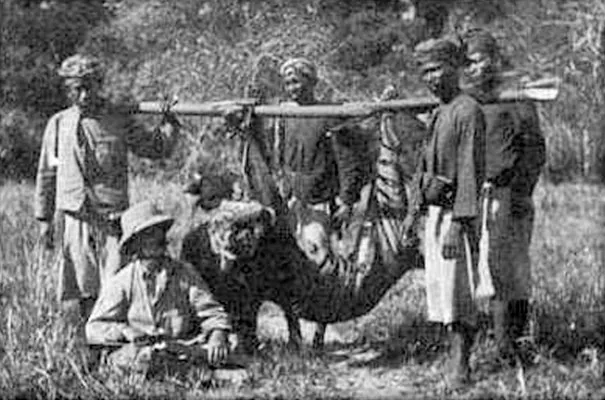
As plantations spread, tigers also took livestock. The Purbawidya study cites a 1926 newspaper report that tigers killed 40 cattle, 4 horses and 80 goats during 1925; the report described tigers as a pest disrupting plantations in West Bali.
Evidence: WildCats Conservation Alliance — Bali tiger facts ↗ · Purbawidya (BRIN) — Wiryandara, Nugroho & Harriyadi (2024), Perburuan Harimau di Bali pada Awal Abad XX Berdasarkan Sumber-Sumber Kolonial ↗
When did the Bali tiger become extinct?
The Bali tiger’s extinction date is unknown; estimates range from the late 1930s to the early 1950s. The IUCN says tigers were last positively recorded in western Bali in the late 1930s and probably died out by the end of the Second World War, possibly as late as the early 1950s. WildCats Conservation Alliance says the last known individual, an adult female, was killed on 27 September 1937.
However, the Purbawidya study cites a newspaper report of a tiger shot at Gondol in November 1938, and missionary J. Kersten’s mention of tigers in Jembrana’s forests in 1940. Boomgaard (2008), cited in the study, dates the extinction to the 1940s.
Evidence: IUCN Red List — Panthera tigris ssp. balica (Jackson & Nowell 2008) ↗ · WildCats Conservation Alliance — Bali tiger facts ↗ · Purbawidya (BRIN) — Wiryandara, Nugroho & Harriyadi (2024), Perburuan Harimau di Bali pada Awal Abad XX Berdasarkan Sumber-Sumber Kolonial ↗
Why did the Bali tiger die out?
The Bali tiger died out mainly because of hunting, forest loss and a shrinking prey base. The Purbawidya study (2024) links the extinction to the Dutch colonial conquest of Bali: private plantations opened in West Bali, conflict with tigers grew and tigers were treated as pests. Colonial records cited in the study suggest the bounty per tiger shot in Buleleng rose from ƒ60 in 1880 to about ƒ125 in 1886, if a newspaper report of the time is accurate.
Boomgaard (2008), cited in the study, estimates that Bali had at most 125 tigers in the early 20th century, and that a few hunters shot over 40 of them in 1913–1918.
Evidence: Purbawidya (BRIN) — Wiryandara, Nugroho & Harriyadi (2024), Perburuan Harimau di Bali pada Awal Abad XX Berdasarkan Sumber-Sumber Kolonial ↗ · IUCN SSC Cat Specialist Group — Living species: Tiger ↗ · WildCats Conservation Alliance — Bali tiger facts ↗
What can we learn from the Bali tiger's extinction?
The main lesson is that a small island population can vanish within a few decades when hunting and forest clearance go unchecked. The Purbawidya study concludes that a small population and unchecked hunting sped up the Bali tiger’s extinction, and WildCats Conservation Alliance notes there was no concerted conservation effort at the time. Today, according to the IUCN assessment published in 2022, Indonesia’s only wild tigers are on Sumatra.
The Bali tiger cannot be brought back, but other animals can be spared the same fate. Do not buy skins, teeth or other wildlife parts, and report poaching or wildlife trade to the local BKSDA or forest police.
Evidence: Purbawidya (BRIN) — Wiryandara, Nugroho & Harriyadi (2024), Perburuan Harimau di Bali pada Awal Abad XX Berdasarkan Sumber-Sumber Kolonial ↗ · WildCats Conservation Alliance — Bali tiger facts ↗ · IUCN Red List — Panthera tigris, Tiger (Goodrich et al. 2022) ↗
Scientific classification of the Bali tiger
| Kingdom | Animalia |
|---|---|
| Phylum | Chordata |
| Class | Mammalia |
| Order | Carnivora |
| Family | Felidae |
| Genus | Panthera |
| Species | Panthera tigris |
| Subspecies | Panthera tigris balica |
Source: GBIF Backbone Taxonomy, adjusted to the ranks commonly used in school biology (for example class Reptilia).
Common questions about the Bali tiger
What is the scientific name of the Bali tiger?
The scientific name of the Bali tiger is Panthera tigris balica, in the family Felidae. In Indonesian it is called Harimau Bali.
Where does the Bali tiger live in Indonesia?
In Indonesia, this guide records the Bali tiger in: Bali (extinct).
What does the Bali tiger eat?
Diet of the Bali tiger: wild pig, deer, muntjac, monkeys, also livestock.
What are the main features of the Bali tiger?
Key features of the Bali tiger, from this guide’s sources: Key feature: described as the smallest tiger subspecies.
What is the scientific classification of the Bali tiger?
Scientific classification of the Bali tiger: kingdom Animalia, phylum Chordata, class Mammalia, order Carnivora, family Felidae, genus Panthera, species Panthera tigris, subspecies Panthera tigris balica.
Source: GBIF Backbone Taxonomy, adjusted to the ranks commonly used in school biology.
Is the Bali tiger endangered?
The global conservation status of the Bali tiger: Extinct (assessment or source update 2008-06-30). In the IUCN system, this category means there is no reasonable doubt that the last individual has died. The IUCN flags this assessment ‘Needs updating’ and has published no newer assessment for the Bali population. The 2017 Cat Specialist Group revision places the Bali tiger in P. t. sondaica, but the same document notes that some researchers provisionally keep it separate. The species-level tiger assessment published in 2022 records the tiger as extinct on Bali and says tiger taxonomy is under review. Source: IUCN Red List — Panthera tigris ssp. balica (Jackson & Nowell 2008).
This global category is separate from legal protection in Indonesia. To check whether the Bali tiger is a protected species, consult the current national list of protected species or contact the local BKSDA (natural resources conservation office).
Sources & references
- IUCN Red List — Panthera tigris ssp. balica (Jackson & Nowell 2008) ↗
- IUCN SSC Cat Specialist Group — Kitchener et al. (2017), A revised taxonomy of the Felidae, Cat News Special Issue 11 ↗
- IUCN SSC Cat Specialist Group — Living species: Tiger ↗
- WildCats Conservation Alliance — Bali tiger facts ↗
- Purbawidya (BRIN) — Wiryandara, Nugroho & Harriyadi (2024), Perburuan Harimau di Bali pada Awal Abad XX Berdasarkan Sumber-Sumber Kolonial ↗
- Ditjen KSDAE Kementerian Kehutanan — Profil Taman Nasional Bali Barat ↗
- IUCN Red List — Panthera tigris, Tiger (Goodrich et al. 2022) ↗
- GBIF Backbone Taxonomy (GBIF) ↗
References can change. Check dates and context in the original source. How we use sources and data →
Cite this page
Credit PanduanHewan when referring to this page. Check the original evidence sources before reusing a claim.
PanduanHewan. Bali tiger (Panthera tigris balica). Last substantive update: 14 October 2026. https://panduanhewan.org/en/species/bali-tiger/