Quick answer
IUCN status: Least ConcernAgile wallaby at a glance
The agile wallaby (Notamacropus agilis) is a mammal in the family Macropodidae. Range in Indonesia: Southern Papua (Merauke). Diet: grass, shrubs, leaves, fruit; digs for roots in drought. IUCN Red List status: Least Concern.
| Scientific name | Notamacropus agilis |
|---|---|
| Indonesian name | Walabi lincah |
| Group | Mammals |
| Family | Macropodidae |
| Range in Indonesia | Southern Papua (Merauke) |
| Linked habitats | Savannas |
| Diet | Grass, shrubs, leaves, fruit; digs for roots in drought |
| Range in Indonesia | Lowland savannas of southern Papua, including Wasur National Park |
| Key feature | Yellowish-brown with white cheek and hip stripes |
| Weight | Males average 20 kg, females 12 kg (Animal Diversity Web) |
| Other names | Kanguru lincah, Macropus agilis (former name) |
| IUCN status | Least Concern · IUCN Red List — Notamacropus agilis, Agile Wallaby (Aplin et al. 2016) · assessment 2015-06-15 |
In this guide (12)
What is the agile wallaby?
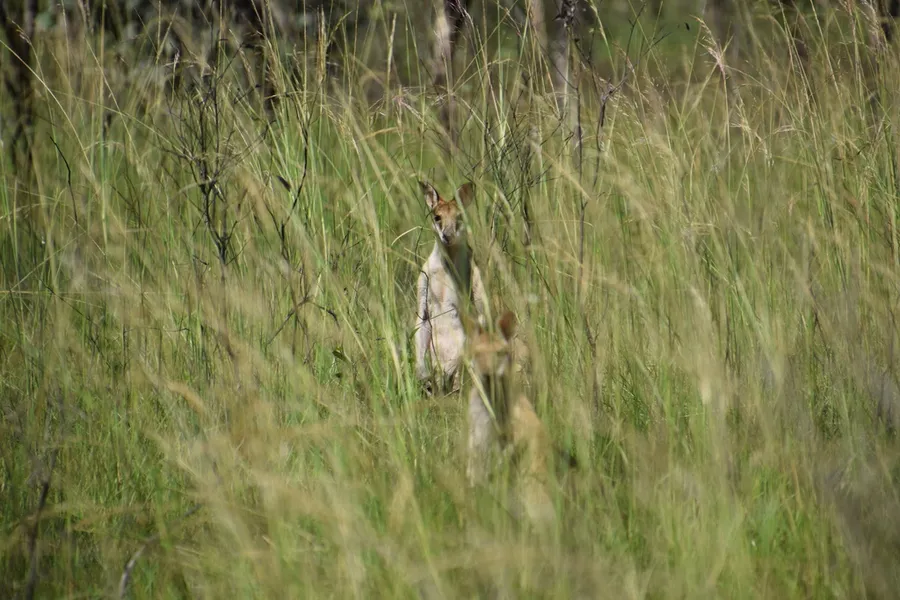
The agile wallaby is a marsupial, a pouched mammal of the kangaroo family. According to Animal Diversity Web, it is yellowish-brown with a white cheek stripe and usually a white stripe near the hip; males average 20 kg and females 12 kg. People in Merauke call wallabies kangaroos, and in the Marind Anim language a kangaroo is called saham (Kompas).
Its scientific name is now Notamacropus agilis. The Mammal Diversity Database records its move from the genus Macropus to Notamacropus, and the IUCN also uses the new name. Several Indonesian sources still use the older names Macropus agilis or Macropus agilis papuanus.
Evidence: Animal Diversity Web — Macropus agilis (agile wallaby) ↗ · Mammal Diversity Database — Notamacropus agilis, Agile Wallaby ↗ · Kompas (2022) — ‘Saham’ Diburu, Hilang Kanguru (Ekspedisi Tanah Papua) ↗
Where does the agile wallaby live?
In Indonesia, the agile wallaby lives in the lowland savannas and grasslands of southern Papua. The IUCN records it in the lowlands of southern New Guinea (Indonesia and Papua New Guinea) and in northern Australia. In Wasur National Park, Merauke, park office data cited by Kompas list three wallaby species: Macropus agilis, Dorcopsis veterum and Thylogale brunii.
A study in the mixed Udi-Udi savanna of Wasur National Park in April–May 2008 found an average density of 0.67 wallabies per hectare, highest in the transition zone between savanna and mixed forest (Media Konservasi, IPB).
Evidence: IUCN Red List — Notamacropus agilis, Agile Wallaby (Aplin et al. 2016) ↗ · Kompas (2022) — ‘Saham’ Diburu, Hilang Kanguru (Ekspedisi Tanah Papua) ↗ · Media Konservasi (IPB) — Santosa & Sitorus, Pendugaan parameter demografi dan pola penyebaran spasial walabi lincah (Macropus agilis papuanus) di Taman Nasional Wasur (vol. 13 no. 2) ↗
What does the agile wallaby eat?
The agile wallaby is a herbivore that mainly eats grass. Animal Diversity Web describes it as a flexible feeder: in the wet season it eats a range of native grasses, shrubs and bushes, as well as leaves and fruit. In dry times it widens its feeding range and digs into the soil for moisture-rich roots.
A Wasur National Park office study of a 16-hectare sanctuary enclosure found 14 grass species available as food, dominated by alang-alang (Imperata cylindrica), Aristida cumingiana, Fimbristylis and Paspalum (Jurnal Kehutanan Papuasia, UNIPA).
Evidence: Animal Diversity Web — Macropus agilis (agile wallaby) ↗ · Jurnal Kehutanan Papuasia (UNIPA) — La Hisa (2022), Potensi dan Daya Dukung Pakan di Kandang Sanctuary Wallaby Lincah (Macropus agilis papuanus) di Taman Nasional Wasur ↗
How does the agile wallaby live and breed?
Agile wallabies live in groups and are mainly active at night. According to Animal Diversity Web, groups usually hold up to 10 animals, but larger gatherings can form when feeding. The IUCN adds that the wallabies shelter in dense vegetation.
Females give birth to a single young after a pregnancy of about 30 days. The newborn travels to the mother’s pouch and stays there for about seven to eight months (Animal Diversity Web). A study in Wasur’s Udi-Udi savanna found a ratio of adult males to females of about 1:1 (Media Konservasi, IPB).
Evidence: Animal Diversity Web — Macropus agilis (agile wallaby) ↗ · IUCN Red List — Notamacropus agilis, Agile Wallaby (Aplin et al. 2016) ↗ · Media Konservasi (IPB) — Santosa & Sitorus, Pendugaan parameter demografi dan pola penyebaran spasial walabi lincah (Macropus agilis papuanus) di Taman Nasional Wasur (vol. 13 no. 2) ↗
Why are agile wallabies harder to find around Merauke?
Overhunting has made agile wallabies harder to find around Merauke. Kompas (2022) reported that ‘kangaroos’, as local people call wallabies, were easy to see in the savannas around Merauke until the early 2000s but have now vanished from many places. The IUCN rates the species Least Concern globally, though declining, and lists hunting for meat as a local threat in the south-east of its New Guinea range.
The Trans-Papua road through Wasur National Park has eased access for hunters. Some use guns or dazzle animals with torches, and wallaby meat is sold in Merauke’s market (Kompas). Jurnal Kehutanan Papuasia also notes reports that the Wasur population is declining.
Evidence: Kompas (2022) — ‘Saham’ Diburu, Hilang Kanguru (Ekspedisi Tanah Papua) ↗ · IUCN Red List — Notamacropus agilis, Agile Wallaby (Aplin et al. 2016) ↗ · Jurnal Kehutanan Papuasia (UNIPA) — La Hisa (2022), Potensi dan Daya Dukung Pakan di Kandang Sanctuary Wallaby Lincah (Macropus agilis papuanus) di Taman Nasional Wasur ↗
How can the agile wallaby be protected?
Agile wallabies can be protected by limiting hunting and conserving the savannas they live in. According to Kompas, hunting in Wasur National Park is allowed only by traditional means such as bows or spears, in small numbers for family food. The IPB study names hunting and the invasion of pure savanna by Melaleuca and Eucalyptus as management problems in Wasur.
A semi-natural sanctuary enclosure has also been built in Wasur National Park to build up a stock of animals that can be released (Jurnal Kehutanan Papuasia). Do not buy live wallabies, and report hunting with guns or torches to park staff.
Evidence: Kompas (2022) — ‘Saham’ Diburu, Hilang Kanguru (Ekspedisi Tanah Papua) ↗ · Media Konservasi (IPB) — Santosa & Sitorus, Pendugaan parameter demografi dan pola penyebaran spasial walabi lincah (Macropus agilis papuanus) di Taman Nasional Wasur (vol. 13 no. 2) ↗ · Jurnal Kehutanan Papuasia (UNIPA) — La Hisa (2022), Potensi dan Daya Dukung Pakan di Kandang Sanctuary Wallaby Lincah (Macropus agilis papuanus) di Taman Nasional Wasur ↗
Explore related habitats
These habitat relationships are supported by species sources in this guide. This is not a complete range map.
Scientific classification of the Agile wallaby
| Kingdom | Animalia |
|---|---|
| Phylum | Chordata |
| Class | Mammalia |
| Order | Diprotodontia |
| Family | Macropodidae |
| Genus | Notamacropus |
| Species | Notamacropus agilis |
Source: GBIF Backbone Taxonomy, adjusted to the ranks commonly used in school biology (for example class Reptilia).
Common questions about the agile wallaby
What is the scientific name of the agile wallaby?
The scientific name of the agile wallaby is Notamacropus agilis, in the family Macropodidae. In Indonesian it is called Walabi lincah.
Where does the agile wallaby live in Indonesia?
In Indonesia, this guide records the agile wallaby in: Southern Papua (Merauke).
Source-supported habitats: Savannas.
What does the agile wallaby eat?
Diet of the agile wallaby: grass, shrubs, leaves, fruit; digs for roots in drought.
What are the main features of the agile wallaby?
Key features of the agile wallaby, from this guide’s sources: Key feature: yellowish-brown with white cheek and hip stripes; Weight: males average 20 kg, females 12 kg (Animal Diversity Web).
What is the scientific classification of the agile wallaby?
Scientific classification of the agile wallaby: kingdom Animalia, phylum Chordata, class Mammalia, order Diprotodontia, family Macropodidae, genus Notamacropus, species Notamacropus agilis.
Source: GBIF Backbone Taxonomy, adjusted to the ranks commonly used in school biology.
Is the agile wallaby endangered?
No, according to the global IUCN assessment. The global conservation status of the agile wallaby: Least Concern (assessment or source update 2015-06-15). In the IUCN system, this category means it does not qualify for a threatened category or for Near Threatened in the global assessment. IUCN flags this assessment as ‘Needs updating’; the population trend is decreasing. Source: IUCN Red List — Notamacropus agilis, Agile Wallaby (Aplin et al. 2016).
This global category is separate from legal protection in Indonesia. To check whether the agile wallaby is a protected species, consult the current national list of protected species or contact the local BKSDA (natural resources conservation office).
Sources & references
- Mammal Diversity Database — Notamacropus agilis, Agile Wallaby ↗
- Animal Diversity Web — Macropus agilis (agile wallaby) ↗
- Kompas (2022) — ‘Saham’ Diburu, Hilang Kanguru (Ekspedisi Tanah Papua) ↗
- Media Konservasi (IPB) — Santosa & Sitorus, Pendugaan parameter demografi dan pola penyebaran spasial walabi lincah (Macropus agilis papuanus) di Taman Nasional Wasur (vol. 13 no. 2) ↗
- Jurnal Kehutanan Papuasia (UNIPA) — La Hisa (2022), Potensi dan Daya Dukung Pakan di Kandang Sanctuary Wallaby Lincah (Macropus agilis papuanus) di Taman Nasional Wasur ↗
- IUCN Red List — Notamacropus agilis, Agile Wallaby (Aplin et al. 2016) ↗
- GBIF Backbone Taxonomy (GBIF) ↗
References can change. Check dates and context in the original source. How we use sources and data →
Cite this page
Credit PanduanHewan when referring to this page. Check the original evidence sources before reusing a claim.
PanduanHewan. Agile wallaby (Notamacropus agilis). Last substantive update: 14 October 2026. https://panduanhewan.org/en/species/agile-wallaby/