Phase C · Primary grade 5; Phase C · IPASPhase C · Primary grades 5–6 · IPASPhase D · Lower secondary grade 7; Phase D · IPA
Quick answer
The lesson in brief
A food chain shows one route of energy transfer through feeding. Arrows point from the organism eaten to its consumer. Interconnected routes form a food web.
- Plants in these examples are producers through photosynthesis.
- Consumers obtain food from other organisms.
- Rice → rat means that the rat eats the rice.
- Consumer level depends on the feeding route being followed.
- Decomposers act on remains from multiple levels.
- A food-chain diagram is a model; each link needs evidence.
What is a food chain?
A food chain is one route of energy transfer through feeding relationships in an ecosystem.
The Grade 5 IPAS textbook explains that one organism can provide energy for another. Plants use sunlight to make food through photosynthesis. When a plant is eaten, some energy in its food passes to a consumer. The Grade 7 science textbook states that only about 10% of energy passes from one trophic level to the next; the rest is partly lost as heat or left in faeces. The word "about" marks this figure as an approximation. This lesson uses simplified examples to make relationships readable, not to suggest that rice-field life consists of only a few organisms.
Distinguish a list of organisms from a food chain. Writing rice, rat and snake produces a list. A chain requires evidence for the feeding relationship between each pair. Check one arrow at a time: what is eaten, who eats it, and which source supports the link? If a relationship is unknown, leave a gap. A diagram that makes its information limits clear is easier to examine and improve than one that adds arrows by guesswork.
Evidence: Kemendikbudristek — IPAS Kelas V (Edisi Revisi 2024), Bab 3 — hlm. 56 ↗ · Kemendikbudristek — IPA Kelas VII (Edisi Revisi 2023), Bab VI — hlm. 167 ↗
Which way do food-chain arrows point?
Food-chain arrows point from the organism being eaten towards its consumer, following energy transfer through food.
Read rice → rat as rice is eaten by the rat. It does not mean that rice eats rats. Start at the tail of an arrow and name the food, then name the recipient at its point. Use that convention consistently. Developmental arrows, travel directions and location markers should not be mixed with feeding arrows without a clear legend.
As a check, write a sentence beneath each pair of cards and compare it with the arrow. Correct any disagreement between the sentence and diagram. The plant → rabbit → eagle example in the Grade 5 textbook demonstrates this reading. However, one task instruction in the same book (p. 60) says arrows point "towards the organism that is eaten". That contradicts the book's own example figure, so follow the figure's direction and add a legend. Apply the same logic to the rice-field model while checking each animal’s diet. Animals appearing together in a photograph do not necessarily eat one another. Evidence that they share a place is not automatically evidence for energy transfer between them.
Evidence: Kemendikbudristek — IPAS Kelas V (Edisi Revisi 2024), Bab 3 — hlm. 60 ↗ · Kemendikbudristek — IPA Kelas VII (Edisi Revisi 2023), Bab VI — hlm. 166 ↗
How do producers, consumers and decomposers differ?
Producers make food, consumers eat other organisms, and decomposers break down remains into materials that can be reused within ecosystems.
Plants are the producers in these examples. An animal eating a plant is a primary consumer along that route, and its predator is at the next consumer level. Read levels alongside the arrows: do not give an animal a fixed number without knowing which food the diagram shows.
Herbivore, carnivore and omnivore describe types of diet. Primary or secondary consumer describes position along a particular feeding route. The terms are related but answer different questions. Use the comparison table to keep their purposes separate. Bacteria and fungi are textbook examples of decomposers. They need not appear only after the final predator; remains from plants and animals at other levels also enter decomposition. Do not label sunlight as an animal or a producer. In the photosynthesis model used here, sunlight is an energy source.
| Role | Food relationship | Example |
|---|---|---|
| Producer | Makes food through photosynthesis | Rice |
| Primary consumer | Eats a producer on the route being read | A rat eating rice |
| Higher consumer | Eats another consumer on that route | A snake eating a rat |
| Decomposer | Breaks down remains from several levels | Bacteria and fungi |
Evidence: Kemendikbudristek — IPAS Kelas V (Edisi Revisi 2024), Bab 3 — hlm. 56 ↗ · Kemendikbudristek — IPA Kelas VII (Edisi Revisi 2023), Bab VI — hlm. 167 ↗
What are examples of rice-field food chains?
A rice-field teaching model can show rice → rat → snake → eagle, or rice → grasshopper → frog → eagle.
These are educational sequences combining sourced feeding relationships, not observations from a single surveyed field. The Buleleng regency agriculture office says rice-field rats eat rice grains and that rice-field snakes are reliable rat predators. An agriculture ministry centre in Medan also lists snakes and eagles as natural rat predators. The ministry's Oxya account states that these grasshoppers eat rice leaves. The Grade 5 IPAS textbook uses the example mustard greens → grasshopper → frog → eagle, and the Grade 7 science textbook places snakes as prey of eagles.
The table lists each relationship so its evidence can be checked. Common names such as eagle and snake do not imply that all species have the same diet. The crested serpent eagle example below shows that some eagles prey mainly on snakes, but it does not show that this species lives in every rice field. Decomposers receive remains from every level, so draw branches from rice and each animal to a decomposer box. Label decomposition separately. The diagram does not imply that an animal must first be eaten by a predator before its remains can decompose.
| Step | Relationship | Evidence |
|---|---|---|
| 1A | Rice → rice-field rat | Buleleng agriculture office: rats eat rice grains |
| 2A | Rat → snake | Buleleng agriculture office; Medan ministry centre: snakes prey on rats |
| 3A | Snake → eagle | Revised Grade 7 science, pp. 166–167; ADW: crested serpent eagle eats snakes |
| 1B | Rice → Oxya grasshopper | Agriculture ministry: Oxya eats rice leaves |
| 2B | Grasshopper → frog | Revised Grade 5 IPAS example, p. 55; Grade 7 science, p. 167 |
| 3B | Frog → eagle | Revised Grade 5 IPAS example, p. 55 |
| Branch | Plant and animal remains → decomposers | Revised Grade 5 IPAS, p. 56; Grade 7 science, p. 167 |
- Crested serpent eagle Spilornis cheela — Crested serpent eagles prey mainly on snakes. source ↗
Evidence: Dinas Pertanian, Ketahanan Pangan dan Perikanan Kabupaten Buleleng — Waspada Hama Tikus! Musuh Utama Tanaman Padi yang Sering Diabaikan (2026) ↗ · Dinas Pertanian, Ketahanan Pangan dan Perikanan Kabupaten Buleleng — Tikus dan Pengendaliannya (2022) ↗ · BBPPTP Medan (Ditjen Perkebunan, Kementerian Pertanian) — Pengembangan Burung Hantu dalam Pengendalian Hama Tikus ↗ · Kementerian Pertanian — Oxya spp., Hama Eksotik Tanaman Padi ↗ · Kemendikbudristek — IPAS Kelas V (Edisi Revisi 2024), Bab 3 — hlm. 55 ↗ · Kemendikbudristek — IPA Kelas VII (Edisi Revisi 2023), Bab VI — hlm. 167 ↗ · University of Michigan, Animal Diversity Web — Spilornis cheela ↗
How does a food web differ from a food chain?
A food chain shows one route, while a food web connects several routes within an ecosystem.
To turn the rice-field exercise into a small web, place the rice card once and draw separate arrows to rats and grasshoppers. Continue each route using the evidence table. An organism shared by several routes needs only one card. The eagle can therefore receive more than one arrow in this model. Each arrow still requires dietary evidence rather than merely shared habitat.
Select a route through the web and read its consumer levels from the beginning, then repeat with another route. This shows why an organism’s position may depend on the route chosen. Do not assume that the diagram with the most lines is the most accurate. Accuracy depends on evidence and purpose. If the sources support only two routes, show those two. Record relationships needing investigation as further questions, not as arrows already treated as established facts.
Evidence: Kemendikbudristek — IPA Kelas VII (Edisi Revisi 2023), Bab VI ↗
Which Indonesian animals illustrate consumers?
Barn owls, dugongs and cattle egrets illustrate consumers with different diets.
The agriculture ministry describes barn owls as rat predators. Animal Diversity Web describes dugongs eating seagrass and cattle egrets taking insects disturbed by grazing animals. These examples help distinguish plant-eating from animal-eating consumers. They come from different contexts and are not joined into one chain.
When following an animal-guide link, read its diet information first. Write only relationships supported by the source. Common names can cover several animals, so a scientific name can clarify the example. Precise naming still does not replace evidence of diet. Compare seagrass → dugong with rat → barn owl: both show energy transfer, but the consumer positions differ. Do not add a link between dugongs and barn owls just to connect every card. A diagram may have separate components when the evidence concerns different ecosystems.
- Barn owl Tyto alba — Barn owls prey on rats. source ↗
- Dugong Dugong dugon — Dugongs eat seagrass. source ↗
Evidence: BBPPTP Medan (Ditjen Perkebunan, Kementerian Pertanian) — Pengembangan Burung Hantu dalam Pengendalian Hama Tikus ↗ · University of Michigan, Animal Diversity Web — Dugong dugon ↗ · University of Michigan, Animal Diversity Web — Bubulcus ibis ↗
What can we predict if one component declines?
A decline in one component may affect others, but a simple diagram cannot establish the size of a population change.
The IPAS textbook asks students to consider what happens when ecosystem components disappear. Begin with direct links: which organisms would lose a food source, and which might experience altered predation? Use may or could. The model identifies relationships to consider, rather than providing exact field outcomes.
State assumptions before predicting. An exercise might ask students to examine one route as though alternative foods were unavailable; make that limitation explicit. Then use a food web to discuss whether another route changes the answer. The next scientific question is what evidence would test the prediction. Students can use diagrams, readings and distant observation. There is no need for an experiment that removes animals from their environment. The learning aim is to understand relationships and examine reasoning, not to manipulate living populations to obtain an answer.
Evidence: Kemendikbudristek — IPAS Kelas V (Edisi Revisi 2024), Bab 3 — hlm. 60 ↗ · Kemendikbudristek — IPA Kelas VII (Edisi Revisi 2023), Bab VI ↗
Common misconceptions
Belief: Arrows point from predator to food.
The fact: In this lesson’s convention, arrows follow energy from food to consumer. source ↗
Belief: Decomposers act only on top predators.
The fact: Remains from multiple levels can be decomposed. source ↗
Belief: All large animals are top consumers.
The fact: Role depends on diet along a route, not size; dugongs eat seagrass. source ↗
Belief: A list of animals is already a food chain.
The fact: A chain must show feeding links supported by evidence. source ↗
Practice questions with answers
Choose your answer, then open “Show answer” to check it.
What does rice → rat mean?
Show answer
Answer: B. The rat eats rice. The arrow points towards the recipient of food energy.
The producer in the rice-field model is …
Show answer
Answer: A. rice. Rice makes food through photosynthesis.
In rice → rat → snake, the snake is …
Show answer
Answer: D. secondary consumer. The snake eats the primary consumer on this route.
A food web is …
Show answer
Answer: C. interconnected feeding routes. A food web links several chains.
The textbook gives which decomposer examples?
Show answer
Answer: A. bacteria and fungi. Bacteria and fungi break down remains.
Seagrass → dugong shows the dugong as …
Show answer
Answer: B. plant-eating consumer. Dugongs obtain food from seagrass.
Before adding an arrow, what should be checked?
Show answer
Answer: D. Evidence for the feeding link. An arrow makes a claim that needs evidence.
Why connect decomposers to several levels?
Show answer
Answer: C. Remains from many organisms decompose. Decomposition is not restricted to the final consumer.
A diagram-based prediction should …
Show answer
Answer: A. state assumptions and use may. A simple model has information limits.
Which classroom activity is suitable?
Show answer
Answer: B. Arranging cards and explaining arrows. Cards and diagrams are sufficient to assess understanding.
For teachers: learning objectives and activities
Learning objectives
- Students can explain arrows as energy transfer.
- Students can compare producers, consumers and decomposers.
- Students can build two rice-field routes with evidence for each link.
- Students can express predictions conditionally.
Classroom activity ideas (about 70 minutes)
- Arrange cards for rice, rats, grasshoppers, frogs, snakes, eagles and decomposers using the evidence table.
- Draw two paper diagrams and explain each arrow.
- Replace one card and discuss what evidence would be needed before accepting the new link.
- Complete the worksheet and compare reasoning with the key.
Materials: Organism name or picture cards, Paper and pencils, A source table printed by the teacher.
Curriculum and textbook links
- Phase C · Primary grade 5; Phase C · IPAS. Chapter 3 of the revised 2024 Grade 5 IPAS textbook covers feeding relationships and organism roles. Kemendikbudristek — IPAS Kelas V (Edisi Revisi 2024), Bab 3 ↗
- Phase C · Primary grades 5–6 · IPAS. The lesson supports analysis of ecosystem relationships in BSKAP Decree 046/H/KR/2025. Keputusan Kepala BSKAP No. 046/H/KR/2025, CP IPAS Fase C ↗
- Phase D · Lower secondary grade 7; Phase D · IPA. Food chains, food webs and energy flow are also covered in Chapter VI (Ecology and Environmental Conservation) of the revised Grade 7 science textbook, in line with the Phase D science outcomes. Keputusan Kepala BSKAP No. 046/H/KR/2025, CP IPA Fase D ↗
May be printed and copied for non-commercial teaching, crediting PanduanHewan.org.
Common questions
Do all food chains start with rice?
No. Rice is the producer in the rice-field example; other examples use different producers.
What do diagram arrows mean?
Feeding arrows point from the eaten organism to its consumer.
Do all eagles eat snakes?
A generic diagram cannot establish that. Diet must be checked for the species concerned.
Does energy cycle like matter?
No. Energy passes along chains, and only about 10% reaches the next level. Some is released as heat, while decomposers help recycle matter.
Animals in this lesson
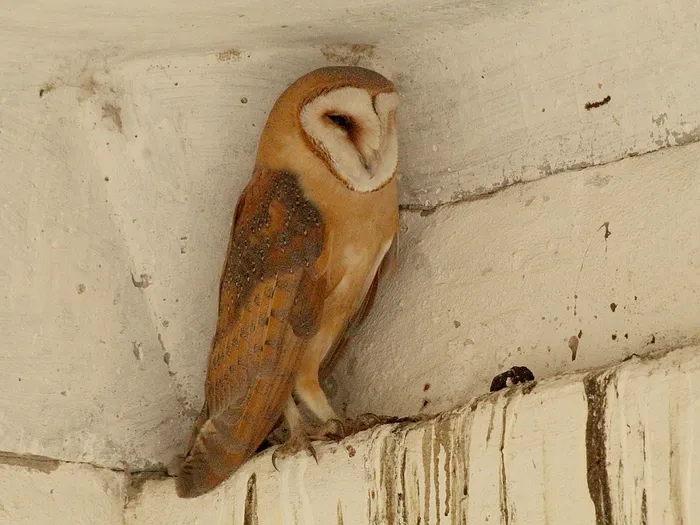
The barn owl (Tyto alba) is a pale, heart-faced owl that hunts rats in rice fields, oil palm plantations and villages across Indonesia.
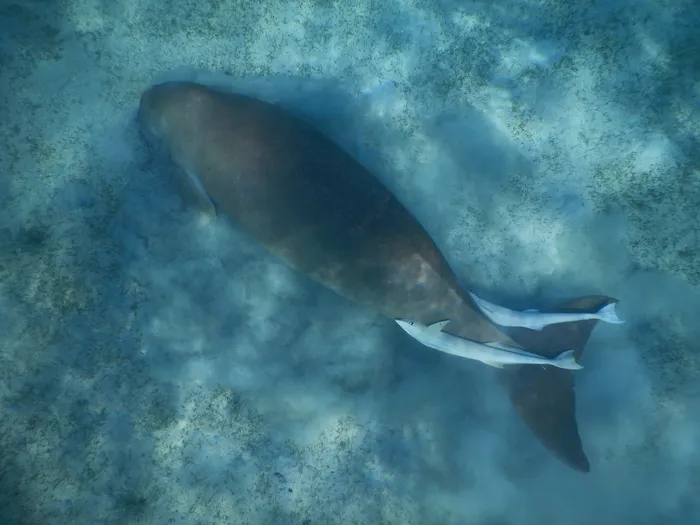
A seagrass-eating marine mammal dependent on healthy coastal waters. Dugong life connects seagrass meadows, sheltered bays, and human activity in shallow seas.
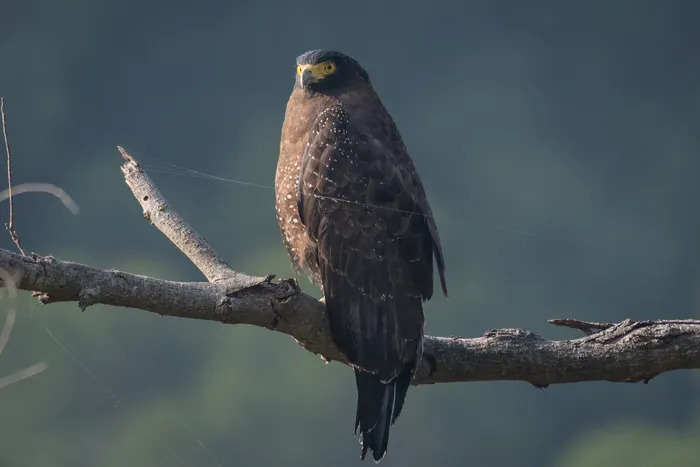
The crested serpent eagle (Spilornis cheela) is a snake-eating eagle of forest edges in Sumatra, Java, Bali and Borneo, and is protected in Indonesia.
Sources and references
- Kemendikbudristek — IPAS Kelas V (Edisi Revisi 2024), Bab 3 ↗
- Keputusan Kepala BSKAP No. 046/H/KR/2025, CP IPA Fase D ↗
- Kemendikbudristek — IPA Kelas VII (Edisi Revisi 2023), Bab VI — hlm. 167 ↗
- Dinas Pertanian, Ketahanan Pangan dan Perikanan Kabupaten Buleleng — Waspada Hama Tikus! Musuh Utama Tanaman Padi yang Sering Diabaikan (2026) ↗
- Dinas Pertanian, Ketahanan Pangan dan Perikanan Kabupaten Buleleng — Tikus dan Pengendaliannya (2022) ↗
- BBPPTP Medan (Ditjen Perkebunan, Kementerian Pertanian) — Pengembangan Burung Hantu dalam Pengendalian Hama Tikus ↗
- Kementerian Pertanian — Oxya spp., Hama Eksotik Tanaman Padi ↗
- University of Michigan, Animal Diversity Web — Spilornis cheela ↗
- University of Michigan, Animal Diversity Web — Dugong dugon ↗
- University of Michigan, Animal Diversity Web — Bubulcus ibis ↗
Checked 2026-10-02. Send a correction