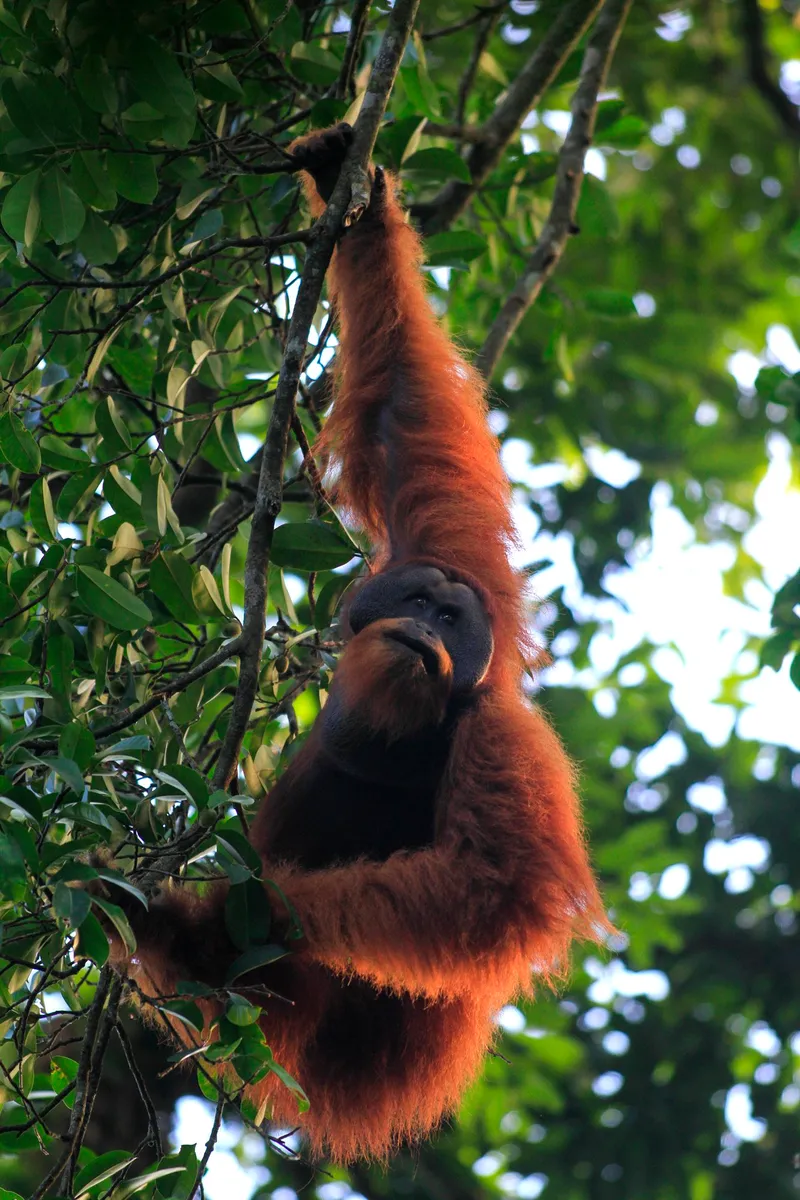

Distinguish three orangutan species
Sumatran orangutan refers to Pongo abelii. The Tapanuli orangutan, Pongo tapanuliensis, also lives in Sumatra but is a different species; the Bornean orangutan is Pongo pygmaeus. Check the scientific name when reading population estimates or conservation news so information about one species is not transferred to another.
Forest is a connected living space
Tree crowns provide movement routes, resting places, and food. Lowland and peat-swamp forests are important parts of orangutan landscapes. Roads and land clearance can separate forest patches; judging habitat only by the area of each patch misses the connections between them. Conservation must consider an entire landscape.
Fruit and a long learning period
Fruit is an important food, with other items varying according to forest availability. Young orangutans learn from their mothers over many years. This long dependence helps explain why the loss of an adult or removal of an infant from the wild cannot be treated as a small impact that is quickly reversed.
Threats that interact
Forest loss, fragmentation, and capture for trade reinforce one another. Fragmented habitat can also increase encounters around farms and settlements. Solutions need habitat protection and work with local communities together; moving individual animals does not replace lost living space. Assess projects by what they protect over time.
What field research can tell us
SOCP describes monitoring at sites such as Sikundur and Suaq Balimbing to understand behaviour and habitat conditions. Repeated research can address questions that a tourism photograph cannot, including changes in space use. One sighting or striking video is not evidence that a population has recovered.
Make encounters responsible
Choose observation experiences that maintain distance and follow local management instructions. Decline offers to hold, feed, or pose while touching an orangutan. To help, examine forest-protection work and the outcomes organisations report. Avoid sharing precise locations that could increase disturbance or capture risk.
Sources & references
- Smithsonian’s National Zoo — Orangutan biology ↗
- WWF — Sumatran orangutan ↗
- SOCP — Biodiversity monitoring, research, and surveys ↗
- Sumatran Orangutan Society — Conservation challenges ↗
- Sumatran Orangutan Society — Our approach ↗
References can change. Check dates and context in the original source.