Quick answer
IUCN status: Least ConcernStandardwing bird-of-paradise at a glance
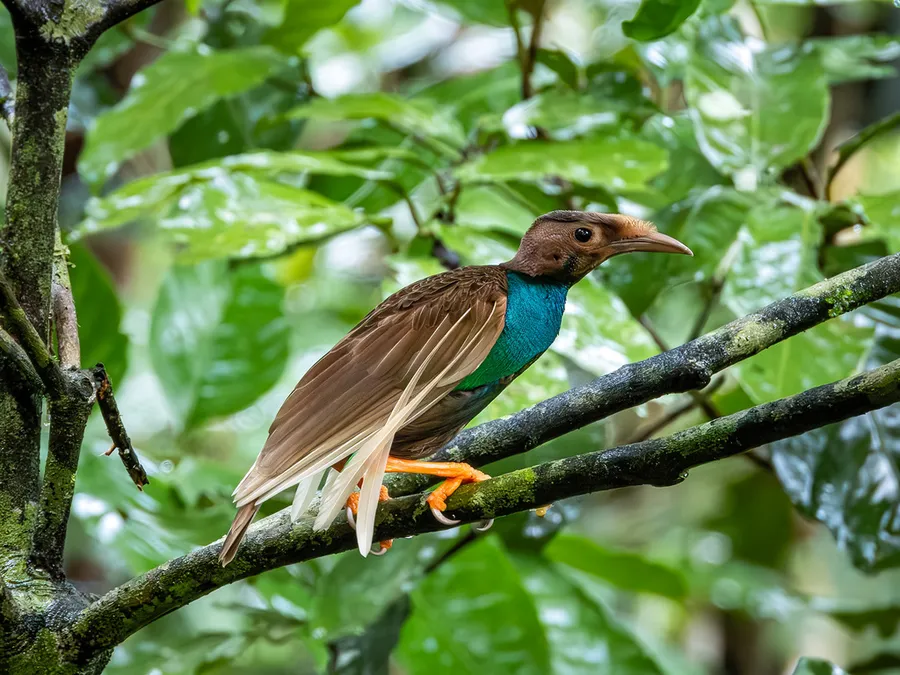
The standardwing bird-of-paradise (Semioptera wallacii) is a bird in the family Paradisaeidae. Range in Indonesia: Halmahera, Bacan and Kasiruta, North Maluku. It is endemic to Indonesia, living naturally only in Halmahera, Bacan and Kasiruta (North Maluku). Diet: fruit, insects and other arthropods; a omnivore. IUCN Red List status: Least Concern. It is a legally protected species in Indonesia (Regulation P.106/2018).
| Scientific name | Semioptera wallacii |
|---|---|
| Indonesian name | Bidadari halmahera |
| Group | Birds |
| Family | Paradisaeidae |
| Range in Indonesia | Halmahera, Bacan and Kasiruta, North Maluku |
| Linked habitats | Tropical Rainforests |
| Diet | Fruit, insects and other arthropods |
| Range in Indonesia | Endemic to Halmahera, Bacan and Kasiruta (North Maluku) |
| Key feature | Male: two pairs of long white plumes, green breast shield |
| Provincial identity animal | North Maluku province |
| Other names | Bidadari halmahera; Wallace's standardwing |
| IUCN status | Least Concern · IUCN Red List (via GBIF) · checked 1 October 2026 |
| Legal protection in Indonesia | Protected · Regulation P.106/2018 · annex no. 457 |
| Diet type | Omnivore (eats plants and animals) — fruit, insects and other arthropods · Mongabay Indonesia |
| Reproduction | Laying eggs (oviparous) · Vigie-Nature École (MNHN) |
| Active | Diurnal (active by day) · Oiseaux.net (AVONET/Birds of the World traits) |
| Endemic to Indonesia | Yes — Halmahera, Bacan and Kasiruta (North Maluku) · BirdLife DataZone |
In this guide (11)
What is the standardwing bird-of-paradise?
The standardwing (Semioptera wallacii) is a bird-of-paradise (family Paradisaeidae) endemic to North Maluku, one of the few birds-of-paradise living outside the Papua region. According to Mongabay Indonesia, the male's most striking feature is two pairs of long white plumes that stick out from the wings and can be raised or lowered.
Oiseaux.net gives its length as 23–26 cm. Its scientific name honours Alfred Russel Wallace, the British naturalist who obtained the bird through his assistant Ali on Bacan in 1858. Mongabay notes that the genus Semioptera contains only this species. Kompas lists the standardwing as the identity animal of North Maluku province, with the clove as its identity plant.
Evidence: Mongabay Indonesia (2021) — Bidadari Halmahera, Burung Cendrawasih di Luar Papua ↗ · Oiseaux.net — Standardwing, Semioptera wallacii ↗ · Kompas.com (2023) — Flora dan Fauna Identitas Maluku Utara (Wayback Machine copy) ↗
Where does the standardwing live?
The standardwing lives only on Halmahera, Kasiruta and Bacan in North Maluku. According to BirdLife International, it lives in primary, secondary and logged rainforest in the lowlands and hills, from sea level to 1,000–1,200 m.
Although it occurs in secondary forest, its display sites (leks) have so far been found only in primary forest, around large trees such as matoa (Pometia pinnata), Canarium and wild nutmeg (Myristica). Mongabay Indonesia names viewing sites including Tayawi, Gunung Tanah Putih in West Halmahera, Binagara in East Halmahera and Gunung Uni-uni.
Evidence: BirdLife DataZone — Standardwing Bird-of-paradise Semioptera wallacii species factsheet ↗ · Mongabay Indonesia (2021) — Bidadari Halmahera, Burung Cendrawasih di Luar Papua ↗
What does the standardwing eat?
The standardwing eats fruit, insects and other arthropods. Mongabay Indonesia lists insects, arthropods and fruit in its diet, and the bird trait databases cited by Oiseaux.net (Pigot et al. 2020; Tobias et al. 2021) class it as a fruit eater.
Because it lives in the forest canopy and is very sensitive to disturbance, it needs forest still rich in fruiting trees. Researchers Supratman Tabba and Lis Nurrani, quoted by Mongabay, say the bird moves very fast and does not appear in disturbed areas. Its presence can therefore signal that a forest is still in good condition.
Evidence: Mongabay Indonesia (2021) — Bidadari Halmahera, Burung Cendrawasih di Luar Papua ↗ · Oiseaux.net — Standardwing, Semioptera wallacii ↗
How does the male standardwing dance?
Male standardwings dance at display sites (leks) in the morning or late afternoon to attract females. According to a 2011 study by Hanom Bashari quoted by Mongabay Indonesia, the male grips a small branch, half-opens his wings and flaps them rapidly and repeatedly without letting go.
Garda Animalia describes the aerial display: the male gives a shrill call, flies off the branch and glides back down, turning slightly, with his emerald breast shield spread and white plumes fluttering. Males have a glossy violet crown; females are olive-brown. Nests are hard to find: the head of Aketajawe Lolobata National Park, quoted by Mongabay, said repeated searches had found none.
Evidence: Mongabay Indonesia (2021) — Bidadari Halmahera, Burung Cendrawasih di Luar Papua ↗ · Garda Animalia (2020) — Bidadari Halmahera, Penari Selendang Putih di Hutan Maluku Utara ↗
Is the standardwing endangered?
The standardwing is not globally threatened: BirdLife International assesses it as Least Concern and describes it as relatively common on Halmahera. BirdLife cites an estimate by Bashari (2012) of 24,128–61,553 birds in Aketajawe-Lolobata National Park alone.
Even so, its population is thought to be declining. The main threat is forest loss to commercial logging, shifting cultivation, mining, settlements, and coconut, clove, nutmeg and timber plantations. Wildfires are a potential threat, especially where forest has been opened up. According to BirdLife, some lek sites may be disturbed by unregulated tourism.
Evidence: BirdLife DataZone — Standardwing Bird-of-paradise Semioptera wallacii species factsheet ↗
How can the standardwing be protected?
The standardwing is protected by keeping the primary forests of Halmahera and Bacan intact, especially lek sites and the large trees around them. Semioptera wallacii is listed as a protected species in the annex to regulation P.106/2018 (entry 457, bidadari halmahera).
According to BirdLife International, Aketajawe Lolobata National Park uses the bird as its flagship species and monitors and restores lek sites. Birdwatchers should go with a guide or park staff, keep their distance and stay quiet at leks. Never buy the birds or their plumes; report hunting or trade to the conservation agency (BKSDA) or park staff. As North Maluku's identity animal, it deserves to be known locally.
Evidence: Kementerian Lingkungan Hidup dan Kehutanan — Permen LHK P.106/MENLHK/SETJEN/KUM.1/12/2018 tentang Jenis Tumbuhan dan Satwa yang Dilindungi (lampiran) ↗ · BirdLife DataZone — Standardwing Bird-of-paradise Semioptera wallacii species factsheet ↗ · Pemerintah Provinsi Sumatera Barat (Humas, 2017) — Fauna Sekaligus Maskot Prov. Sumbar ↗
Explore related habitats
These habitat relationships are supported by species sources in this guide. This is not a complete range map.
Scientific classification of the Standardwing bird-of-paradise
| Kingdom | Animalia |
|---|---|
| Phylum | Chordata |
| Class | Aves |
| Order | Passeriformes |
| Family | Paradisaeidae |
| Genus | Semioptera |
| Species | Semioptera wallacii |
Source: GBIF Backbone Taxonomy, adjusted to the ranks commonly used in school biology (for example class Reptilia).
Common questions about the standardwing bird-of-paradise
What is the scientific name of the standardwing bird-of-paradise?
The scientific name of the standardwing bird-of-paradise is Semioptera wallacii, in the family Paradisaeidae. In Indonesian it is called Bidadari halmahera.
What kind of animal is the standardwing bird-of-paradise?
The standardwing bird-of-paradise is a bird in the family Paradisaeidae. By diet it is a omnivore (eats plants and animals): a fruit, insects and other arthropods. It is also endemic to Indonesia.
Where does the standardwing bird-of-paradise live in Indonesia?
In Indonesia, this guide records the standardwing bird-of-paradise in: Halmahera, Bacan and Kasiruta, North Maluku.
The standardwing bird-of-paradise is endemic to Indonesia and lives naturally only in Halmahera, Bacan and Kasiruta (North Maluku). Source: BirdLife DataZone.
Source-supported habitats: Tropical Rainforests.
What does the standardwing bird-of-paradise eat?
Diet of the standardwing bird-of-paradise: fruit, insects and other arthropods. That makes it a omnivore (eats plants and animals). Source: Mongabay Indonesia.
How does the standardwing bird-of-paradise reproduce?
The standardwing bird-of-paradise reproduces by laying eggs (oviparous). Source: Vigie-Nature École (MNHN).
Is the standardwing bird-of-paradise nocturnal?
No. The standardwing bird-of-paradise is diurnal (active by day). Source: Oiseaux.net (AVONET/Birds of the World traits).
See also the list of nocturnal and diurnal animals in Indonesia.
What are the main features of the standardwing bird-of-paradise?
Key features of the standardwing bird-of-paradise, from this guide’s sources: Key feature: male: two pairs of long white plumes, green breast shield.
What is the scientific classification of the standardwing bird-of-paradise?
Scientific classification of the standardwing bird-of-paradise: kingdom Animalia, phylum Chordata, class Aves, order Passeriformes, family Paradisaeidae, genus Semioptera, species Semioptera wallacii.
Source: GBIF Backbone Taxonomy, adjusted to the ranks commonly used in school biology.
Is the standardwing bird-of-paradise endangered?
No, according to the global IUCN assessment. On the IUCN Red List, the standardwing bird-of-paradise is listed as Least Concern: it does not qualify for a threatened category or for Near Threatened in the global assessment. Source: IUCN Red List (via GBIF), checked 1 October 2026.
This global category is separate from national legal protection. Is the standardwing bird-of-paradise protected in Indonesia?
Is the standardwing bird-of-paradise protected in Indonesia?
Yes. The standardwing bird-of-paradise (Semioptera wallacii) is a protected species in Indonesia under Environment and Forestry Ministerial Regulation No. P.106/MENLHK/SETJEN/KUM.1/12/2018 on protected plant and animal species (annex, entry 457).
Article 21(2) of Law No. 5 of 1990, as amended by Law No. 32 of 2024, prohibits anyone from hunting, catching, injuring, killing, storing, owning, keeping, transporting or trading a protected animal, alive or dead, including its body parts, eggs and nests.
If you see this animal being traded, kept or injured, contact the local BKSDA office.
Can the standardwing bird-of-paradise be kept as a pet?
No. Because the standardwing bird-of-paradise is a protected species, catching, owning, keeping, transporting or trading it without a permit is prohibited by law. Trading without a permit through electronic media is also prohibited.
If you see this animal for sale or being kept, report it to the local BKSDA office.
Sources & references
- BirdLife DataZone — Standardwing Bird-of-paradise Semioptera wallacii species factsheet ↗
- Mongabay Indonesia (2021) — Bidadari Halmahera, Burung Cendrawasih di Luar Papua ↗
- Garda Animalia (2020) — Bidadari Halmahera, Penari Selendang Putih di Hutan Maluku Utara ↗
- Oiseaux.net — Standardwing, Semioptera wallacii ↗
- Kompas.com (2023) — Flora dan Fauna Identitas Maluku Utara (Wayback Machine copy) ↗
- Pemerintah Provinsi Sumatera Barat (Humas, 2017) — Fauna Sekaligus Maskot Prov. Sumbar ↗
- Kementerian Lingkungan Hidup dan Kehutanan — Permen LHK P.106/MENLHK/SETJEN/KUM.1/12/2018 tentang Jenis Tumbuhan dan Satwa yang Dilindungi (lampiran) ↗
- Vigie-Nature École (MNHN) ↗
- GBIF Backbone Taxonomy (GBIF) ↗
- IUCN Red List of Threatened Species, version 2026-1, via GBIF (CC BY 4.0) ↗
References can change. Check dates and context in the original source.
Cite this page
PanduanHewan. (2026, 1 October). Standardwing bird-of-paradise (Semioptera wallacii). PanduanHewan.org. https://panduanhewan.org/en/species/standardwing-bird-of-paradise/