Quick answer
IUCN status: Least ConcernReinwardt's flying frog at a glance
Reinwardt's flying frog (Rhacophorus reinwardtii) is an amphibian in the family Rhacophoridae. Range in Indonesia: Java and northern Sumatra. It is endemic to Indonesia, living naturally only in Java (records from northern Sumatra need confirmation). Diet: spiders, grasshoppers and other insects; a carnivore. IUCN Red List status: Least Concern.
| Scientific name | Rhacophorus reinwardtii |
|---|---|
| Indonesian name | Katak terbang Jawa |
| Group | Amphibians |
| Family | Rhacophoridae |
| Range in Indonesia | Java and northern Sumatra |
| Linked habitats | Tropical Rainforests |
| Diet | Spiders, grasshoppers and other insects |
| Range in Indonesia | Java; also recorded in North Sumatra |
| Key feature | Green back, fully webbed digits, dark blue flank streaks |
| Elevation | 20–1,800 m above sea level on Java |
| Other names | Katak terbang Jawa, katak pohon hijau, Reinwardt's gliding frog |
| IUCN status | Least Concern · IUCN Red List (via GBIF) · checked 1 October 2026 |
| Diet type | Carnivore (meat-eater) — insect- and small-invertebrate-eater (insectivore) · Australian Museum |
| Reproduction | Laying eggs (oviparous) · Semantic Scholar (paper PDF) |
| Endemic to Indonesia | Yes — Java (records from northern Sumatra need confirmation) · Semantic Scholar (paper PDF) |
In this guide (12)
What is Reinwardt's flying frog?
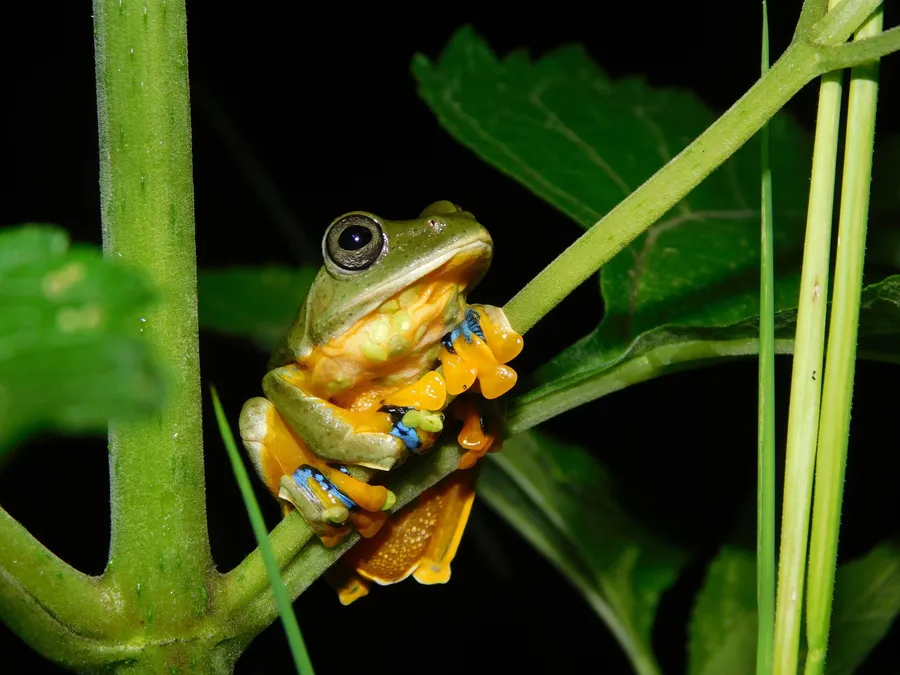
Reinwardt's flying frog (Rhacophorus reinwardtii) is a medium to large tree frog with a green back and fully webbed fingers and toes. Researchers describe Rhacophorus as a genus of parachuting frogs.
Fajri and colleagues (2023), summarising Schlegel's 1840 description, list skin flaps along the front and rear edges of the limbs, a green back with small dark spots, a yellow or orange belly and dark blue streaks on the flanks. It was once thought to range widely in South-east Asia, but populations in Peninsular Malaysia, Borneo, southern Vietnam and northern Thailand are now treated as separate species.
Evidence: Raffles Bulletin of Zoology — Fajri, Tjong & Hamidy (2023), Identification and taxonomic status of a Sumatran population of Norhayati's gliding frog (PDF) ↗ · Molecular Phylogenetics and Evolution (PubMed) — O'Connell et al. (2018), Synchronous diversification of parachuting frogs (genus Rhacophorus) on Sumatra and Java ↗
Where does Reinwardt's flying frog live?
Reinwardt's flying frog lives on Java and, according to a 2023 genetic study, also in North Sumatra, where frogs from Mardingding grouped with Javan R. reinwardtii. On Java it has been recorded from 20 to 1,800 m above sea level, in primary and secondary rainforest and on agroforestry land.
Habitat modelling by Kurniawan and colleagues (2024) estimated that only about 27 per cent of Java is suitable for the species, mainly the large forests of West and Central Java. Tree canopy cover and elevation were the strongest predictors in the model. In East Java it has been recorded in places including Bromo Tengger Semeru National Park, Bondowoso and Kediri.
Evidence: Raffles Bulletin of Zoology — Fajri, Tjong & Hamidy (2023), Identification and taxonomic status of a Sumatran population of Norhayati's gliding frog (PDF) ↗ · Journal of Tropical Biodiversity and Biotechnology — Kurniawan et al. (2024), Habitat suitability modelling of Rhacophorus reinwardtii in Java, with notes on habitat characteristics from Malang, East Java ↗ · Berkala Ilmiah Biologi (UGM) — Pratama et al. (2023), Distribusi dan karakteristik habitat katak pohon hijau (Rhacophorus reinwardtii) di Jawa Timur (PDF) ↗
What does Reinwardt's flying frog eat?
Reinwardt's flying frog is a generalist predator of small animals, especially spiders and grasshoppers. An undergraduate study at Universitas Pendidikan Indonesia (UPI) examined the stomach contents of this frog at Ranca Upas, Ciwidey, West Java, during the March–May 2017 rainy season, using stomach flushing.
By number, spiders (Araneae) were the most common prey, at 40 per cent. By volume, grasshoppers and their relatives (Orthoptera) dominated, at 40.72 per cent. Its diet overlapped heavily with that of R. margaritifer at the same site, suggesting the two species compete for food. The frog is active at night and helps control insect pests.
Evidence: Universitas Pendidikan Indonesia Repository — Ramadi (2017), Karakteristik habitat dan makanan alami dua spesies katak pohon simpatrik Rhacophorus di kawasan Ranca Upas Ciwidey, Jawa Barat ↗ · West Java Conservation Trust Fund (WJCTF) — Info Spesies: Katak Pohon Hijau (Rhacophorus reinwardtii) ↗
How does Reinwardt's flying frog breed?
Reinwardt's flying frog lays its eggs in foam nests attached to leaves above water. In Malang, East Java, Kurniawan and colleagues found foam nests at the base of leaves, with eggs wrapped in the leaves of trees near pools. Its tadpoles need natural or artificial ponds to develop.
Breeding sites included permanent ponds, rainwater reservoirs in plantations and densely vegetated roadside puddles. The frog lives in the tree canopy, 2.5–5.5 metres above the ground, but comes down to mate; in the breeding season 10–15 frogs may gather at one site. In Malang, males outnumbered females by about three to one.
Is Reinwardt's flying frog endangered?
The IUCN Red List (2022) lists Reinwardt's flying frog as Least Concern, but Indonesian researchers argue its habitat is much smaller and more fragmented than previously thought. Kurniawan and colleagues (2024) suggest that the impression of a large population may come from the frogs gathering in large numbers at breeding sites.
The frog depends on dense tree cover and water bodies. Much of Java's lowland forest has been lost, so in East Java its suitable habitat lies mainly in the highlands. At its breeding sites around Malang, mostly agroforestry land, farmers often use pesticides and herbicides that could harm the frogs.
Evidence: Journal of Tropical Biodiversity and Biotechnology — Kurniawan et al. (2024), Habitat suitability modelling of Rhacophorus reinwardtii in Java, with notes on habitat characteristics from Malang, East Java ↗ · Berkala Ilmiah Biologi (UGM) — Pratama et al. (2023), Distribusi dan karakteristik habitat katak pohon hijau (Rhacophorus reinwardtii) di Jawa Timur (PDF) ↗
How can Reinwardt's flying frog be protected?
The most important step is to protect forests with dense canopy and the water bodies where the frog breeds. Kurniawan and colleagues recommend creating water reservoirs around its natural habitat, especially on agroforestry land, and planting broadleaf shade plants around them as egg-laying sites.
Reduce pesticide and herbicide use near the ponds and puddles where the frogs breed. Do not catch the frogs or remove their foam nests. Observers can help by photographing frogs without touching them and uploading records to citizen-science platforms such as iNaturalist; Pratama and colleagues (2023) used 16 iNaturalist records to map the species in East Java.
Evidence: Journal of Tropical Biodiversity and Biotechnology — Kurniawan et al. (2024), Habitat suitability modelling of Rhacophorus reinwardtii in Java, with notes on habitat characteristics from Malang, East Java ↗ · Berkala Ilmiah Biologi (UGM) — Pratama et al. (2023), Distribusi dan karakteristik habitat katak pohon hijau (Rhacophorus reinwardtii) di Jawa Timur (PDF) ↗
Explore related habitats
These habitat relationships are supported by species sources in this guide. This is not a complete range map.
Scientific classification of the Reinwardt's flying frog
| Kingdom | Animalia |
|---|---|
| Phylum | Chordata |
| Class | Amphibia |
| Order | Anura |
| Family | Rhacophoridae |
| Genus | Rhacophorus |
| Species | Rhacophorus reinwardtii |
Source: GBIF Backbone Taxonomy, adjusted to the ranks commonly used in school biology (for example class Reptilia).
Common questions about Reinwardt's flying frog
What is the scientific name of Reinwardt's flying frog?
The scientific name of Reinwardt's flying frog is Rhacophorus reinwardtii, in the family Rhacophoridae. In Indonesian it is called Katak terbang Jawa.
What kind of animal is Reinwardt's flying frog?
Reinwardt's flying frog is an amphibian in the family Rhacophoridae. By diet it is a carnivore (meat-eater): a insect- and small-invertebrate-eater (insectivore). It is also endemic to Indonesia.
Where does Reinwardt's flying frog live in Indonesia?
In Indonesia, this guide records Reinwardt's flying frog in: Java and northern Sumatra.
Reinwardt's flying frog is endemic to Indonesia and lives naturally only in Java (records from northern Sumatra need confirmation). Source: Semantic Scholar (paper PDF).
Source-supported habitats: Tropical Rainforests.
What does Reinwardt's flying frog eat?
Diet of Reinwardt's flying frog: spiders, grasshoppers and other insects. That makes it a carnivore (meat-eater). Source: Australian Museum.
How does Reinwardt's flying frog reproduce?
Reinwardt's flying frog reproduces by laying eggs (oviparous). Eggs are laid in a foam nest wrapped in leaves on trees near water. Source: Semantic Scholar (paper PDF).
What are the main features of Reinwardt's flying frog?
Key features of Reinwardt's flying frog, from this guide’s sources: Key feature: green back, fully webbed digits, dark blue flank streaks.
What is the scientific classification of Reinwardt's flying frog?
Scientific classification of Reinwardt's flying frog: kingdom Animalia, phylum Chordata, class Amphibia, order Anura, family Rhacophoridae, genus Rhacophorus, species Rhacophorus reinwardtii.
Source: GBIF Backbone Taxonomy, adjusted to the ranks commonly used in school biology.
Is Reinwardt's flying frog endangered?
No, according to the global IUCN assessment. On the IUCN Red List, Reinwardt's flying frog is listed as Least Concern: it does not qualify for a threatened category or for Near Threatened in the global assessment. Source: IUCN Red List (via GBIF), checked 1 October 2026.
This global category is separate from legal protection in Indonesia. To check whether Reinwardt's flying frog is a protected species, consult the current national list of protected species or contact the local BKSDA (natural resources conservation office).
Sources & references
- Raffles Bulletin of Zoology — Fajri, Tjong & Hamidy (2023), Identification and taxonomic status of a Sumatran population of Norhayati's gliding frog (PDF) ↗
- Journal of Tropical Biodiversity and Biotechnology — Kurniawan et al. (2024), Habitat suitability modelling of Rhacophorus reinwardtii in Java, with notes on habitat characteristics from Malang, East Java ↗
- Berkala Ilmiah Biologi (UGM) — Pratama et al. (2023), Distribusi dan karakteristik habitat katak pohon hijau (Rhacophorus reinwardtii) di Jawa Timur (PDF) ↗
- Universitas Pendidikan Indonesia Repository — Ramadi (2017), Karakteristik habitat dan makanan alami dua spesies katak pohon simpatrik Rhacophorus di kawasan Ranca Upas Ciwidey, Jawa Barat ↗
- Molecular Phylogenetics and Evolution (PubMed) — O'Connell et al. (2018), Synchronous diversification of parachuting frogs (genus Rhacophorus) on Sumatra and Java ↗
- West Java Conservation Trust Fund (WJCTF) — Info Spesies: Katak Pohon Hijau (Rhacophorus reinwardtii) ↗
- Australian Museum ↗
- Semantic Scholar (paper PDF) ↗
- GBIF Backbone Taxonomy (GBIF) ↗
- IUCN Red List of Threatened Species, version 2026-1, via GBIF (CC BY 4.0) ↗
References can change. Check dates and context in the original source. How we use sources and data →
Cite this page
Credit PanduanHewan when referring to this page. Check the original evidence sources before reusing a claim.
PanduanHewan. Reinwardt's flying frog (Rhacophorus reinwardtii). Last substantive update: 1 October 2026. https://panduanhewan.org/en/species/reinwardts-flying-frog/