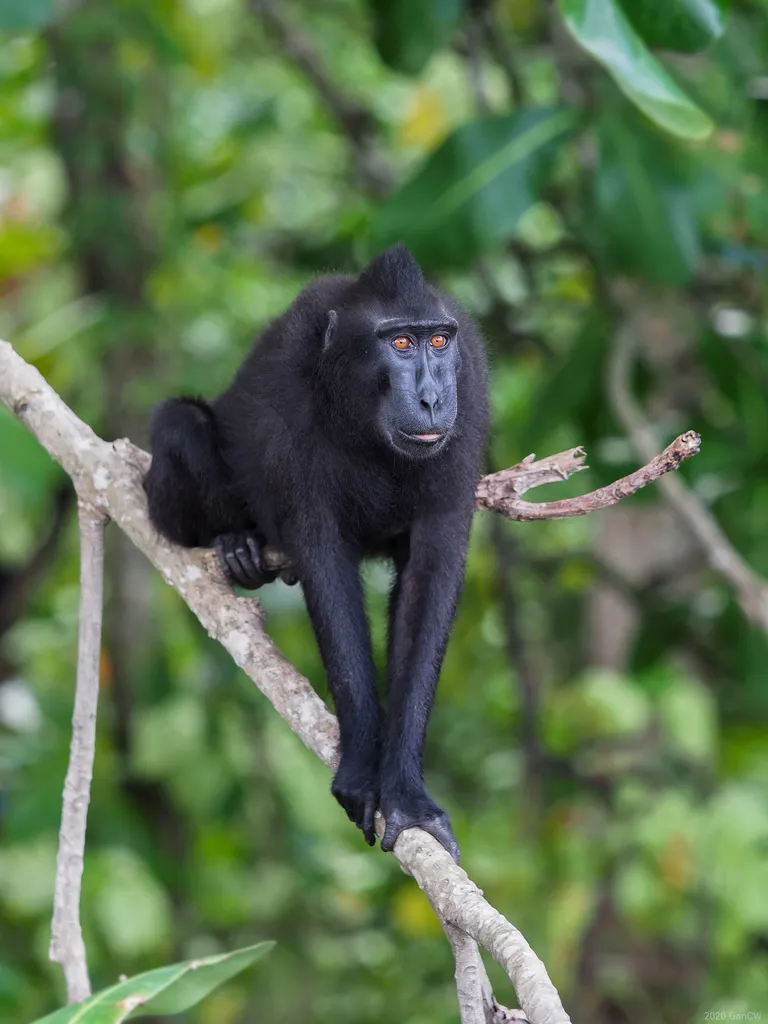
What is a crested black macaque?
Macaca nigra is a macaque native to northern Sulawesi. Its upright crest and dark body are distinctive, though a wild animal should be identified using its location and full set of features. “Crested black macaque” distinguishes it from Sulawesi’s other macaques; the scientific name is the clearest reference.
Where does it live?
Tangkoko in North Sulawesi has supported long-term research on wild crested macaques. Its lowland forest experiences seasonal changes in fruit availability. Findings from one reserve do not describe the species’ entire range, but they give direct evidence of how wild groups use forest space.
Why do fruit and forest matter?
A Tangkoko phenology study examined how changing fruit supplies relate to macaque home ranges. Fruit is an important food, so food trees and connections among forest areas matter together. Groups do not necessarily use every site in the same way; season and forest condition shape movement.
How do groups live?
Field research following several wild Tangkoko groups has examined social relationships and offspring survival. Those groups offer insight into social behaviour, but their results cannot simply be treated as a population count for all Sulawesi. Watching a group rather than one individual helps reveal how habitat change can affect social animals.
What threatens the species?
Conservation assessments and Tangkoko research document pressure on the species and the need to protect habitat. Hunting and forest loss require local context; an old count should not be presented as today’s population. Prefer organisations that show recent monitoring methods, and avoid feeding or crowding wild groups for photographs.
Sources & references
- Longitudinal phenological study of Macaca nigra in Sulawesi ↗
- Crested black macaque conservation in Tangkoko — Oryx ↗
- Wild female crested macaque social study ↗
- Indonesia Travel — 10 endemic animals ↗
References can change. Check dates and context in the original source.