Quick answer
IUCN status: Least ConcernClown anemonefish at a glance
The clown anemonefish (Amphiprion ocellaris) is a marine animal in the family Pomacentridae. Range in Indonesia: Indonesian seas except northern Papua. Diet: zooplankton, algae, small crustaceans and detritus. IUCN Red List status: Least Concern.
| Scientific name | Amphiprion ocellaris |
|---|---|
| Indonesian name | Ikan badut |
| Group | Marine |
| Family | Pomacentridae |
| Range in Indonesia | Indonesian seas except northern Papua |
| Linked habitats | Coral Reefs |
| Diet | Zooplankton, algae, small crustaceans and detritus |
| Range in Indonesia | Most of Indonesia except northern Papua |
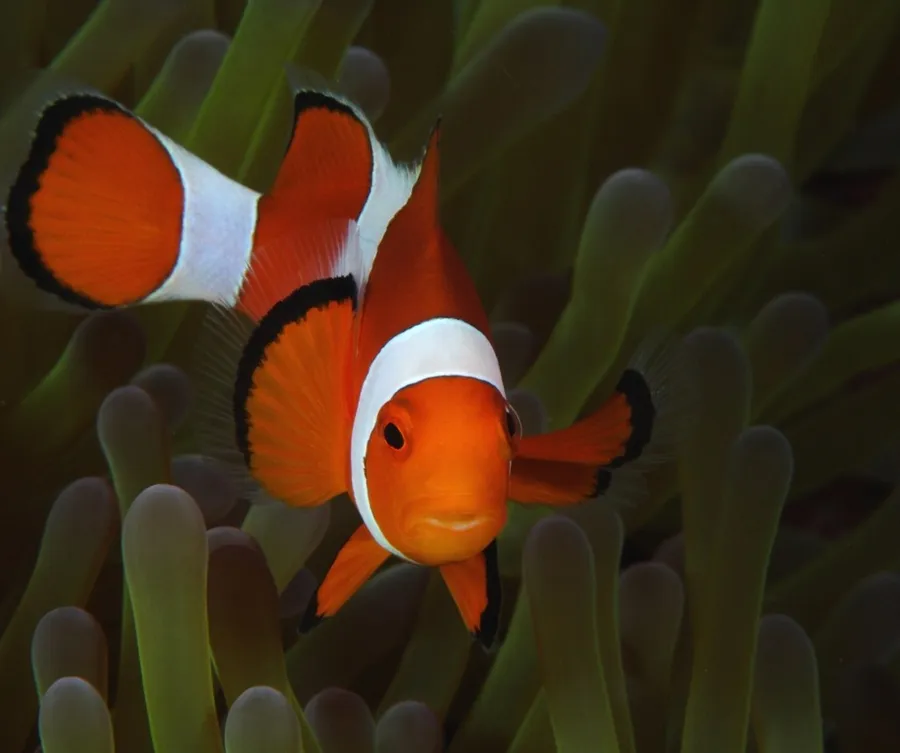
| Key feature | Orange with three white bars; up to 11 cm |
| Host anemones | Heteractis magnifica, Stichodactyla gigantea, S. mertensii |
| Other names | Ikan badut, ikan nemo, ikan giru, false clown anemonefish |
| Look-alike | Amphiprion percula, in northern Papua |
| IUCN status | Least Concern · IUCN Red List (via GBIF) · checked 14 October 2026 |
In this guide (12)
What is the clown anemonefish?
The clown anemonefish (Amphiprion ocellaris) is a small orange reef fish with three white bars that lives among the tentacles of sea anemones. FishBase gives a maximum length of 11 cm. In Indonesia it is also called ikan nemo or ikan giru, and Mongabay Indonesia names A. ocellaris as the inspiration for Finding Nemo.
National Geographic notes that the heroes of Finding Nemo are actually false anemonefish. Its relative, the true anemonefish (A. percula), is nearly identical but differs slightly in shape and habitat. This page focuses on A. ocellaris, and the differences between the two are explained below.
Evidence: FishBase — Amphiprion ocellaris, Clown anemonefish ↗ · National Geographic — Clownfish ↗ · Mongabay Indonesia (2022) — Upaya Melestarikan Si Lucu di Perairan Laut Bebas ↗
Where does the clown anemonefish live?
The clown anemonefish lives on coral reefs and in calm, shallow lagoons across most of Indonesia. The IUCN records it from the Andaman Sea, Malaysia and Singapore to Indonesia (except northern Papua), the Philippines, north-western Australia, Taiwan and the Ryukyu Islands, at depths of 1–15 metres.
It lives with a host anemone. According to the IUCN and FishBase, A. ocellaris lives with three large anemone species: Heteractis magnifica, Stichodactyla gigantea and Stichodactyla mertensii. A layer of mucus on its skin protects it from the anemone's sting (National Geographic).
Evidence: IUCN Red List — Amphiprion ocellaris, Clown Anemonefish (Allen et al. 2022) ↗ · FishBase — Amphiprion ocellaris, Clown anemonefish ↗ · National Geographic — Clownfish ↗
What does the clown anemonefish eat?
The clown anemonefish eats zooplankton, algae and small animals. FishBase's list of food items, from studies of young and adult fish in Malaysia and the Ryukyu Islands, includes copepods, barnacle and tunicate larvae, fish eggs, filamentous algae, amphipods, shrimps and detritus.
Its partnership with the anemone also involves food. According to National Geographic, the fish gains safety from predators and food scraps from its anemone, and in return drives off intruders and cleans parasites from its host.
Evidence: FishBase — Food items reported for Amphiprion ocellaris ↗ · National Geographic — Clownfish ↗
How does the clown anemonefish breed and change sex?
Clown anemonefish are born male and can change into females; the IUCN and FishBase describe them as protandrous hermaphrodites. Pairs are monogamous. Their eggs are laid on and stick to the bottom surface, and are guarded and aerated by the male (FishBase). National Geographic notes that the sex change cannot be reversed.
For the related A. percula, the IUCN explains that each group consists of a breeding pair and up to four non-breeders. The female is the largest and the male the second largest. If the female dies, the male changes sex and becomes the breeding female, and the largest non-breeder becomes the breeding male.
Evidence: FishBase — Amphiprion ocellaris, Clown anemonefish ↗ · IUCN Red List — Amphiprion percula (Jenkins et al. 2017) ↗ · National Geographic — Clownfish ↗
How do Amphiprion ocellaris and A. percula differ?
The main differences lie in range and small body details, because the colours are almost the same. A. ocellaris occurs across most of Indonesia, while A. percula lives in the western Pacific: Queensland, northern New Guinea, New Britain, the Solomon Islands and Vanuatu (IUCN; FishBase). FishBase gives 10–11 dorsal-fin spines for A. ocellaris and 9–10 for A. percula.
The IUCN and FishBase note that the two are often confused, so location helps. According to the IUCN range descriptions, A. ocellaris occurs throughout Indonesia except northern Papua, which is where A. percula occurs. A. percula also appears to live in shallower water (IUCN).
Evidence: IUCN Red List — Amphiprion percula (Jenkins et al. 2017) ↗ · FishBase — Amphiprion percula, Orange clownfish ↗ · FishBase — Amphiprion ocellaris, Clown anemonefish ↗
How can wild clown anemonefish be protected?
The best way to protect clown anemonefish is to leave the fish and their anemones on the reef. The IUCN rates A. ocellaris as Least Concern, but notes that aquarium collection can have local impacts, parts of its range are subject to blast fishing, and its host anemones are vulnerable to bleaching.
The IUCN calls A. ocellaris one of the world's most commercialised fish; in the Spermonde Archipelago an estimated 140,000 a year on average are taken for aquariums. Indonesia's fisheries ministry (KKP) breeds it in Lampung and Ambon to reduce reliance on wild-caught fish (Mongabay Indonesia). When diving or snorkelling, do not touch or step on anemones or corals.
Evidence: IUCN Red List — Amphiprion ocellaris, Clown Anemonefish (Allen et al. 2022) ↗ · Mongabay Indonesia (2022) — Upaya Melestarikan Si Lucu di Perairan Laut Bebas ↗
Explore related habitats
These habitat relationships are supported by species sources in this guide. This is not a complete range map.
Scientific classification of the Clown anemonefish
| Kingdom | Animalia |
|---|---|
| Phylum | Chordata |
| Class | Actinopterygii |
| Order | Perciformes |
| Family | Pomacentridae |
| Genus | Amphiprion |
| Species | Amphiprion ocellaris |
Source: GBIF Backbone Taxonomy, adjusted to the ranks commonly used in school biology (for example class Reptilia).
Common questions about the clown anemonefish
What is the scientific name of the clown anemonefish?
The scientific name of the clown anemonefish is Amphiprion ocellaris, in the family Pomacentridae. In Indonesian it is called Ikan badut.
Where does the clown anemonefish live in Indonesia?
In Indonesia, this guide records the clown anemonefish in: Indonesian seas except northern Papua.
Source-supported habitats: Coral Reefs.
What does the clown anemonefish eat?
Diet of the clown anemonefish: zooplankton, algae, small crustaceans and detritus.
What are the main features of the clown anemonefish?
Key features of the clown anemonefish, from this guide’s sources: Key feature: orange with three white bars; up to 11 cm.
What is the scientific classification of the clown anemonefish?
Scientific classification of the clown anemonefish: kingdom Animalia, phylum Chordata, class Actinopterygii, order Perciformes, family Pomacentridae, genus Amphiprion, species Amphiprion ocellaris.
Source: GBIF Backbone Taxonomy, adjusted to the ranks commonly used in school biology.
Is the clown anemonefish endangered?
No, according to the global IUCN assessment. On the IUCN Red List, the clown anemonefish is listed as Least Concern: it does not qualify for a threatened category or for Near Threatened in the global assessment. Source: IUCN Red List (via GBIF), checked 14 October 2026.
This global category is separate from legal protection in Indonesia. To check whether the clown anemonefish is a protected species, consult the current national list of protected species or contact the local BKSDA (natural resources conservation office).
Sources & references
- IUCN Red List — Amphiprion ocellaris, Clown Anemonefish (Allen et al. 2022) ↗
- FishBase — Amphiprion ocellaris, Clown anemonefish ↗
- FishBase — Amphiprion percula, Orange clownfish ↗
- FishBase — Food items reported for Amphiprion ocellaris ↗
- FishBase — Common names of Amphiprion ocellaris ↗
- National Geographic — Clownfish ↗
- IUCN Red List — Amphiprion percula (Jenkins et al. 2017) ↗
- Mongabay Indonesia (2022) — Upaya Melestarikan Si Lucu di Perairan Laut Bebas ↗
- GBIF Backbone Taxonomy (GBIF) ↗
- IUCN Red List of Threatened Species, version 2026-1, via GBIF (CC BY 4.0) ↗
References can change. Check dates and context in the original source. How we use sources and data →
Cite this page
Credit PanduanHewan when referring to this page. Check the original evidence sources before reusing a claim.
PanduanHewan. Clown anemonefish (Amphiprion ocellaris). Last substantive update: 14 October 2026. https://panduanhewan.org/en/species/clown-anemonefish/