Quick answer
IUCN status: Near ThreatenedTiger shark at a glance
The Tiger shark (Galeocerdo cuvier) is a marine animal in the family Carcharhinidae. Its IUCN Red List category is Near Threatened.
| Scientific name | Galeocerdo cuvier |
|---|---|
| Indonesian name | Hiu macan |
| Group | Marine |
| Family | Carcharhinidae |
| Range in Indonesia | Aceh, West Nusa Tenggara and East Nusa Tenggara |
| Linked habitats | Coral Reefs |
| Diet | Fish, sharks, rays, turtles, seabirds, carrion and even rubbish |
| Range in Indonesia | Landed at Lampulo (Aceh) and Tanjung Luar (West Nusa Tenggara) |
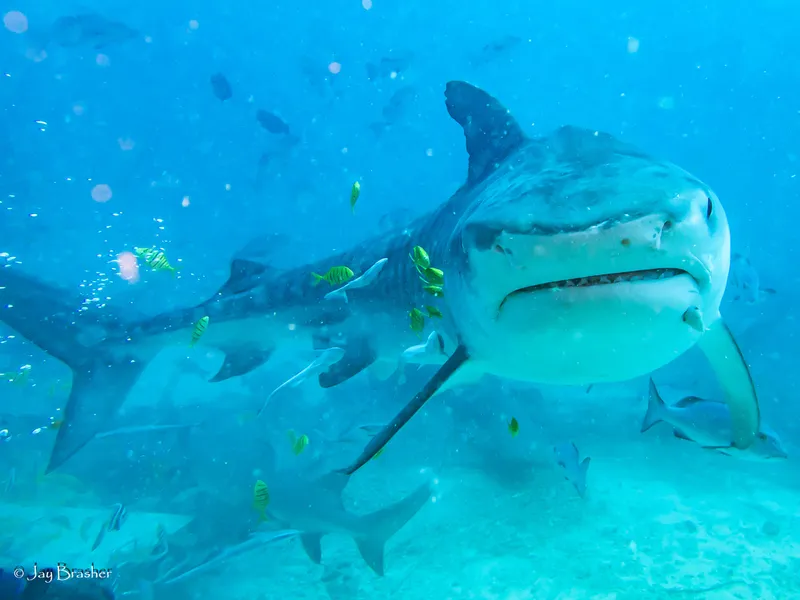
| Key feature | Dark vertical bars that fade with age; broad, blunt snout |
| Other names | Hiu macan, cucut macan; hiu diamin (Aceh) |
| Risk to people | Bites are rare but can be fatal |
| IUCN status | Near Threatened · IUCN Red List (via GBIF) · checked 25 September 2026 |
In this guide (10)
What is the tiger shark?
The tiger shark (Galeocerdo cuvier) is a large shark named for the dark vertical bars on its body. The bars are clearest in young sharks and fade with age. Its snout is very short, broad and blunt, and its large, serrated teeth are shaped like a cockscomb. The Florida Museum says tiger sharks commonly reach 3.25–4.25 m and weigh about 385–635 kg. Fishes of Australia records a maximum known length of 7.4 m, although most are under 5 m. It was long placed among the requiem sharks (Carcharhinidae), but FishBase now puts it in its own family, Galeocerdonidae.
Evidence: FishBase — Galeocerdo cuvier, Tiger shark ↗ · Florida Museum of Natural History — Galeocerdo cuvier (tiger shark) species profile ↗ · Museums Victoria, Fishes of Australia — Tiger Shark, Galeocerdo cuvier ↗
Where does the tiger shark live?
Tiger sharks live in tropical and warm temperate seas worldwide, including Indonesian waters. They range from inshore waters to the outer continental shelf, often around coral reefs and sometimes far offshore. Most stay above 100 m, but tagging shows they can dive below 1,000 m and travel thousands of kilometres. In Indonesia the tiger shark is one of the five sharks most often landed at Lampulo fishing port in Banda Aceh. At Tanjung Luar in East Lombok, it made up 20 per cent of the sharks landed in 2014–2017, according to Wildlife Conservation Society data.
Evidence: Museums Victoria, Fishes of Australia — Tiger Shark, Galeocerdo cuvier ↗ · Kementerian Kelautan dan Perikanan (PIPP) — Identifikasi Hiu di Pelabuhan Perikanan Lampulo ↗ · Mongabay Indonesia (2019) — Saat Hiu-Hiu itu Didaratkan di Pelabuhan Tanjung Luar ↗
What does the tiger shark eat?
Tiger sharks eat almost anything, and Fishes of Australia says they may have the most varied diet of any shark. Prey includes bony fish, other sharks, rays, turtles, seabirds, sea snakes, dolphins, squid, crabs and lobsters. They also scavenge carrion, including whale carcasses. Rubbish such as plastic, cans and sacks has been found in their stomachs. Juveniles eat mainly fish and crustaceans, and their diet broadens as they grow. FishBase describes the species as a night-time feeder. Serrated teeth and a side-to-side shake of the head let it tear chunks from much larger animals.
Evidence: Museums Victoria, Fishes of Australia — Tiger Shark, Galeocerdo cuvier ↗ · Florida Museum of Natural History — Galeocerdo cuvier (tiger shark) species profile ↗ · FishBase — Galeocerdo cuvier, Tiger shark ↗
How do tiger sharks reproduce?
Tiger sharks give birth to live young after a long pregnancy. Fishes of Australia says females bear litters of 10–80 pups, 50–90 cm long, after a gestation of 15–16 months. Males mature at about 3 m long and females at about 3.3 m. Animal Diversity Web says females mate roughly once every three years. Pups are independent from birth, and the mother does not help them find food or shelter. Their striped pattern gives young sharks camouflage. FishBase lists a maximum reported age of 50 years.
Evidence: Museums Victoria, Fishes of Australia — Tiger Shark, Galeocerdo cuvier ↗ · Animal Diversity Web — Galeocerdo cuvier (tiger shark) ↗ · FishBase — Galeocerdo cuvier, Tiger shark ↗
Is the tiger shark dangerous to people?
Yes, tiger sharks can be dangerous, but shark bites on people are very rare. The International Shark Attack File (ISAF) at the Florida Museum lists 142 confirmed unprovoked bites by tiger sharks since 1580, 39 of them fatal. Only the white shark has more. ISAF cautions that large, easily recognised species are more likely to be identified in bite records. The Florida Museum says tiger sharks are often curious and unaggressive when met, but should be treated with great caution. In 2025 ISAF recorded just 65 unprovoked bites worldwide. If someone is bitten, seek medical care at a health facility immediately.
Evidence: Florida Museum, International Shark Attack File — Species Implicated in Attacks ↗ · Florida Museum of Natural History — Galeocerdo cuvier (tiger shark) species profile ↗ · Florida Museum, International Shark Attack File — Yearly Worldwide Shark Attack Summary (2025) ↗
What should you do if you meet a tiger shark?
If a shark comes close, ISAF advises keeping your eyes on it, moving away slowly and leaving the water if you can. Do not approach, feed or harass sharks. To lower your risk, swim with a friend, stay close to shore and avoid swimming at dawn or dusk. Do not swim near schools of fish or people who are fishing. The Florida Museum notes that tiger sharks favour murky coastal waters, river mouths and harbours. Tiger sharks are themselves under fishing pressure and are listed as Near Threatened by the IUCN. At Tanjung Luar, almost every part of a shark is sold, from fins and meat to skin.
Evidence: Florida Museum, International Shark Attack File — Quick Tips ↗ · Florida Museum of Natural History — Galeocerdo cuvier (tiger shark) species profile ↗ · Mongabay Indonesia (2019) — Saat Hiu-Hiu itu Didaratkan di Pelabuhan Tanjung Luar ↗
Explore related habitats
These habitat relationships are supported by species sources in this guide. This is not a complete range map.
Common questions about the Tiger shark
What is the scientific name of the Tiger shark?
The scientific name of the Tiger shark is Galeocerdo cuvier, in the family Carcharhinidae. In Indonesian it is called Hiu macan.
Where can the Tiger shark be found in Indonesia?
In Indonesia, this guide records the Tiger shark in: Aceh, West Nusa Tenggara and East Nusa Tenggara.
Source-supported habitats: Coral Reefs.
What does the Tiger shark eat?
Diet of the Tiger shark: fish, sharks, rays, turtles, seabirds, carrion and even rubbish.
What is the conservation status of the Tiger shark?
On the IUCN Red List, the Tiger shark is listed as Near Threatened: it is close to qualifying, or likely to qualify, for a threatened category in the near future. Source: IUCN Red List (via GBIF), checked 25 September 2026.
This global category is separate from legal protection in Indonesia. To check whether the Tiger shark is a protected species, consult the current national list of protected species or contact the local BKSDA (natural resources conservation office).
Sources & references
- FishBase — Galeocerdo cuvier, Tiger shark ↗
- Animal Diversity Web — Galeocerdo cuvier (tiger shark) ↗
- Florida Museum of Natural History — Galeocerdo cuvier (tiger shark) species profile ↗
- Museums Victoria, Fishes of Australia — Tiger Shark, Galeocerdo cuvier ↗
- Florida Museum, International Shark Attack File — Species Implicated in Attacks ↗
- Florida Museum, International Shark Attack File — Yearly Worldwide Shark Attack Summary (2025) ↗
- Florida Museum, International Shark Attack File — Quick Tips ↗
- Mongabay Indonesia (2019) — Saat Hiu-Hiu itu Didaratkan di Pelabuhan Tanjung Luar ↗
- Kementerian Kelautan dan Perikanan (PIPP) — Identifikasi Hiu di Pelabuhan Perikanan Lampulo ↗
- IUCN Red List of Threatened Species, version 2026-1, via GBIF (CC BY 4.0) ↗
References can change. Check dates and context in the original source.
Further reading
Tiger shark: facts, threats and conservation ↗ — World Animal Rescue Network.
Cite this page
PanduanHewan. (2026, 25 September). Tiger shark (Galeocerdo cuvier). PanduanHewan.org. https://panduanhewan.org/en/species/tiger-shark/