Quick answer
IUCN status: Least ConcernBlack-striped Squirrel at a glance
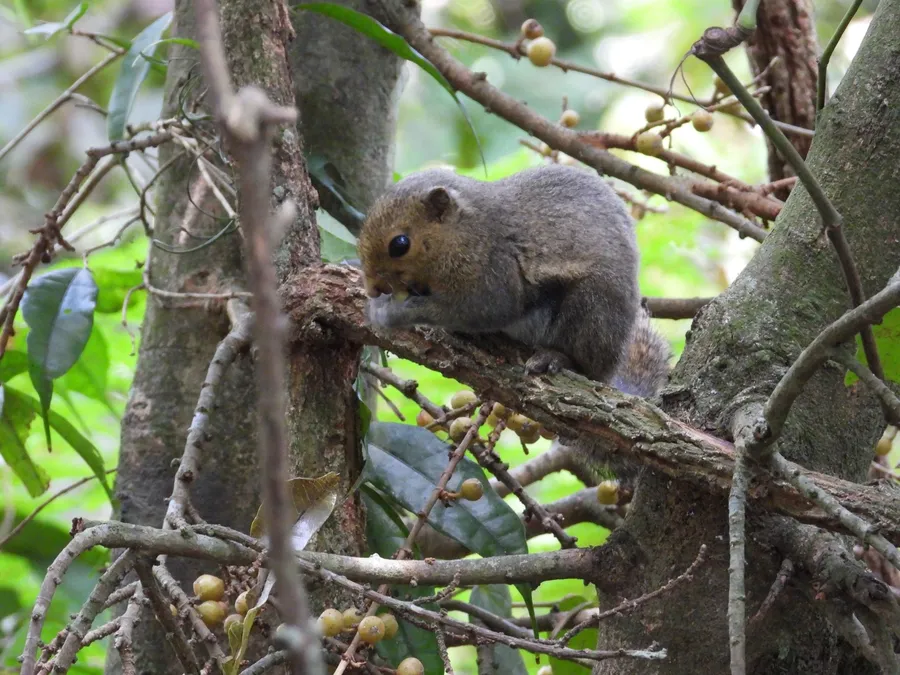
The Black-striped Squirrel (Callosciurus nigrovittatus) is a mammal in the family Sciuridae. In Indonesia, observation records come mainly from West Java, Jambi, East Java. Diet: fruit and insects; a omnivore. IUCN Red List status: Least Concern.
| Scientific name | Callosciurus nigrovittatus |
|---|---|
| Indonesian name | Bajing Kelabu |
| Group | Mammals |
| Family | Sciuridae |
| Observation records | West Java, Jambi, East Java |
| Linked habitats | Tropical Rainforests |
| Taxonomic group | Rodentia |
| GBIF records | 120 human-observation records, 2016–2026 |
| Data retrieved | 2026-09-23 |
| IUCN status | Least Concern · IUCN Red List (via GBIF) · checked 1 October 2026 |
| Diet type | Omnivore (eats plants and animals) — fruit and insects · Handbook of the Mammals of the World (via Zenodo) |
| Reproduction | Giving birth to live young (viviparous) · Animal Diversity Web |
| Active | Diurnal (active by day) · EltonTraits 1.0 (Wilman et al. 2014, Ecology 95:2027), MamFuncDat.txt |
In this guide (13)
What is the Black-striped Squirrel?
Black-striped Squirrel refers to Callosciurus nigrovittatus, in the genus Callosciurus, family Sciuridae, and order Rodentia. The scientific name follows the accepted taxon in the GBIF Backbone Taxonomy. Common names can vary between places; the scientific name distinguishes this species from relatives.
What is known about the Black-striped Squirrel?
The black-striped squirrel occurs on Java, Sumatra and the Malay Peninsula; its dark side stripe can assist identification in a clear view.
Read that fact alongside the scientific name and species source, not as proof from an unclear photograph. Populations, ages and taxonomic limits can differ; when identification is uncertain, record the broader group.
Evidence: Species account — background reading ↗
Habitat and field observations of the Black-striped Squirrel
Black-striped squirrels forage in the canopy and understorey of primary and secondary forest. Fruit and insects are documented foods; use of disturbed sites varies by study area.
Evidence: GBIF species treatments — natural-history accounts ↗
How many Indonesian records name the Black-striped Squirrel?
When checked on 2026-09-23, the GBIF search returned 120 human-observation records from Indonesia under this species name for 2016–2026. That is a count of indexed records, not an estimate of population, abundance or unique individuals. Observation effort can vary by location, and the count may change as records are added or identifications revised.
Evidence: GBIF occurrence search — Indonesia, human observations, 2016–2026 ↗
Where were observations reported?
Place labels appearing in the results include West Java, Jambi, East Java. They are labels attached to records, not a complete range map or evidence that the species occurs only there. Some labels may be broad or inconsistent. Check the underlying records before using the location information for field decisions.
Evidence: GBIF occurrence search — Indonesia, human observations, 2016–2026 ↗
How can you observe the Black-striped Squirrel?
Watch from a distance, do not feed, and avoid sharing precise locations of vulnerable dens or resting sites. Do not try to catch or touch wild mammals. A well-documented sighting helps others check the identification without turning one encounter into a conservation-status claim.
Explore related animals
To explore this group further, compare Black-striped Squirrel with Prevost's Squirrel, Plantain Squirrel, Whitish Dwarf Squirrel. These links reflect a shared genus, family, order, class or catalogue group; taxonomic proximity does not imply identical habitat needs or conservation status.
Explore related habitats
These habitat relationships are supported by species sources in this guide. This is not a complete range map.
Scientific classification of the Black-striped Squirrel
| Kingdom | Animalia |
|---|---|
| Phylum | Chordata |
| Class | Mammalia |
| Order | Rodentia |
| Family | Sciuridae |
| Genus | Callosciurus |
| Species | Callosciurus nigrovittatus |
Source: GBIF Backbone Taxonomy, adjusted to the ranks commonly used in school biology (for example class Reptilia).
Common questions about the Black-striped Squirrel
What is the scientific name of the Black-striped Squirrel?
The scientific name of the Black-striped Squirrel is Callosciurus nigrovittatus, in the family Sciuridae and the order Rodentia. In Indonesian it is called Bajing Kelabu.
What kind of animal is the Black-striped Squirrel?
The Black-striped Squirrel is a mammal in the family Sciuridae. By diet it is a omnivore (eats plants and animals): a fruit and insects.
Where does the Black-striped Squirrel live in Indonesia?
Observation records of the Black-striped Squirrel summarised in this guide mainly come from West Java, Jambi, East Java. That list is not a complete range map.
Source-supported habitats: Tropical Rainforests.
What does the Black-striped Squirrel eat?
The Black-striped Squirrel is a fruit and insects. That makes it a omnivore (eats plants and animals). Source: Handbook of the Mammals of the World (via Zenodo).
How does the Black-striped Squirrel reproduce?
The Black-striped Squirrel reproduces by giving birth to live young (viviparous). Source: Animal Diversity Web.
Is the Black-striped Squirrel nocturnal?
The cited source records the Black-striped Squirrel as diurnal (active by day). Source: EltonTraits 1.0 (Wilman et al. 2014, Ecology 95:2027), MamFuncDat.txt.
See also the list of nocturnal and diurnal animals in Indonesia.
What is the scientific classification of the Black-striped Squirrel?
Scientific classification of the Black-striped Squirrel: kingdom Animalia, phylum Chordata, class Mammalia, order Rodentia, family Sciuridae, genus Callosciurus, species Callosciurus nigrovittatus.
Source: GBIF Backbone Taxonomy, adjusted to the ranks commonly used in school biology.
Is the Black-striped Squirrel endangered?
No, according to the global IUCN assessment. On the IUCN Red List, the Black-striped Squirrel is listed as Least Concern: it does not qualify for a threatened category or for Near Threatened in the global assessment. Source: IUCN Red List (via GBIF), checked 1 October 2026.
This global category is separate from legal protection in Indonesia. To check whether the Black-striped Squirrel is a protected species, consult the current national list of protected species or contact the local BKSDA (natural resources conservation office).
Sources & references
- GBIF Backbone Taxonomy — accepted taxon ↗
- GBIF occurrence search — Indonesia, human observations, 2016–2026 ↗
- GBIF species treatments — natural-history accounts ↗
- iNaturalist — exact species taxon and community observations ↗
- Species account — background reading ↗
- Handbook of the Mammals of the World (via Zenodo) ↗
- Animal Diversity Web ↗
- EltonTraits 1.0 (Wilman et al. 2014, Ecology 95:2027), MamFuncDat.txt ↗
- GBIF Backbone Taxonomy (GBIF) ↗
- IUCN Red List of Threatened Species, version 2026-1, via GBIF (CC BY 4.0) ↗
References can change. Check dates and context in the original source. How we use sources and data →
Cite this page
Credit PanduanHewan when referring to this page. Check the original evidence sources before reusing a claim.
PanduanHewan. Black-striped Squirrel (Callosciurus nigrovittatus). Last substantive update: 1 October 2026. https://panduanhewan.org/en/species/callosciurus-nigrovittatus/