Quick answer
IUCN status: Critically EndangeredScalloped hammerhead shark at a glance
The Scalloped hammerhead shark (Sphyrna lewini) is a marine animal in the family Sphyrnidae. Its IUCN Red List category is Critically Endangered.
| Scientific name | Sphyrna lewini |
|---|---|
| Indonesian name | Hiu martil |
| Group | Marine |
| Family | Sphyrnidae |
| Range in Indonesia | Indian Ocean, Sunda Strait, Java Sea, Borneo waters, South China Sea, Sulawesi, Maluku and Papua |
| Diet | Fish, squid, crustaceans, small sharks and rays |
| Range in Indonesia | Indian Ocean to Papua, including the Java Sea |
| Key feature | Curved front edge of head with a shallow central notch |
| Other names | Hiu martil, hiu caping, hiu topeng (Indonesian) |
| Risk to people | Potentially dangerous, but often not aggressive towards divers |
| IUCN status | Critically Endangered · IUCN Red List (via GBIF) · checked 25 September 2026 |
In this guide (10)
What is the scalloped hammerhead shark?
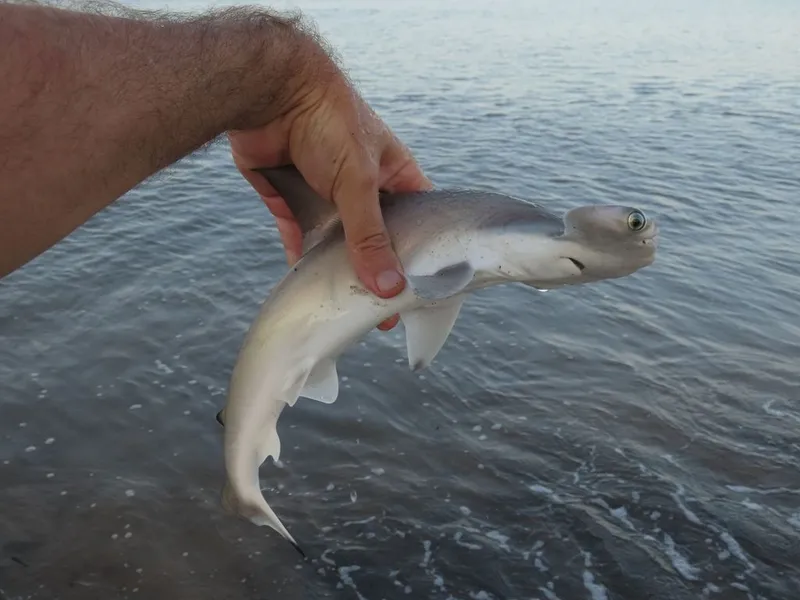
The scalloped hammerhead (Sphyrna lewini) is a shark whose head is widened sideways like a hammer. According to Indonesian fisheries regulation No. 5/PERMEN-KP/2018, the front edge of the head is strongly curved with a shallow central notch, and the head is less than a third as wide as the body is long. The first dorsal fin is tall and curved. The back is grey, the belly white and the pectoral fin tips dark. FishBase gives a maximum length of 430 cm and weight of 152.4 kg. It resembles the great hammerhead (S. mokarran), with an almost straight head edge, and the smooth hammerhead (S. zygaena), which lacks the notch.
Evidence: Kementerian Kelautan dan Perikanan (via JDIH BPK) — Permen KP Nomor 5/PERMEN-KP/2018, lampiran deskripsi hiu koboi dan hiu martil ↗ · Animal Diversity Web — Sphyrna lewini (scalloped hammerhead shark) ↗ · FishBase — Sphyrna lewini, Scalloped hammerhead ↗
Where does the scalloped hammerhead shark live?
Scalloped hammerheads live in warm tropical and subtropical seas worldwide, from coastal waters to the open sea over continental and island shelves. In Indonesia, according to the fisheries ministry (KKP), the species ranges across the Indian Ocean, Sunda Strait, Java Sea, western and eastern Borneo waters, South China Sea, Sulawesi, Maluku and Papua. It is usually found down to about 275 metres. It often comes close inshore and enters bays and estuaries, and juveniles live in coastal waters. A 2020 genetic study found that hammerheads from Aceh and West Papua form separate populations, while sharks from Balikpapan and Lombok are mixed.
Evidence: Kementerian Kelautan dan Perikanan (via JDIH BPK) — Permen KP Nomor 5/PERMEN-KP/2018, lampiran deskripsi hiu koboi dan hiu martil ↗ · FishBase — Sphyrna lewini, Scalloped hammerhead ↗ · PLOS ONE (2020) — Genetic connectivity of the scalloped hammerhead shark Sphyrna lewini across Indonesia and the Western Indian Ocean ↗
What does the scalloped hammerhead shark eat?
Scalloped hammerheads feed mainly on bony fish and squid, as well as lobsters, shrimps, crabs and smaller sharks and rays. According to Animal Diversity Web (ADW), young sharks tend to eat bottom-dwelling fish in coastal waters, while adults hunt fish and squid in deeper water. Hammerheads in the Indo-West Pacific have also been seen eating sea snakes. The species forages actively at night. The underside of its snout and wide head carries electrical sensors, the ampullae of Lorenzini, which help it find prey buried in the seabed.
Evidence: FishBase — Sphyrna lewini, Scalloped hammerhead ↗ · Animal Diversity Web — Sphyrna lewini (scalloped hammerhead shark) ↗
How do scalloped hammerhead sharks live and breed?
Scalloped hammerheads give birth to live young through a placenta, with 12–41 pups born after a gestation of 9–10 months, according to FishBase. Newborns measure about 39–57 cm. Adults may live alone, in pairs or in schools, while juveniles form large schools. By day, females often school around drop-offs, reefs and seamounts, then return to the open sea to hunt at dusk. Females tend to return to a single nursery area to give birth. Slow growth, late maturity and a long pregnancy make the population easy to deplete.
Evidence: FishBase — Sphyrna lewini, Scalloped hammerhead ↗ · Animal Diversity Web — Sphyrna lewini (scalloped hammerhead shark) ↗ · PLOS ONE (2020) — Genetic connectivity of the scalloped hammerhead shark Sphyrna lewini across Indonesia and the Western Indian Ocean ↗
Why is the scalloped hammerhead shark endangered?
Scalloped hammerheads are threatened mainly by overfishing, both targeted and as bycatch, for their fins, meat and skin. The IUCN assessed the species as Critically Endangered in 2018, and it is listed on CITES Appendix II, so international trade is monitored. A 2020 genetic study describes Indonesia as the world's top shark-fishing country. At the Tanjung Luar fish auction in East Lombok, scalloped hammerheads made up about 10 per cent of sharks landed in 2014–2017, according to WCS data reported by Mongabay. Fins are the most valuable part, and the meat is sold smoked or as satay in local markets.
Evidence: FishBase — Sphyrna lewini, Scalloped hammerhead ↗ · PLOS ONE (2020) — Genetic connectivity of the scalloped hammerhead shark Sphyrna lewini across Indonesia and the Western Indian Ocean ↗ · Mongabay Indonesia (2019) — Saat Hiu-Hiu itu Didaratkan di Pelabuhan Tanjung Luar ↗
What should you do if you meet a scalloped hammerhead shark?
If you meet a scalloped hammerhead while diving, stay calm, keep your distance and do not chase, touch or feed it. FishBase considers the species potentially dangerous to people but often not aggressive when approached by divers. ADW notes no confirmed attacks on humans by this species. A threatened shark may signal aggression by lowering its pectoral fins and arching its back, so move away slowly if you see this. To help protect it, avoid buying shark fin or shark products of unclear origin, and report suspicious shark trading to fisheries officers.
Evidence: FishBase — Sphyrna lewini, Scalloped hammerhead ↗ · Animal Diversity Web — Sphyrna lewini (scalloped hammerhead shark) ↗
Common questions about the Scalloped hammerhead shark
What is the scientific name of the Scalloped hammerhead shark?
The scientific name of the Scalloped hammerhead shark is Sphyrna lewini, in the family Sphyrnidae. In Indonesian it is called Hiu martil.
Where can the Scalloped hammerhead shark be found in Indonesia?
In Indonesia, this guide records the Scalloped hammerhead shark in: Indian Ocean, Sunda Strait, Java Sea, Borneo waters, South China Sea, Sulawesi, Maluku and Papua.
What does the Scalloped hammerhead shark eat?
Diet of the Scalloped hammerhead shark: fish, squid, crustaceans, small sharks and rays.
What is the conservation status of the Scalloped hammerhead shark?
On the IUCN Red List, the Scalloped hammerhead shark is listed as Critically Endangered: it is considered to face an extremely high risk of extinction in the wild. Source: IUCN Red List (via GBIF), checked 25 September 2026.
This global category is separate from legal protection in Indonesia. To check whether the Scalloped hammerhead shark is a protected species, consult the current national list of protected species or contact the local BKSDA (natural resources conservation office).
Sources & references
- FishBase — Sphyrna lewini, Scalloped hammerhead ↗
- Animal Diversity Web — Sphyrna lewini (scalloped hammerhead shark) ↗
- Kementerian Kelautan dan Perikanan (via JDIH BPK) — Permen KP Nomor 5/PERMEN-KP/2018, lampiran deskripsi hiu koboi dan hiu martil ↗
- PLOS ONE (2020) — Genetic connectivity of the scalloped hammerhead shark Sphyrna lewini across Indonesia and the Western Indian Ocean ↗
- Mongabay Indonesia (2019) — Saat Hiu-Hiu itu Didaratkan di Pelabuhan Tanjung Luar ↗
- IUCN Red List of Threatened Species, version 2026-1, via GBIF (CC BY 4.0) ↗
References can change. Check dates and context in the original source.
Further reading
Hammerhead shark: facts, threats and conservation ↗ — World Animal Rescue Network. A broader overview that covers this animal.
Cite this page
PanduanHewan. (2026, 25 September). Scalloped hammerhead shark (Sphyrna lewini). PanduanHewan.org. https://panduanhewan.org/en/species/scalloped-hammerhead-shark/