Quick answer
IUCN status: EndangeredOceanic Manta Ray at a glance
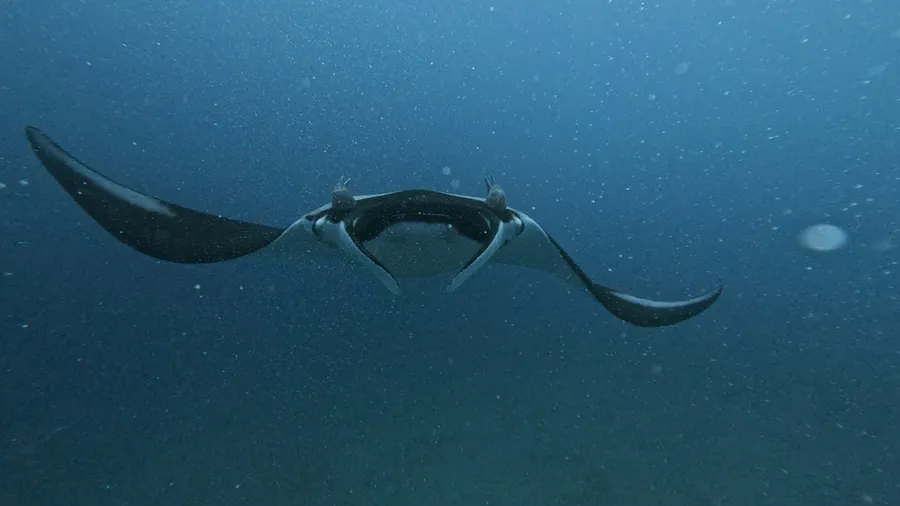
The Oceanic Manta Ray (Mobula birostris) is a marine animal in the family Mobulidae. In Indonesia, observation records come mainly from West Papua, East Nusa Tenggara, Bali. Diet: plankton filter-feeder, sometimes small fish; a carnivore. IUCN Red List status: Endangered. It is a legally protected species in Indonesia (Fisheries Decree 4/2014).
| Scientific name | Mobula birostris |
|---|---|
| Former scientific name | Manta birostris |
| Indonesian name | Pari manta oseanik |
| Group | Marine |
| Family | Mobulidae |
| Observation records | West Papua, East Nusa Tenggara, Bali |
| Taxonomic group | Myliobatiformes |
| GBIF records | 80 human-observation records, 2016–2026 |
| Data retrieved | 2026-09-23 |
| IUCN status | Endangered · IUCN Red List (via GBIF) · checked 1 October 2026 |
| Legal protection in Indonesia | Protected · Fisheries Decree 4/2014 |
| Diet type | Carnivore (meat-eater) — plankton filter-feeder, sometimes small fish · FishBase |
| Reproduction | Ovoviviparity: eggs hatch inside the mother and live young are born · FishBase |
| Venom or poison | Not venomous · FishBase: Mobula birostris species summary |
In this guide (12)
What is the Oceanic Manta Ray?
Oceanic Manta Ray refers to Mobula birostris, in the genus Mobula, family Myliobatidae, and order Myliobatiformes. The scientific name follows the accepted taxon in the GBIF Backbone Taxonomy. Common names can vary between places; the scientific name distinguishes this species from relatives.
What is known about the Oceanic Manta Ray?
The giant oceanic manta ray differs from Indonesia's reef manta; size, habitat and body characters should be considered together rather than the word 'manta' alone.
Read that fact alongside the scientific name and species source, not as proof from an unclear photograph. Populations, ages and taxonomic limits can differ; when identification is uncertain, record the broader group.
Evidence: Species account — background reading ↗
How many Indonesian records name the Oceanic Manta Ray?
When checked on 2026-09-23, the GBIF search returned 80 human-observation records from Indonesia under this species name for 2016–2026. That is a count of indexed records, not an estimate of population, abundance or unique individuals. Observation effort can vary by location, and the count may change as records are added or identifications revised.
Evidence: GBIF occurrence search — Indonesia, human observations, 2016–2026 ↗
Where were observations reported?
Place labels appearing in the results include West Papua, East Nusa Tenggara, Bali. They are labels attached to records, not a complete range map or evidence that the species occurs only there. Some labels may be broad or inconsistent. Check the underlying records before using the location information for field decisions.
Evidence: GBIF occurrence search — Indonesia, human observations, 2016–2026 ↗
How can you observe the Oceanic Manta Ray?
In the water, keep space, do not chase or touch, and avoid blocking the animal’s route. Record place and date; photographs cannot estimate how many individuals live throughout a sea area. A well-documented sighting helps others check the identification without turning one encounter into a conservation-status claim.
Explore related animals
To explore this group further, compare Oceanic Manta Ray with Reef manta ray, Bluespotted Fantail Ray, Bluespotted Maskray. These links reflect a shared genus, family, order, class or catalogue group; taxonomic proximity does not imply identical habitat needs or conservation status.
Scientific classification of the Oceanic Manta Ray
| Kingdom | Animalia |
|---|---|
| Phylum | Chordata |
| Class | Chondrichthyes |
| Order | Myliobatiformes |
| Family | Mobulidae |
| Genus | Mobula |
| Species | Mobula birostris |
Source: GBIF Backbone Taxonomy, adjusted to the ranks commonly used in school biology (for example class Reptilia).
Common questions about the Oceanic Manta Ray
What is the scientific name of the Oceanic Manta Ray?
The scientific name of the Oceanic Manta Ray is Mobula birostris, in the family Mobulidae and the order Myliobatiformes. In Indonesian it is called Pari manta oseanik. A former scientific name still often used: Manta birostris.
What kind of animal is the Oceanic Manta Ray?
The Oceanic Manta Ray is a marine animal in the family Mobulidae. By diet it is a carnivore (meat-eater): a plankton filter-feeder, sometimes small fish.
Where does the Oceanic Manta Ray live in Indonesia?
Observation records of the Oceanic Manta Ray summarised in this guide mainly come from West Papua, East Nusa Tenggara, Bali. That list is not a complete range map.
What does the Oceanic Manta Ray eat?
The Oceanic Manta Ray is a plankton filter-feeder, sometimes small fish. That makes it a carnivore (meat-eater). Source: FishBase.
How does the Oceanic Manta Ray reproduce?
The Oceanic Manta Ray reproduces by ovoviviparity: eggs hatch inside the mother and live young are born. Usually one pup (at most two); embryos use yolk and then nutritious uterine fluid (aplacental viviparity). Source: FishBase.
Is the Oceanic Manta Ray venomous?
No. The Oceanic Manta Ray is not venomous. Unlike stingrays, the oceanic manta's tail usually lacks a stinging spine. Source: FishBase: Mobula birostris species summary.
Do not catch, handle or disturb wild animals. If bitten, stung or exposed to its toxins, go to the nearest health facility straight away.
What is the scientific classification of the Oceanic Manta Ray?
Scientific classification of the Oceanic Manta Ray: kingdom Animalia, phylum Chordata, class Chondrichthyes, order Myliobatiformes, family Mobulidae, genus Mobula, species Mobula birostris.
Source: GBIF Backbone Taxonomy, adjusted to the ranks commonly used in school biology.
Is the Oceanic Manta Ray endangered?
Yes. On the IUCN Red List, the Oceanic Manta Ray is listed as Endangered: it is considered to face a very high risk of extinction in the wild. Source: IUCN Red List (via GBIF), checked 1 October 2026.
This global category is separate from national legal protection. Is the Oceanic Manta Ray protected in Indonesia?
Is the Oceanic Manta Ray protected in Indonesia?
Yes. The Oceanic Manta Ray (Mobula birostris) is a protected species in Indonesia under Marine Affairs and Fisheries Ministerial Decree No. 4/KEPMEN-KP/2014 on full protection of manta rays; the annex lists it as Manta birostris.
If you see this animal being traded, kept or injured, contact the local BKSDA office or the local marine and fisheries office.
Compare with similar animals
Sources & references
- GBIF Backbone Taxonomy — accepted taxon ↗
- GBIF occurrence search — Indonesia, human observations, 2016–2026 ↗
- iNaturalist — exact species taxon and community observations ↗
- Species account — background reading ↗
- Keputusan Menteri Kelautan dan Perikanan Nomor 4/KEPMEN-KP/2014 tentang Penetapan Status Perlindungan Penuh Ikan Pari Manta ↗
- FishBase ↗
- GBIF Backbone Taxonomy (GBIF) ↗
- IUCN Red List of Threatened Species, version 2026-1, via GBIF (CC BY 4.0) ↗
References can change. Check dates and context in the original source. How we use sources and data →
Related causes and news
Further reading
Manta ray: facts, threats and conservation ↗ — World Animal Rescue Network. A broader overview that covers this animal.
Related site: PanduanHewan’s founder is also a director of World Animal Rescue Network.
Cite this page
Credit PanduanHewan when referring to this page. Check the original evidence sources before reusing a claim.
PanduanHewan. Oceanic Manta Ray (Mobula birostris). Last substantive update: 1 October 2026. https://panduanhewan.org/en/species/mobula-birostris/