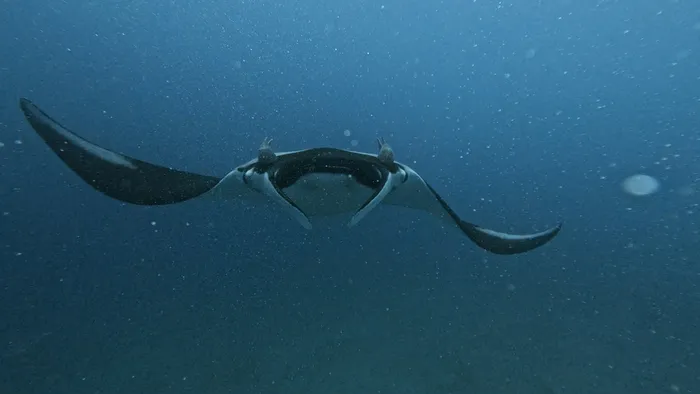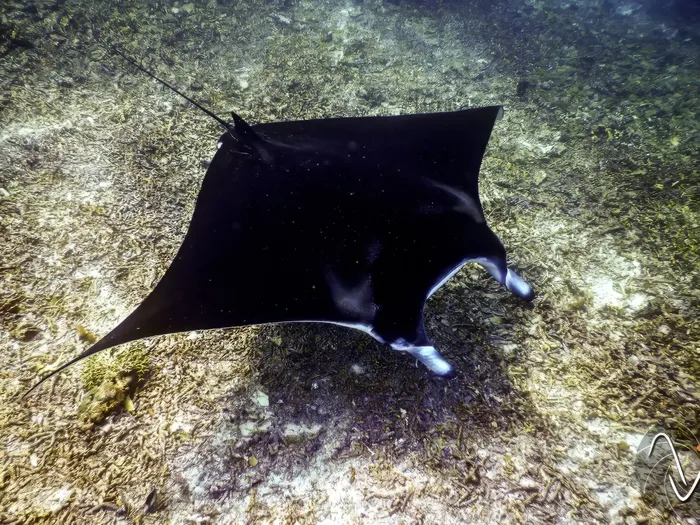
Mobula alfredi
A large ray that filters zooplankton and uses coastal and reef areas. Learn its identity, feeding behaviour, and why observation needs to leave it space.
PANDUANHEWAN · INDONESIA
How do the Reef manta ray (Mobula alfredi) and Oceanic Manta Ray (Mobula birostris) differ? Classification, features, range, diet, size, IUCN status and legal protection, from cited sources.
The reef manta ray (Mobula alfredi) and the Oceanic Manta Ray (Mobula birostris) are different species in the same genus, Mobula. Range in Indonesia — the reef manta ray: Main populations at Berau (East Kalimantan), Nusa Penida (Bali), Komodo (East Nusa Tenggara) and Raja Ampat (Southwest Papua); the Oceanic Manta Ray: West Papua, East Nusa Tenggara, Bali.
A large ray that filters zooplankton and uses coastal and reef areas. Learn its identity, feeding behaviour, and why observation needs to leave it space.
Oceanic Manta Ray (Mobula birostris). The giant oceanic manta ray differs from Indonesia's reef manta; size, habitat and body characters should be considered together rather than the word 'manta' alone.
| Aspect | Reef manta ray | Oceanic Manta Ray |
|---|---|---|
| Scientific name | Mobula alfredi | Mobula birostris |
| Indonesian name | Pari manta karang | Pari manta oseanik |
| Class | Chondrichthyes | Chondrichthyes |
| Order | Myliobatiformes | Myliobatiformes |
| Family | Mobulidae | Mobulidae |
| Range in Indonesia | Main populations at Berau (East Kalimantan), Nusa Penida (Bali), Komodo (East Nusa Tenggara) and Raja Ampat (Southwest Papua) | West Papua, East Nusa Tenggara, Bali |
| Endemic to Indonesia | No | No |
| Size | Disc width: Average 3–3.5 m; maximum recorded 4.31 m | — |
| Diet | Zooplankton | — |
| Diet type | carnivore (meat-eater) | carnivore (meat-eater) |
| Reproduction | ovoviviparity | ovoviviparity |
| IUCN status | Vulnerable | Endangered |
| Legal protection | Protected (Fisheries Decree 4/2014) | Protected (Fisheries Decree 4/2014) |
Every cell comes from the sourced data on each animal’s page; an empty cell means the data is not yet available, not that it is absent.
Search by name, habitat or island in the animal directory.