
Quick answer
IUCN status: VulnerableIndonesian coelacanth at a glance
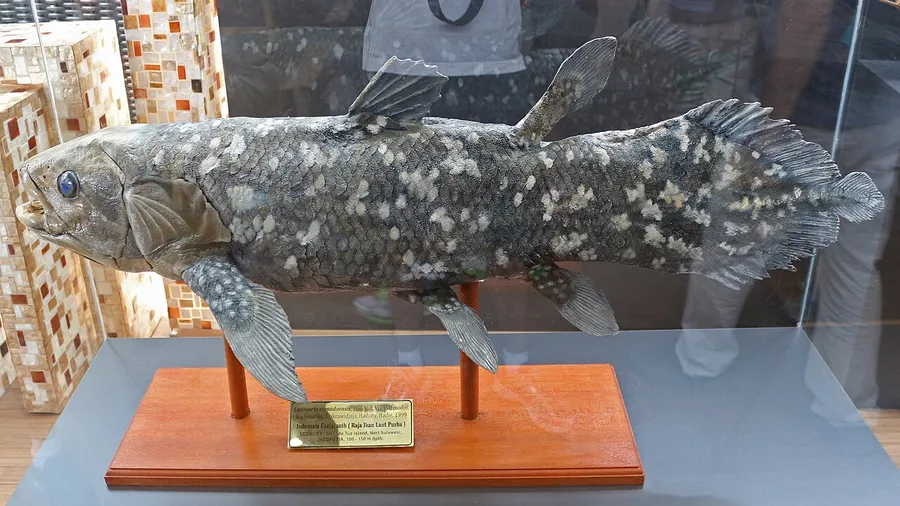
The Indonesian coelacanth (Latimeria menadoensis) is a marine animal in the family Latimeriidae. Range in Indonesia: North Sulawesi, Gorontalo, North Maluku, Raja Ampat and Biak (Papua). It is endemic to Indonesia, living naturally only in Deep waters off North Sulawesi, North Maluku and Papua. Diet: probably fish and squid, like its African relative; a carnivore. IUCN Red List status: Vulnerable. It is a legally protected species in Indonesia (Regulation P.106/2018).
| Scientific name | Latimeria menadoensis |
|---|---|
| Indonesian name | Ikan raja laut |
| Group | Marine |
| Family | Latimeriidae |
| Range in Indonesia | North Sulawesi, Gorontalo, North Maluku, Raja Ampat and Biak (Papua) |
| Diet | Probably fish and squid, like its African relative |
| Range in Indonesia | North Sulawesi, Gorontalo, North Maluku, Raja Ampat, Biak |
| Key feature | Fleshy lobed fins; brownish-grey body with white blotches |
| Other names | Sulawesi coelacanth; raja laut (king of the sea) |
| IUCN status | Vulnerable · IUCN Red List (via GBIF) · checked 1 October 2026 |
| Legal protection in Indonesia | Protected · Regulation P.106/2018 · annex no. 742 |
| Specimen weight | A North Gorontalo specimen (January 2025) was about 1 m and 41 kg; a Siladen Island specimen (2026) about 105 cm and 30 kg · Mongabay Indonesia — Ikan Purba Coelacanth dan Masa Depan Laut Indonesia (2026) |
| Diet type | Carnivore (meat-eater) — predator of fish and squid (inferred from its African relative) · FishBase |
| Reproduction | Ovoviviparity: eggs hatch inside the mother and live young are born · FishBase |
| Venom or poison | Not venomous · FishBase: Latimeria menadoensis species summary |
| Active | Nocturnal (active at night) — Based on coelacanth studies in Africa; in Indonesia one has been seen outside a cave by day. · Sakaue et al. 2021, New Insights About the Behavioral Ecology of the Coelacanth Latimeria chalumnae Video Recorded in the Absence of Humans Off South Africa, Frontiers in Marine Science |
| Endemic to Indonesia | Yes — Deep waters off North Sulawesi, North Maluku and Papua · Nature |
In this guide (12)
What is the Indonesian coelacanth?
The Indonesian coelacanth (Latimeria menadoensis) is a deep-water lobe-finned fish often called a living fossil. Coelacanths belong to a lineage more than 400 million years old, and only two species survive: this one and the African coelacanth (L. chalumnae). According to an FAO identification sheet, it is brownish grey with irregular white blotches, with fleshy lobed fins and a three-part tail. FishBase gives a maximum length of 140 cm. A specimen caught off West Papua proved genetically distinct from the Sulawesi fish, and researchers suggest that another coelacanth species may still await description.
Evidence: FAO Species Identification Guide, Western Central Pacific — Latimeriidae: Latimeria menadoensis (S.L. Jewett) ↗ · FishBase — Latimeria menadoensis, Sulawesi coelacanth ↗ · Scientific Reports (2020) — A thirteen-million-year divergence between two lineages of Indonesian coelacanths ↗
Where does the Indonesian coelacanth live?
The Indonesian coelacanth lives on rocky slopes and in caves in the deep waters of eastern Indonesia, usually at about 150–200 metres according to FishBase. Indonesia's 2025 decree on protected fish species lists its range as North Sulawesi, Biak and Raja Ampat. In October 2024, technical divers photographed a living coelacanth in North Maluku for the first time, at 144 metres in water of 19–20 °C. The fish was hovering above a rock on a steep volcanic slope rather than hiding in a cave. The researchers say the find supports the idea that its range is wider than first thought.
Evidence: FishBase — Latimeria menadoensis, Sulawesi coelacanth ↗ · Kementerian Kelautan dan Perikanan (JDIH KKP) — Keputusan Menteri Kelautan dan Perikanan Nomor 66 Tahun 2025 tentang Jenis Ikan yang Dilindungi ↗ · Scientific Reports (2025) — First record of a living coelacanth from North Maluku, Indonesia ↗
What does the Indonesian coelacanth eat?
The Indonesian coelacanth's diet has hardly been studied directly, but coelacanths are known predators of fish and squid. Most of what we know comes from the African coelacanth. According to FishBase, African coelacanths forage alone at night, drifting slowly with the current near the seabed, and shelter in the nearest cave before dawn. They may travel up to 8 km in a night. Recorded prey includes several deep-water fishes, a skate, an eel and a small shark. For the Indonesian species, FishBase estimates a trophic level of about 4.5, which places it high in the food chain.
Evidence: FishBase — Latimeria chalumnae, Coelacanth ↗ · FishBase — Latimeria menadoensis, Sulawesi coelacanth ↗
How does the Indonesian coelacanth reproduce?
Coelacanths are ovoviviparous: eggs are fertilised inside the female, and the young develop in her oviduct until they are born alive. Most details come from the African coelacanth. FishBase records African females carrying 5–29 young, with gestation estimated at about three years, among the longest known in vertebrates. Newborns measure about 36–38 cm. Researchers describe coelacanths as long-lived, with a low metabolic rate and late sexual maturity, which makes them very sensitive to disturbance. The first juvenile Indonesian coelacanth was sighted in 2009 during surveys in North Sulawesi.
Evidence: FishBase — Latimeria chalumnae, Coelacanth ↗ · Scientific Reports (2025) — First record of a living coelacanth from North Maluku, Indonesia ↗
How was the Indonesian coelacanth discovered?
Science learned of the Indonesian coelacanth after Arnaz and Mark Erdmann saw one for sale at a fish market in Manado, North Sulawesi, on 18 September 1997. Mark recognised the shape of the African coelacanth, but this fish was brown rather than blue. In 1998 fishers netted a second specimen off Manado Tua Island, and the discovery was reported in the journal Nature that year. In 1999 Pouyaud and colleagues described it as a new species, Latimeria menadoensis. Since then, specimens have been reported from Raja Ampat (2018), North Gorontalo (2025) and near Siladen Island, Manado (2026).
Evidence: Mongabay Indonesia (2026) — Ikan Purba Coelacanth dan Masa Depan Laut Indonesia ↗ · FAO Species Identification Guide, Western Central Pacific — Latimeriidae: Latimeria menadoensis (S.L. Jewett) ↗ · Mongabay Indonesia (2021) — Inilah Wujud Ikan Purba Coelacanth yang Hanya Ada di Indonesia dan Afrika ↗
What should you do if you find an Indonesian coelacanth?
The Indonesian coelacanth is fully protected in Indonesia, including its body parts and derived products, under the 2025 decree of the Minister of Marine Affairs and Fisheries. International commercial trade is banned because the species is listed on CITES Appendix I. If one is caught or found, do not sell, eat or keep it, and report it promptly to local marine and fisheries officers. Divers should not chase, touch or disturb it. The researchers who found the North Maluku coelacanth kept the site secret and warned that unregulated coelacanth tourism could become a new threat.
Evidence: Kementerian Kelautan dan Perikanan (JDIH KKP) — Keputusan Menteri Kelautan dan Perikanan Nomor 66 Tahun 2025 tentang Jenis Ikan yang Dilindungi ↗ · FishBase — Latimeria menadoensis, Sulawesi coelacanth ↗ · Scientific Reports (2025) — First record of a living coelacanth from North Maluku, Indonesia ↗
Scientific classification of the Indonesian coelacanth
| Kingdom | Animalia |
|---|---|
| Phylum | Chordata |
| Class | Sarcopterygii |
| Order | Coelacanthiformes |
| Family | Latimeriidae |
| Genus | Latimeria |
| Species | Latimeria menadoensis |
Source: GBIF Backbone Taxonomy, adjusted to the ranks commonly used in school biology (for example class Reptilia).
Common questions about the Indonesian coelacanth
What is the scientific name of the Indonesian coelacanth?
The scientific name of the Indonesian coelacanth is Latimeria menadoensis, in the family Latimeriidae. In Indonesian it is called Ikan raja laut.
What kind of animal is the Indonesian coelacanth?
The Indonesian coelacanth is a marine animal in the family Latimeriidae. By diet it is a carnivore (meat-eater): a predator of fish and squid (inferred from its African relative). It is also endemic to Indonesia.
Where does the Indonesian coelacanth live in Indonesia?
In Indonesia, this guide records the Indonesian coelacanth in: North Sulawesi, Gorontalo, North Maluku, Raja Ampat and Biak (Papua).
The Indonesian coelacanth is endemic to Indonesia and lives naturally only in Deep waters off North Sulawesi, North Maluku and Papua. Source: Nature.
What does the Indonesian coelacanth eat?
Diet of the Indonesian coelacanth: probably fish and squid, like its African relative. That makes it a carnivore (meat-eater). Source: FishBase.
How does the Indonesian coelacanth reproduce?
The Indonesian coelacanth reproduces by ovoviviparity: eggs hatch inside the mother and live young are born. FishBase calls the African coelacanth (Latimeria chalumnae) 'ovoviviparous': huge eggs develop in the mother's oviduct and live young (5–29) are born. Reproductive data for the Indonesian species are very scarce, so this follows its relative. Source: FishBase.
Is the Indonesian coelacanth venomous?
No. The Indonesian coelacanth is not venomous. Source: FishBase: Latimeria menadoensis species summary.
Do not catch, handle or disturb wild animals. If bitten, stung or exposed to its toxins, go to the nearest health facility straight away.
Is the Indonesian coelacanth nocturnal?
The cited source records the Indonesian coelacanth as nocturnal (active at night). Based on coelacanth studies in Africa; in Indonesia one has been seen outside a cave by day. Source: Sakaue et al. 2021, New Insights About the Behavioral Ecology of the Coelacanth Latimeria chalumnae Video Recorded in the Absence of Humans Off South Africa, Frontiers in Marine Science.
See also the list of nocturnal and diurnal animals in Indonesia.
What are the main features of the Indonesian coelacanth?
Key features of the Indonesian coelacanth, from this guide’s sources: Key feature: fleshy lobed fins; brownish-grey body with white blotches.
What is the scientific classification of the Indonesian coelacanth?
Scientific classification of the Indonesian coelacanth: kingdom Animalia, phylum Chordata, class Sarcopterygii, order Coelacanthiformes, family Latimeriidae, genus Latimeria, species Latimeria menadoensis.
Source: GBIF Backbone Taxonomy, adjusted to the ranks commonly used in school biology.
Is the Indonesian coelacanth endangered?
Yes. On the IUCN Red List, the Indonesian coelacanth is listed as Vulnerable: it is considered to face a high risk of extinction in the wild. Source: IUCN Red List (via GBIF), checked 1 October 2026.
This global category is separate from national legal protection. Is the Indonesian coelacanth protected in Indonesia?
Is the Indonesian coelacanth protected in Indonesia?
Yes. The Indonesian coelacanth (Latimeria menadoensis) is a protected species in Indonesia under Environment and Forestry Ministerial Regulation No. P.106/MENLHK/SETJEN/KUM.1/12/2018 on protected plant and animal species (annex, entry 742).
It is also fully protected under Marine Affairs and Fisheries Ministerial Decree No. 66 of 2025 on protected fish species (first provision, entry 63).
Article 21(2) of Law No. 5 of 1990, as amended by Law No. 32 of 2024, prohibits anyone from hunting, catching, injuring, killing, storing, owning, keeping, transporting or trading a protected animal, alive or dead, including its body parts, eggs and nests.
If you see this animal being traded, kept or injured, contact the local BKSDA office.
Can the Indonesian coelacanth be kept as a pet?
No. Because the Indonesian coelacanth is a protected species, catching, owning, keeping, transporting or trading it without a permit is prohibited by law. Trading without a permit through electronic media is also prohibited.
If you see this animal for sale or being kept, report it to the local BKSDA office.
Sources & references
- FishBase — Latimeria menadoensis, Sulawesi coelacanth ↗
- FishBase — Latimeria chalumnae, Coelacanth ↗
- FAO Species Identification Guide, Western Central Pacific — Latimeriidae: Latimeria menadoensis (S.L. Jewett) ↗
- Scientific Reports (2025) — First record of a living coelacanth from North Maluku, Indonesia ↗
- Scientific Reports (2020) — A thirteen-million-year divergence between two lineages of Indonesian coelacanths ↗
- Mongabay Indonesia (2021) — Inilah Wujud Ikan Purba Coelacanth yang Hanya Ada di Indonesia dan Afrika ↗
- Mongabay Indonesia (2026) — Ikan Purba Coelacanth dan Masa Depan Laut Indonesia ↗
- Kementerian Kelautan dan Perikanan (JDIH KKP) — Keputusan Menteri Kelautan dan Perikanan Nomor 66 Tahun 2025 tentang Jenis Ikan yang Dilindungi ↗
- Peraturan Menteri LHK Nomor P.106/MENLHK/SETJEN/KUM.1/12/2018 tentang Jenis Tumbuhan dan Satwa yang Dilindungi ↗
- Sakaue et al. 2021, New Insights About the Behavioral Ecology of the Coelacanth Latimeria chalumnae Video Recorded in the Absence of Humans Off South Africa, Frontiers in Marine Science ↗
- GBIF Backbone Taxonomy (GBIF) ↗
- IUCN Red List of Threatened Species, version 2026-1, via GBIF (CC BY 4.0) ↗
References can change. Check dates and context in the original source. How we use sources and data →
Further reading
Coelacanth: facts, threats and conservation ↗ — World Animal Rescue Network. A broader overview that covers this animal.
Related site: PanduanHewan’s founder is also a director of World Animal Rescue Network.
Cite this page
Credit PanduanHewan when referring to this page. Check the original evidence sources before reusing a claim.
PanduanHewan. Indonesian coelacanth (Latimeria menadoensis). Last substantive update: 1 October 2026. https://panduanhewan.org/en/species/indonesian-coelacanth/