Quick answer
IUCN status: VulnerableLeatherback turtle at a glance
The Leatherback turtle (Dermochelys coriacea) is a marine animal in the family Dermochelyidae. Its IUCN Red List category is Vulnerable.
| Scientific name | Dermochelys coriacea |
|---|---|
| Indonesian name | Penyu belimbing |
| Group | Marine |
| Family | Dermochelyidae |
| Range in Indonesia | Southwest Papua (Tambrauw) and Maluku (Kei Islands and Buru) |
| Diet | Mainly jellyfish and salps |
| Range in Indonesia | Nests mainly at Jamursba Medi and Wermon, Tambrauw |
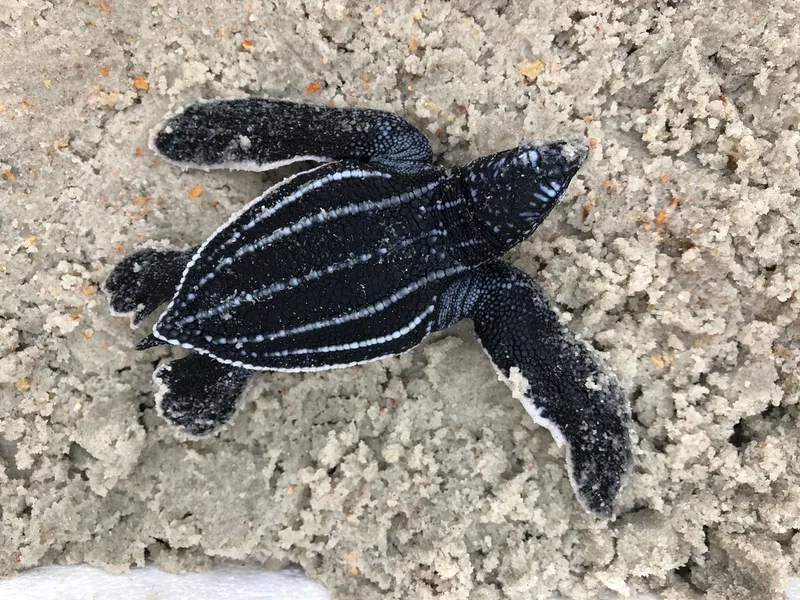
| Key feature | Dark leathery carapace with seven lengthwise ridges |
| Other names | Penyu belimbing (Indonesian), leatherback sea turtle |
| Legal protection in Indonesia | Fully protected (KKP Decree 66/2025; Environment Regulation P.106/2018) |
| IUCN status | Vulnerable · IUCN Red List (via GBIF) · checked 25 September 2026 |
In this guide (10)
What is the leatherback turtle?
The leatherback turtle (Dermochelys coriacea) is the world's largest turtle and the only sea turtle without scales or a hard shell. Its carapace is thick, rubbery skin over small interlocking bones. It is black or dark brown with white spots and has seven ridges running along its length, which inspired the Indonesian name penyu belimbing, after the star fruit. Mongabay Indonesia reports lengths of up to 2 metres and weights of up to one tonne. Its front flippers are much longer than those of other sea turtles, so it is hard to confuse with the hard-shelled green, hawksbill or olive ridley turtles.
Evidence: NOAA Fisheries — Leatherback Turtle ↗ · Kementerian Kelautan dan Perikanan (JDIH KKP) — Keputusan Menteri Kelautan dan Perikanan Nomor 66 Tahun 2025 tentang Jenis Ikan yang Dilindungi ↗ · Mongabay Indonesia (2024) — Migrasi Terjauh Penyu Belimbing dari Papua ke Amerika Berjarak 20.558 Kilometer ↗
Where does the leatherback turtle live?
Leatherbacks live in the open ocean and come ashore only to nest on tropical beaches. Indonesia's most important nesting beaches are Jamursba Medi (now called Jeen Yessa) and Wermon (Jeen Syuab) in Tambrauw Regency, Southwest Papua. Both lie within the Jeen Womom Coastal Park, designated by the Minister of Marine Affairs and Fisheries in 2017. NOAA Fisheries says this Papuan nesting population makes up 50–75 per cent of the western Pacific population. Leatherbacks are also found around the Kei Islands and nest on Buru Island in Maluku. Outside the nesting season, Papuan leatherbacks cross the Pacific to feed off the west coast of the United States.
Evidence: Frontiers in Marine Science (2025) — Population structure and genetic diversity of leatherback turtles (Dermochelys coriacea) in Bird's Head Seascape, Papua-Indonesia ↗ · Mongabay Indonesia (2018) — Pelindung Penyu dari Kepunahan itu Bernama Taman Pesisir Jeen Womom ↗ · NOAA Fisheries — Leatherback Turtle ↗
What does the leatherback turtle eat?
Leatherbacks feed mainly on jellyfish and other soft-bodied animals such as salps. Unlike other sea turtles, they lack a crushing beak. Instead they have sharp-edged jaws with tooth-like points, and their mouth and throat are lined with backward-pointing spines that hold slippery prey. Mongabay Indonesia notes that they also take small amounts of seaweed, fish, shrimp and other invertebrates. To find food, leatherbacks can dive to nearly 1,200 metres and stay down for up to 85 minutes. Floating plastic bags and balloons look like jellyfish, and NOAA Fisheries warns that leatherbacks swallow them by mistake.
Evidence: NOAA Fisheries — Leatherback Turtle ↗ · Mongabay Indonesia (2024) — Migrasi Terjauh Penyu Belimbing dari Papua ke Amerika Berjarak 20.558 Kilometer ↗
How do leatherback turtles nest and migrate?
Female leatherbacks come ashore at night, dig a deep nest and return to the sea. According to NOAA Fisheries, a female nests several times in one season at 8–12-day intervals, and Pacific nests hold about 85–95 eggs the size of tennis balls. The eggs hatch after about two months, and females return to nest every 2–4 years. In Tambrauw, nesting happens all year, peaking from May to September at Jeen Yessa and from December to February at Jeen Syuab. A female from Jamursba Medi, tracked by satellite in 2007, travelled at least 20,558 km in 647 days, reaching Oregon in the United States and returning.
Evidence: NOAA Fisheries — Leatherback Turtle ↗ · Frontiers in Marine Science (2025) — Population structure and genetic diversity of leatherback turtles (Dermochelys coriacea) in Bird's Head Seascape, Papua-Indonesia ↗ · Mongabay Indonesia (2024) — Migrasi Terjauh Penyu Belimbing dari Papua ke Amerika Berjarak 20.558 Kilometer ↗
Why is the leatherback turtle endangered?
Leatherbacks are threatened by egg harvesting, hunting of adults, entanglement in fishing gear and damage to nesting beaches. NOAA Fisheries reports that the western Pacific population has fallen by more than 80 per cent. WWF-Indonesia data quoted by Mongabay show a 78.3 per cent decline at Jeen Womom over the 27 years to 2016. Wild pigs, dogs and monitor lizards dig up nests, and overheated sand can kill the eggs. At sea, leatherbacks are often caught in gillnets and longlines. Globally the IUCN lists the species as Vulnerable, and a 2025 study cites a nesting decline of about 5.9 per cent a year in Tambrauw since 1984.
Evidence: NOAA Fisheries — Leatherback Turtle ↗ · Mongabay Indonesia (2018) — Pelindung Penyu dari Kepunahan itu Bernama Taman Pesisir Jeen Womom ↗ · Frontiers in Marine Science (2025) — Population structure and genetic diversity of leatherback turtles (Dermochelys coriacea) in Bird's Head Seascape, Papua-Indonesia ↗
How can we protect leatherback turtles?
The leatherback is fully protected in Indonesia, including its eggs, body parts and derived products, under Decree No. 66 of 2025 of the Minister of Marine Affairs and Fisheries. Do not buy or eat turtle eggs or meat. On nesting beaches, keep your distance, do not touch turtles or hatchlings, and do not shine lights or torches at them. Cut down on single-use plastic and join beach clean-ups. If you find a stranded, injured or entangled turtle, contact the authorities. In Tambrauw, local people patrol the beaches, relocate some nests and shade nests with palm fronds so the sand does not overheat.
Evidence: Kementerian Kelautan dan Perikanan (JDIH KKP) — Keputusan Menteri Kelautan dan Perikanan Nomor 66 Tahun 2025 tentang Jenis Ikan yang Dilindungi ↗ · NOAA Fisheries — Leatherback Turtle ↗ · Mongabay (2021) — Time is running out for embattled Pacific leatherback sea turtles ↗
Common questions about the Leatherback turtle
What is the scientific name of the Leatherback turtle?
The scientific name of the Leatherback turtle is Dermochelys coriacea, in the family Dermochelyidae. In Indonesian it is called Penyu belimbing.
Where can the Leatherback turtle be found in Indonesia?
In Indonesia, this guide records the Leatherback turtle in: Southwest Papua (Tambrauw) and Maluku (Kei Islands and Buru).
What does the Leatherback turtle eat?
Diet of the Leatherback turtle: mainly jellyfish and salps.
What is the conservation status of the Leatherback turtle?
On the IUCN Red List, the Leatherback turtle is listed as Vulnerable: it is considered to face a high risk of extinction in the wild. Source: IUCN Red List (via GBIF), checked 25 September 2026.
This global category is separate from legal protection in Indonesia. To check whether the Leatherback turtle is a protected species, consult the current national list of protected species or contact the local BKSDA (natural resources conservation office).
Sources & references
- NOAA Fisheries — Leatherback Turtle ↗
- Frontiers in Marine Science (2025) — Population structure and genetic diversity of leatherback turtles (Dermochelys coriacea) in Bird's Head Seascape, Papua-Indonesia ↗
- Mongabay Indonesia (2018) — Pelindung Penyu dari Kepunahan itu Bernama Taman Pesisir Jeen Womom ↗
- Mongabay Indonesia (2024) — Migrasi Terjauh Penyu Belimbing dari Papua ke Amerika Berjarak 20.558 Kilometer ↗
- Mongabay (2021) — Time is running out for embattled Pacific leatherback sea turtles ↗
- Kementerian Kelautan dan Perikanan (JDIH KKP) — Keputusan Menteri Kelautan dan Perikanan Nomor 66 Tahun 2025 tentang Jenis Ikan yang Dilindungi ↗
- Kementerian LHK (via JDIH Kemenko Infrastruktur) — Permen LHK Nomor P.106/MENLHK/SETJEN/KUM.1/12/2018 tentang Jenis Tumbuhan dan Satwa yang Dilindungi ↗
- IUCN Red List of Threatened Species, version 2026-1, via GBIF (CC BY 4.0) ↗
References can change. Check dates and context in the original source.
Further reading
Leatherback turtle: facts, threats and conservation ↗ — World Animal Rescue Network.
Cite this page
PanduanHewan. (2026, 25 September). Leatherback turtle (Dermochelys coriacea). PanduanHewan.org. https://panduanhewan.org/en/species/leatherback-turtle/