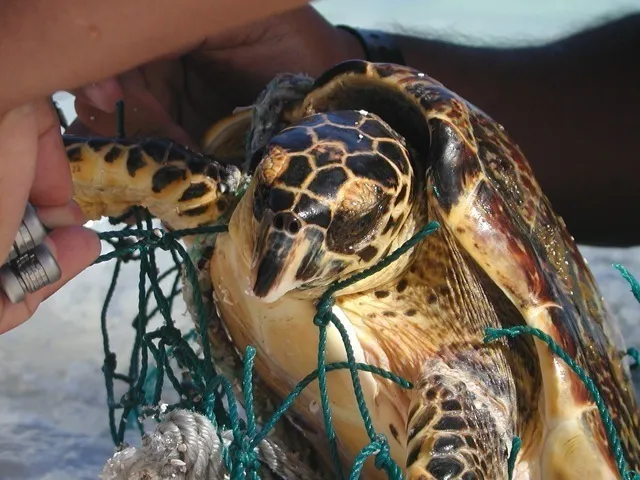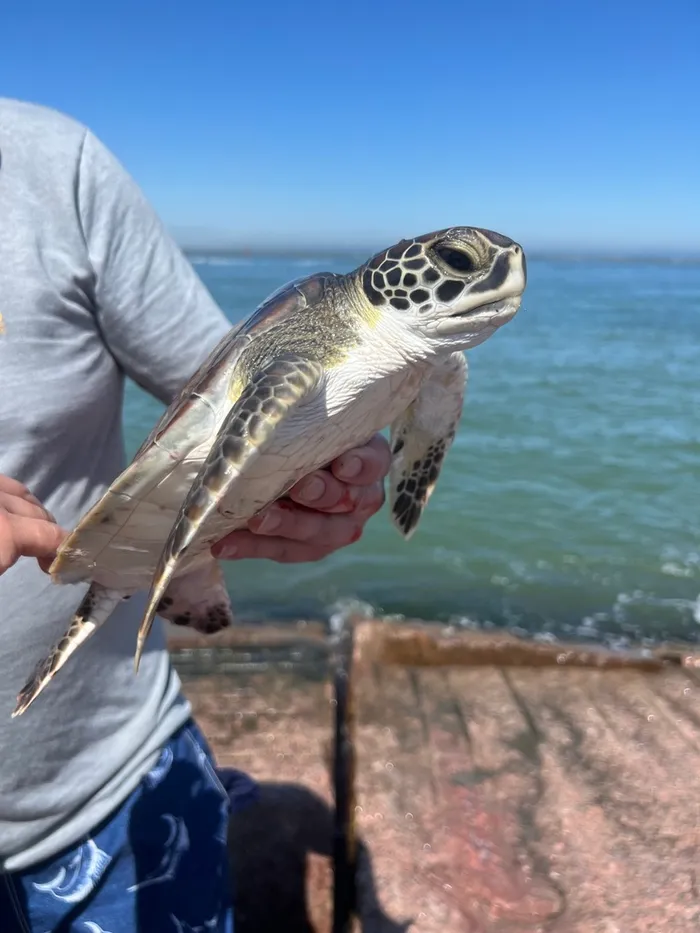
Chelonia mydas
A marine reptile connecting seagrass meadows, coastal waters, and nesting beaches. Global recovery does not remove the threats turtles face at individual sites.
PANDUANHEWAN · INDONESIA
How do the Green turtle (Chelonia mydas) and Hawksbill turtle (Eretmochelys imbricata) differ? Classification, features, range, diet, size, IUCN status and legal protection, from cited sources.
The green turtle (Chelonia mydas) and the hawksbill turtle (Eretmochelys imbricata) share the family Cheloniidae but belong to different genera: Chelonia and Eretmochelys. Range in Indonesia — the green turtle: Widespread in Indonesian waters, from Aceh, West Sumatra, the Riau Islands and West Kalimantan to Java, Bali, Nusa Tenggara, Sulawesi and Papua; nesting beaches include Jamursba Medi (Papua), Sangalaki (Berau), Paloh (Sambas), Pangumbahan (West Java), Sukamade (Meru Betiri) and Perancak (Bali); the hawksbill turtle: Coral-reef waters across Indonesia, especially around small islands in the Java Sea, Flores Sea, Makassar Strait and Karimata Strait.
A marine reptile connecting seagrass meadows, coastal waters, and nesting beaches. Global recovery does not remove the threats turtles face at individual sites.
A pointed-beaked turtle closely associated with coral reefs. Shell trade, accidental capture, and habitat loss connect human choices with its future.
| Aspect | Green turtle | Hawksbill turtle |
|---|---|---|
| Scientific name | Chelonia mydas | Eretmochelys imbricata |
| Indonesian name | Penyu hijau | Penyu sisik |
| Class | Reptilia | Reptilia |
| Order | Testudines | Testudines |
| Family | Cheloniidae | Cheloniidae |
| Range in Indonesia | Widespread in Indonesian waters, from Aceh, West Sumatra, the Riau Islands and West Kalimantan to Java, Bali, Nusa Tenggara, Sulawesi and Papua; nesting beaches include Jamursba Medi (Papua), Sangalaki (Berau), Paloh (Sambas), Pangumbahan (West Java), Sukamade (Meru Betiri) and Perancak (Bali) | Coral-reef waters across Indonesia, especially around small islands in the Java Sea, Flores Sea, Makassar Strait and Karimata Strait |
| Endemic to Indonesia | No | No |
| Key features | — | Pointed beak; overlapping shell scutes |
| Size | — | Carapace length: Up to about 1 m |
| Diet | Mainly seagrasses and algae | Marine sponges |
| Diet type | herbivore (plant-eater) | carnivore (meat-eater) |
| Reproduction | laying eggs (oviparous) | laying eggs (oviparous) |
| IUCN status | Least Concern | Critically Endangered |
| Legal protection | Protected (Regulation P.106/2018) | Protected (Regulation P.106/2018) |
Every cell comes from the sourced data on each animal’s page; an empty cell means the data is not yet available, not that it is absent.
Search by name, habitat or island in the animal directory.