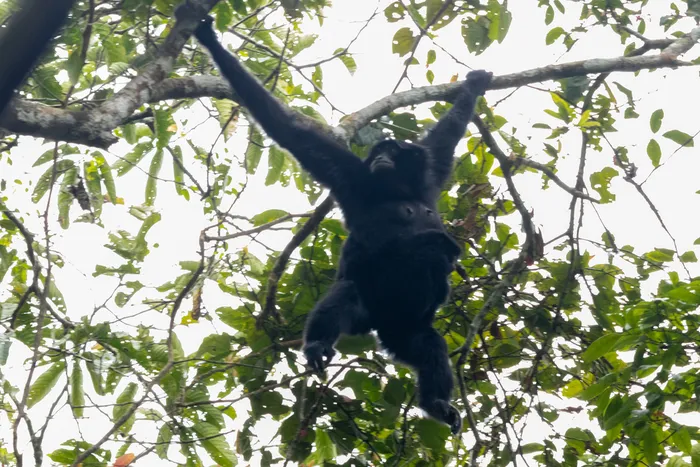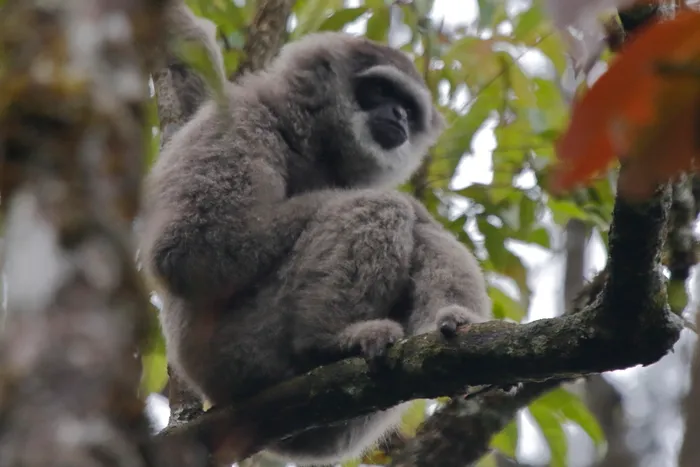
Hylobates moloch
A silvery small ape dependent on Java’s forest canopy. Calls, family relationships, and routes through the trees shape its life.
PANDUANHEWAN · INDONESIA
How do the Javan gibbon (Hylobates moloch) and Siamang (Symphalangus syndactylus) differ? Classification, features, range, diet, size, IUCN status and legal protection, from cited sources.
The Javan gibbon (Hylobates moloch) and the siamang (Symphalangus syndactylus) share the family Hylobatidae but belong to different genera: Hylobates and Symphalangus. Range in Indonesia — the Javan gibbon: Forests on Java; the siamang: Sumatra.
A silvery small ape dependent on Java’s forest canopy. Calls, family relationships, and routes through the trees shape its life.
The largest gibbon, with a throat sac that amplifies its calls. Group life connects communication, infant care, and connected forest.
| Aspect | Javan gibbon | Siamang |
|---|---|---|
| Scientific name | Hylobates moloch | Symphalangus syndactylus |
| Indonesian name | Owa Jawa | Siamang |
| Class | Mammalia | Mammalia |
| Order | Primates | Primates |
| Family | Hylobatidae | Hylobatidae |
| Range in Indonesia | Forests on Java | Sumatra |
| Endemic to Indonesia | Yes | No |
| Key features | — | Inflatable throat sac |
| Size | — | Body size: About 10 kg; 74–89 cm tall |
| Diet | Fruit, leaves, and flowers | Fruit and young leaves |
| Diet type | herbivore (plant-eater) | herbivore (plant-eater) |
| Reproduction | giving birth to live young (viviparous) | giving birth to live young (viviparous) |
| IUCN status | Endangered | Endangered |
| Legal protection | Protected (Regulation P.106/2018) | Protected (Regulation P.106/2018) |
Every cell comes from the sourced data on each animal’s page; an empty cell means the data is not yet available, not that it is absent.
Search by name, habitat or island in the animal directory.